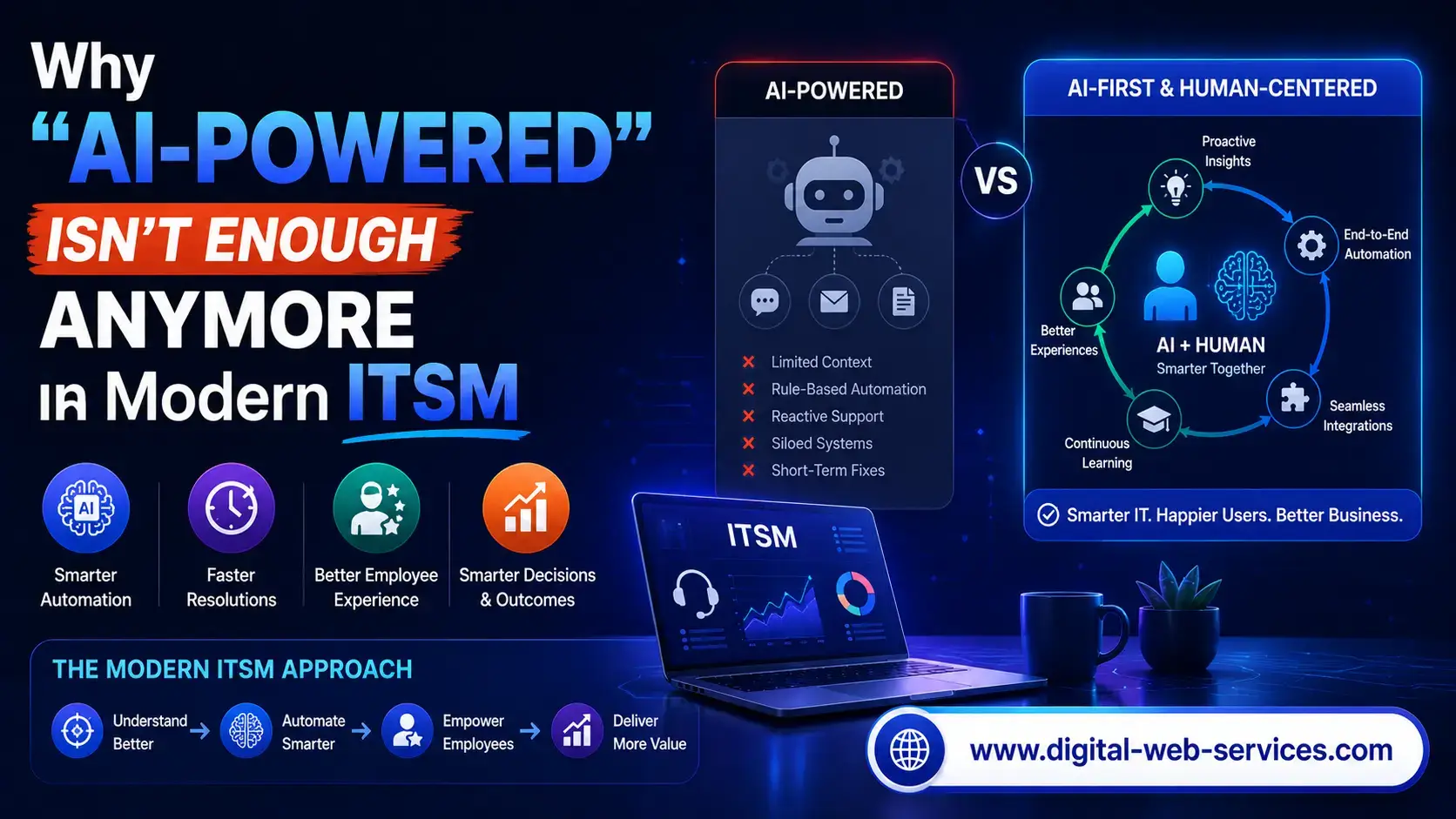
Why “AI-Powered” Isn’t Enough Anymore: Lessons from a Gold Stevie-Winning ITSM Platform

How Alloy Software’s approach to embedded AI earned it a spot alongside Intuit, Cisco, and Bank of America — and what it signals about where IT service management is headed.
Every SaaS vendor claims to be “AI-powered” in 2026. Judging panels at major industry awards are increasingly the ones separating genuine product innovation from marketing dressing — and that distinction is exactly what just earned Alloy Software a Gold Stevie Award.
The Award
Alloy Software’s flagship platform, Alloy Navigator Enterprise, was named a Gold Stevie Award winner in the Service Management Solution category of the 2026 American Business Awards. The category recognizes tools that align IT service delivery with actual business needs — not just ticket volume or SLA compliance, but whether the platform helps teams make better decisions.
This year’s winners list is a useful benchmark on its own: Intuit, Cisco Systems, Bank of America, SolarWinds, CVS Health, and Verizon Connect all took home Stevies in 2026. Being named in the same breath as companies of that scale is a meaningful signal for a mid-market ITSM/ITAM vendor.
What the Judges Actually Rewarded
The recognition centers on the 2025 release of Alloy Navigator Enterprise, and specifically on how AI was integrated into the product — not bolted onto it. Three elements stood out:
AI embedded directly into workflows. Rather than a separate “AI module” users have to opt into, automation is threaded through incident, request, and change management processes themselves. That’s a meaningful architectural distinction: it’s the difference between a chatbot sitting next to your ITSM tool and a system that actually acts on context as tickets move through their lifecycle.
A Self-Service AI Assistant designed to absorb routine, repetitive requests before they ever reach a human agent — reducing workload while keeping response times down.
Interactive analytics and dashboards that turn raw operational data into something teams can act on, alongside expanded task, project, and calendar management.
The Stevie judges’ commentary reinforces the “embedded, not bolted-on” theme. One judge noted that embedding context-aware AI directly into the workflow engine allows automated actions to trigger with precision. Another pointed to the platform’s security-first approach to AI integration as setting a benchmark for the ITSM/ITAM category. A third framed the bigger-picture shift: the platform helps teams move from reactive troubleshooting toward data-driven strategy.
Why This Matters Beyond Alloy
For SaaS buyers evaluating ITSM tools in 2026, this award is a useful data point in a market that’s genuinely hard to differentiate by feature list alone. Nearly every vendor now advertises AI-assisted ticketing, some kind of self-service layer, and dashboards. What’s harder to fake — and what judging panels are increasingly trained to spot — is architecture: whether AI is a layer sitting on top of the product, or whether it’s threaded into the core workflow engine where automated decisions actually happen.
That distinction has practical consequences for IT leaders:
- Faster resolution isn’t just about chatbots. If AI can only answer FAQs but can’t trigger or route an actual workflow action, it saves time on the margins, not on the actual case load.
- Security posture matters as automation increases. As more actions get automated, the security model behind who can trigger what becomes a bigger part of the evaluation than it used to be.
- The judges’ emphasis on “reactive to strategic” reflects a broader industry shift: ITSM tools are increasingly expected to support planning and forecasting, not just ticket resolution.
Read the original announcement on the Alloy Software newsroom.
A Quick Framework for Evaluating “AI-Powered” ITSM Claims
If you’re in the middle of an ITSM or ITAM evaluation right now, the Alloy Navigator case is a decent prompt to ask sharper questions of every vendor on your shortlist — not just the award winners. A few questions worth putting directly to sales engineers during a demo:
Can the AI trigger an action, or only suggest one? There’s a real difference between a system that drafts a suggested response for a human to approve and one that can actually route a request, update a CMDB record, or kick off a change workflow on its own. Ask for a live demo of an end-to-end automated action, not a scripted screenshot.
What happens when the AI gets it wrong? Every vendor will show you the happy path. Ask about escalation logic — how a misrouted ticket or a bad auto-classification gets caught and corrected, and whether there’s an audit trail showing what the AI decided and why. This matters more once automation starts touching security-sensitive tickets (access requests, permission changes) rather than just password resets.
Is the self-service layer actually reducing ticket volume, or just moving where tickets are logged? A chatbot that deflects easy questions but funnels everything else into the same queue isn’t really solving the workload problem — it’s just adding a UI layer. Ask vendors for deflection-rate data from existing customers, not projected estimates.
How is analytics data actually used operationally? Dashboards are table stakes now. The more useful question is whether the platform surfaces anything a team wouldn’t have caught manually — recurring incident patterns tied to a specific asset, for instance, or capacity trends that predict an SLA breach before it happens.
Does the vendor treat security as a layer bolted onto AI, or as part of the AI’s design? As the Stevie judges specifically flagged Alloy’s security-first approach, this is worth probing directly: ask how permissions are scoped for AI-triggered actions, and whether there’s a way to audit which automated decisions touched sensitive data.
None of this is unique to Alloy — it’s a reasonable checklist for evaluating any platform claiming embedded AI in 2026. But it’s a useful lens for understanding why award judges, who see dozens of similar submissions each cycle, are increasingly rewarding architectural depth over feature lists. A tool that can point to concrete deflection numbers, an audit trail, and a specific security model is making a fundamentally different claim than one that can just point to a chat window.
About Alloy Software
Alloy Software is a global provider of IT Service Management (ITSM) and IT Asset Management (ITAM) solutions. Its flagship product, Alloy Navigator, helps organizations unify service management, asset tracking, and workflows in a single platform. More information is available at alloysoftware.com.
About the Stevie Awards
The American Business Awards has recognized organizations across the U.S. — public and private, for-profit and non-profit — for more than 20 years, spanning hundreds of categories in management, marketing, and product development. More information at stevieawards.com.
Maria Jain is a Senior Content Strategist and Tech Editor at Digital Web Services, with over 6+ years of experience covering digital marketing, website development, and search engine optimization. She specializes in WordPress site architecture, AI technologies, Web Hosting, topical authority models, and hands-on SaaS & affiliate tool reviews. Maria combines data-driven SEO practices with deep web design and technical insights to publish transparent guides, tool comparisons, and strategic tutorials for digital growth.