What Is Topical Authority and Pillar-Cluster Model in SEO and How Does It Work With Example?

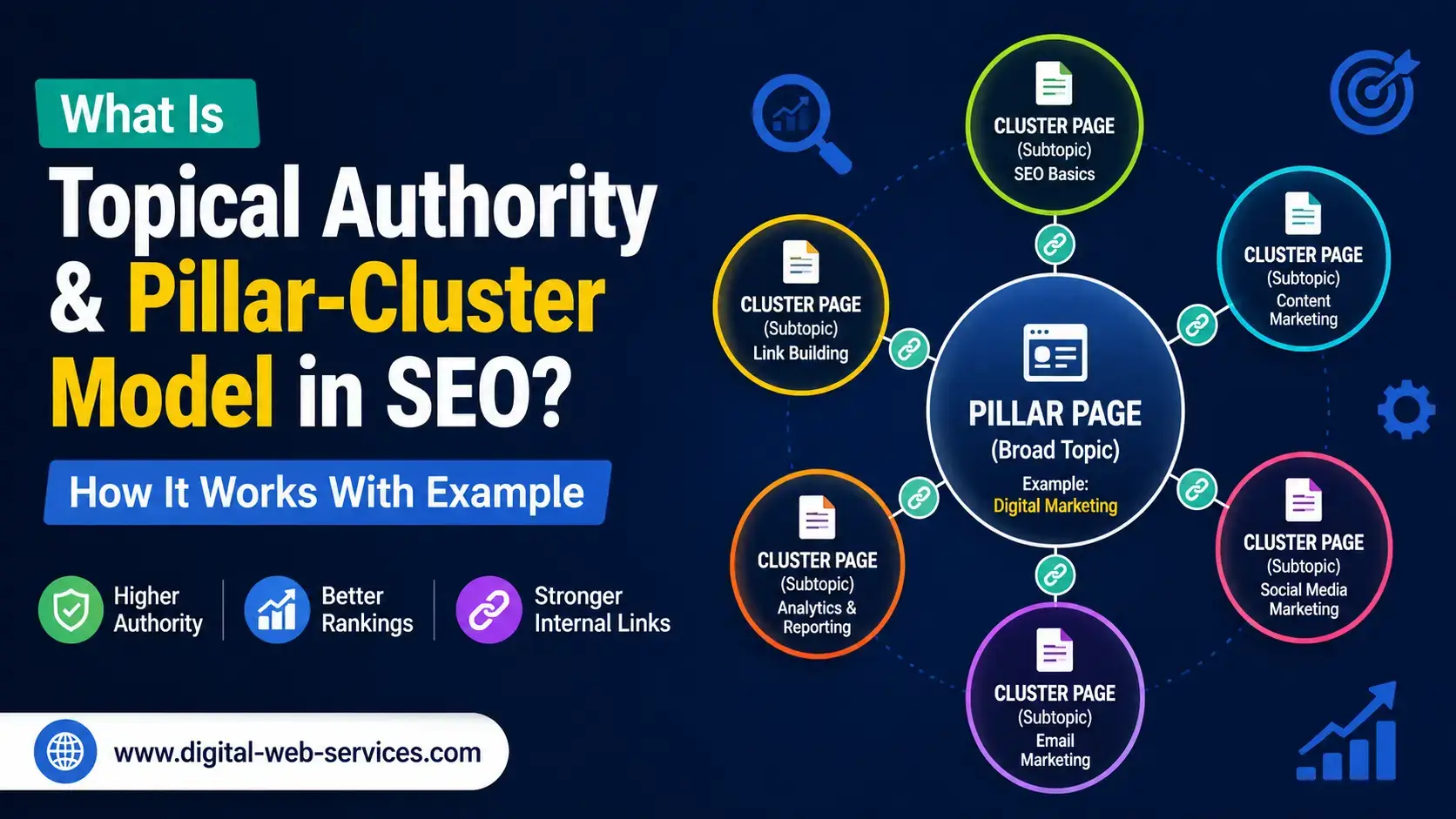
Topical authority in SEO means your website becomes a trusted source for a specific subject by covering it deeply, clearly, and consistently. The pillar-cluster model is the content structure used to build that authority. In this model, one main page, called a pillar page, covers a broad topic, while several supporting articles, called cluster pages, explain related subtopics in detail. These pages are connected through internal links. This helps users find complete answers and helps search engines understand that your website has strong expertise in that topic. Google says SEO should help search engines understand content while keeping the content useful for people first.
For example, if your pillar page is “How to Reduce PDF Size,” your cluster articles can cover “compress PDF without losing quality,” “reduce PDF size on Mac,” and “compress PDF for email.”
What Is Topical Authority in SEO?
Topical authority is the level of trust and expertise your website builds around one main topic. When your website covers a subject from many useful angles, search engines can understand that your site is not just publishing random articles but has real depth in that niche.
In simple words, topical authority means:
Your website answers most of the important questions people have about a topic.
For example, a website that has only one article about “PDF compression” may not look very strong. But if the same website has complete guides about PDF size reduction, PDF compression tools, offline PDF compression, Adobe Acrobat PDF compression, Mac PDF compression, Windows PDF compression, and PDF email attachment size limits, it starts looking more useful and trustworthy.
Topical authority is important because modern SEO is not only about one keyword. It is about topic coverage, search intent, helpful content, internal linking, user experience, and trust.
Important SEO Keywords Used Naturally
Some common and useful keywords related to this topic are:
topical authority SEO, topic authority, pillar cluster model, topic cluster strategy, pillar page, cluster content, content hub, internal linking, SEO content strategy, keyword clustering, semantic SEO, content clusters, topical map, search intent, long-tail keywords, LSI keywords, E-E-A-T, AI Overviews, Google rankings, organic traffic, SEO strategy.
What Is the Pillar-Cluster Model in SEO?
The pillar-cluster model is an SEO content strategy where you create one main page around a broad topic and support it with multiple detailed subtopic pages.
A pillar page gives a complete overview of the main topic. Cluster pages go deeper into specific questions or subtopics. All cluster pages link back to the pillar page, and the pillar page also links to the cluster pages.
Semrush describes pillar pages as content that gives an overview of a topic and links to more specific cluster posts. Ahrefs also explains topic clusters as interlinked pages about a particular subject.
Simple Structure
Pillar Page:
What is SEO?
Cluster Pages:
- What is on-page SEO?
- What is technical SEO?
- What is keyword research?
- What is link building?
- How to write SEO-friendly content?
- What is internal linking in SEO?
- How to improve website ranking on Google?
- Together, these pages create a strong content hub.
How Does the Pillar-Cluster Model Work?
The pillar-cluster model works by organizing your website content in a way that is easy for both users and search engines to understand.
Here is how it works:
First, you choose one broad topic that is important for your business or blog. Then you create a pillar page that explains the topic in a complete but not too deep way. After that, you create multiple cluster articles that answer specific user questions related to that topic. Finally, you connect all pages with internal links.
This creates a clear topical relationship.
For example:
Your pillar page:
5 Best Ways to Reduce the Size of PDF Files
Your cluster pages:
- How to Compress PDF Without Losing Quality
- How to Reduce PDF Size in Adobe Acrobat Pro
- How to Compress PDF Files on Mac
- How to Compress PDF Files on Windows
- Best Free Online PDF Compressor Tools
- How to Reduce PDF Size Offline
- How to Compress PDF for Email Attachments
- How to Reduce PDF Size to Less Than 100KB or 200KB
Each cluster page should link back to the pillar page using natural anchor text like “reduce PDF size,” “compress PDF file,” or “PDF compression guide.”
This tells Google that your pillar page is the main resource and your cluster pages are supporting proof of your expertise.
Why Is Topical Authority Important for SEO Rankings?
Topical authority is important because search engines want to show helpful, reliable, and complete content to users. Google’s people-first content guidance recommends creating content that is useful, reliable, and written for people rather than only for search engines.
When your website has strong topical authority, it can improve:
- Organic traffic
- Keyword rankings
- Internal link strength
- User engagement
- Crawlability
- Content relevance
- Chances of appearing in featured snippets
- Chances of being cited in AI Overviews
- Trust and brand authority
A single article can rank, but a complete topic cluster gives that article more support. This is why many SEO experts use topic clusters, pillar pages, and content hubs to grow long-term rankings.
How Does Google Understand Topic Authority?
Google understands topic authority through different content and website signals. These may include content quality, page relevance, internal links, external links, user satisfaction, author credibility, freshness, and overall topic coverage.
Google also uses structured data to better understand the meaning of page content where applicable. This does not mean schema alone will rank your page, but it can help search engines understand important details such as author, FAQ, article type, organization, and page information.
To build authority, your website should not only repeat keywords. It should solve real user problems.
For example, instead of only writing:
- “PDF compressor is useful. Use PDF compressor to compress PDF.”
- Write useful content like:
- “If your PDF is too large for Gmail, first check the file size limit, then compress images inside the PDF, remove unnecessary pages, flatten layers, and export with optimized settings. If quality matters, use lossless or balanced compression instead of extreme compression.”
- This type of content provides information gain, which means the reader gets something more useful than basic repeated information.
What Is the Difference Between Topical Authority and Domain Authority?
Topical authority and domain authority are not the same.
Topical authority means your website is trusted for a specific subject. For example, a site may be very strong in PDF tools, SEO, or fitness.
Domain authority is a third-party SEO metric used by different tools to estimate the overall strength of a domain based on backlinks and other signals. Google does not use third-party “Domain Authority” scores as an official ranking metric.
So, a small website can still build topical authority in a narrow niche if it covers the topic better than larger websites.
Example:
A small website only about PDF tools can become more topically relevant for “compress PDF” searches than a big general tech blog that has only one article about the topic.
What Are Pillar Pages and Cluster Pages?
A pillar page is the main page that covers a broad topic. It gives users a complete overview and links to detailed subtopics.
A cluster page is a supporting article that explains one specific subtopic in depth.
Pillar Page Example
Main Topic:
- Complete Guide to PDF Compression
- This page can include:
- What PDF compression means
- Why PDF files become large
- Best ways to reduce PDF size
- Online vs offline PDF compression
- PDF compression for email
- PDF compression without quality loss
- Common mistakes
- FAQs
Cluster Page Examples
- How to compress PDF without losing quality
- How to compress PDF on Mac
- How to reduce PDF size on Windows
- Best free PDF compressor tools
- How to compress PDF for email
- How to reduce PDF size to 100KB
- How to compress scanned PDF files
- How to reduce PDF size in Adobe Acrobat
- Each cluster article should target a specific search intent and link back to the pillar page.
How Can You Build a Topic Cluster Step by Step?
Building a topic cluster is simple when you follow a clear SEO workflow.
Step 1: Choose Your Main Topic
Start with a topic that is important for your website, business, product, or audience.
Examples:
- PDF compression
- SEO content strategy
- Digital marketing
- WordPress speed optimization
- Email marketing
- AI tools
- Local SEO
Your main topic should be broad enough to create 10–30 supporting articles.
Step 2: Find Search Intent
Search intent means the reason behind a user’s search.
For example, people searching “what is topical authority” want information. People searching “best keyword clustering tool” may want tool recommendations. People searching “how to build topical authority” want a step-by-step guide.
Common search intent types are:
- Informational
- Commercial
- Transactional
- Navigational
Your content should match the intent. If users want a step-by-step guide, do not give only definitions. If users want a comparison, include pros and cons.
Step 3: Collect SEO Keywords and LSI Keywords
Find primary keywords, long-tail keywords, and related terms.
For this topic, useful keywords include:
- topical authority
- topical authority SEO
- is topical authority
- hoto build topical authority
- pill cluster model
- pillarage SEO
- topic clter SEO
- content clter strategy
- SEO content b
- semantic SEO
- keyword clusteri
- internal linking sategy
- E-E-A-T SEO
- AI Overview optimization
- featured snippet optimization
- Use these keywords naturally. Do not force them in every sentence.
Step 4: Create a Topical Map
A topical map is a plan that shows your pillar page and all related cluster pages.
Example topical map:
Pillar Page:
What Is Topical Authority and Pillar-Cluster Model in SEO?
Cluster Pages:
- How to Build Topical Authority for a New Website
- What Is a Pillar Page in SEO?
- How to Create SEO Topic Clusters
- Best Internal Linking Strategy for Topic Clusters
- How to Do Keyword Clustering for SEO
- Topical Authority vs Domain Authority
- How to Optimize Content for AI Overviews
- How to Find Content Gaps in SEO
- How to Update Old Content for Better Rankings
- How to Build an SEO Content Hub
Step 5: Write the Pillar Page First
Your pillar page should answer the broad topic clearly. It should not be too thin. It should guide users to deeper pages.
A strong pillar page should include:
- Direct answer in the opening
- Table of contents
- Clear question-based headings
- Simple explanations
- Examples
- Internal links
- FAQs
- Author or expert note
- Updated date
- Useful visuals or tables
- Schema markup where suitable
Step 6: Publish Cluster Content
After publishing the pillar page, write cluster articles one by one. Each article should focus on one search intent.
Do not write multiple articles targeting the exact same keyword. This can create keyword cannibalization, where your own pages compete with each other.
Step 7: Add Internal Links
Internal linking is one of the most important parts of the pillar-cluster model.
Use natural anchor text like:
- topical authority guide
- pillar page SEO
- topic cluster strategy
- internal linking for SEO
- keyword clustering process
- SEO content hub
- Avoid using the same exact anchor text every time. Mix exact match, partial match, and natural anchors.
Step 8: Update and Improve Existing Pages
If one of your pages is already ranking on page 4 or page 5 of Google, it means Google has started understanding your page for that topic. That page may need a push.
You can improve it by:
- Adding missing subtopics
- Improving headings
- ding FAQs
- Adng comparison tables
- Adding internal links from new cluster pages
- Improving page speed
- Adding original examples
- Updating outdated information
- Adding expert insights
- Improving the introduction
- Adding schema markup
- This is how a weak ranking page can become stronger over time.
What Is a Practical Example of Topic Authority and Pillar-Cluster Model?
Let’s take a real SEO example based on PDF compression.
Suppose your article “5 Best Ways to Reduce the Size of PDF Files” is ranking around position 40–50 and showing keywords in Semrush or Google Search Console.
This means search engines are already testing your website for that topic. Your page is not invisible. It only needs stronger topical support.
Pillar Page
5 Best Ways to Reduce the Size of PDF Files
This is your main page.
Cluster Articles
How to Compress PDF Without Losing Quality
This targets users who want quality-safe compression.
How to Reduce PDF Size in Adobe Acrobat Pro
This targets tool-specific intent.
How to Compress PDF on Mac
This targets OS-specific intent.
How to Compress PDF on Windows
This targets Windows users.
Best Free Online PDF Compressor Tools
This targets users looking for free tools.
How to Reduce PDF Size Offline
This targets people who do not want to upload files online.
How to Compress PDF for Email Attachments
This targets a practical use case.
How to Reduce PDF Size to Less Than 100KB or 200KB
This targets high-intent long-tail keywords.
Internal Linking Example
From “How to Compress PDF on Mac,” add a link like:
“To learn all methods in one place, read our complete guide on how to reduce PDF size.”
From the pillar page, link to the cluster article like:
“If you are using a Mac, follow this step-by-step guide to compress PDF files on Mac.”
This creates a strong hub-and-spoke model.
How Does Internal Linking Improve Topic Authority?
Internal linking helps search engines discover pages, understand relationships, and identify your most important content.
If many related cluster pages link to one pillar page, the pillar page receives more internal importance. This can help search engines understand that the pillar page is the main resource for that topic.
Good internal linking also helps users. A visitor who lands on one cluster article can easily explore more related content. This can improve engagement, reduce bounce rate, and increase page views.
Internal Linking Best Practices
- Use descriptive anchor text
- Link from cluster pages to pillar pages
- Link from pillar pages to cluster pages
- Link between related cluster pages
- Avoid irrelevant links
- Do not over-optimize anchor text
- Update old articles with links to new content
- Place important links near useful context
How Can You Optimize Topic Clusters for Google AI Overviews?
To increase your chances of appearing in Google AI Overviews, structure your content so it gives clear, direct, and complete answers. Google’s AI content guidance says the focus is on helpful, reliable, people-first content, not on how the content is produced.
Use these methods:
- Start with a 100–150 word direct answer
- Use question-based H2 and H3 headings
- swer each question clearly in the first few lines
- Adexamples, steps, tables, and summaries
- Include first-hand insights or practical experience
- Add author details and trust signals
- Use FAQ schema where suitable
- Keep sentences simple
- Avoid fluff
- Update content regularly
- Cover related questions users also search for
- AI Overviews often prefer content that is easy to extract, easy to understand, and clearly answers user intent.
What Are Information Gain Sections and Why Do They Matter?
Information gain means adding something useful that is not already repeated on every competing page.
Many SEO articles only define topical authority and topic clusters. To stand out, your article should include real insights, examples, workflows, and mistakes.
Useful Information Gain Ideas
- Add a topical map example
- Show internal linking anchor text examples
- Explain how to improve a page ranking on page 5
- Add a content refresh checklist
- Add a keyword mapping table
- Add a real niche example
- Explain common mistakes
- Show how to measure success
- Include expert tips from experience
- Example insight:
If your page is already ranking between positions 40 and 50, do not delete it. Improve it. Google has already connected your page with the topic. Add missing sections, create supporting cluster articles, and build internal links to push the page higher.
This is more useful than simply saying “write more content.”
How Can You Measure Topical Authority?
You can measure topical authority by tracking how your website performs across a group of related keywords, not just one keyword.
Important metrics include:
- Number of ranking keywords in the topic
- Average ranking position
- Organic traffic growth
- Impressions in Google Search Console
- Internal link coverage
- Number of indexed cluster pages
- Engagement rate
- Backlinks to pillar and cluster pages
- Featured snippet wins
- AI Overview mentions
- Topical keyword growth in SEO tools
For example, if your PDF compression cluster starts ranking for keywords like “compress PDF,” “reduce PDF size,” “compress PDF for email,” and “compress PDF without losing quality,” your topical authority is improving.
What Are Common Mistakes in the Pillar-Cluster Model?
Many websites create topic clusters but do not get results because they make basic mistakes.
Mistake 1: Writing Random Articles
Do not publish unrelated articles just to increase content count. Every cluster page should support the main topic.
Mistake 2: No Internal Linking
Without internal links, your cluster is weak. Search engines and users need clear pathways between related pages.
Mistake 3: Same Keyword on Multiple Pages
If several pages target the same keyword, they may compete with each other. Map one main keyword to one main page.
Mistake 4: Thin Pillar Page
A pillar page should be useful and complete. A 500-word page with many links is not a strong pillar page.
Mistake 5: Ignoring Search Intent
If the user wants a tool list, give a tool list. If the user wants a step-by-step guide, give steps. Matching intent is more important than adding keywords.
Mistake 6: Keyword Stuffing
Using “topical authority SEO” 50 times will not make your article better. Use keywords naturally and focus on helpful answers.
What Is the Best Workflow to Build Topical Authority?
Here is a simple workflow you can follow:
- Choose one niche topic
- Research keywords and user questions
- oup keywords by intent
- Crte a topical map
- Writone strong pillar page
- Write pporting cluster articles
- Add internal links both ways
- Add FAQs and schema markup
- Update old pages
- Track rankings and impressions
- Improve weak pages
- Repeat the process for the next topic
- This workflow works well for blogs, affiliate websites, SaaS websites, service businesses, local businesses, and tool-based websites.
How Long Does It Take to Build Topical Authority?
Topical authority usually takes time. A new website may need several months to show strong results. An existing website with some rankings may see faster improvement after adding cluster content and internal links.
The timeline depends on:
- Website age
- Content quality
- Competition level
- Backlink profile
- Publishing consistency
- Internal linking
- Technical SEO
- Search intent match
- Content freshness
- User engagement
If your page is already ranking on page 4 or 5, it may improve faster than a completely new page because Google has already discovered and tested it for related keywords.
How Can You Improve E-E-A-T in Topic Clusters?
E-E-A-T stands for Experience, Expertise, Authoritativeness, and Trustworthiness. It is especially important for content where trust matters.
To improve E-E-A-T:
- Add author name and bio
- Mention real experience
- Use original screenshots or examples
- Cite trusted sources where needed
- Update content regularly
- Avoid false claims
- Add clear contact or about page
- Show case studies or results
- Explain methods step by step
- Use simple and honest language
- Add editorial review where possible
For example, instead of saying “this method always ranks,” say:
“In our SEO workflow, we first improve the existing page, then publish supporting cluster articles, and finally add internal links. This helps search engines understand the full topic better.”
This sounds more trustworthy and realistic.
What Is the Role of Keywords in Topical Authority?
Keywords still matter, but they should be used naturally. Topical authority is not about repeating the same keyword again and again. It is about covering the full topic.
Use a mix of:
- Primary keyword
- Secondary keywords
- Long-tail keywords
- Question keywords
- LSI keywords
- Entity-based terms
- Related search terms
- User pain points
For this article, the primary keyword can be:
- topical authority and pillar cluster model in SEO
- Secondary keywords can include:
- pical authority SEO
- piar cluster model
- topic cluster strategy
- pillar page SEO
- content clusters
- SEO content strategy
- semantic SEO
- internal linking strategy
- keyword clustering
- AI Overview optimization
Natural keyword use is better than forced keyword density.
Is a Good Keyword Density for SEO?
There is no perfect keyword density for SEO. A natural keyword frequency is better than a fixed percentage.
- A good rule is:
- Use the primary keyword in the title
- Use it in the first 100–150 words
- Use it in one or two headings if natural
- Use variations throughout the article
- Use related terms in subheadings
- Avoid repeating the same phrase unnaturally
- Search engines are now better at understanding meaning, entities, and context. So, semantic
SEO and topic coverage are more important than exact keyword repetition.
How Can This Strategy Help a Page Move from Page 5 to Page 1?
If a page is ranking on page 5, it means Google sees some relevance but not enough strength. You can improve that page with a pillar-cluster strategy.
Here is the action plan:
- Improve the existing page
- Add missing user questions
- d clear steps and examples
- AdFAQs
- Add iginal insights
- Add inrnal links from new cluster pages
- Create supporting articles
- Use better anchor text
- Improve page speed and readability
- Update title and meta description
- Add schema markup
- Track performance in Google Search Console
- This gives the page more topical support and improves its chance of ranking higher.
Conclusion: Why Should You Use Topical Authority and Pillar-Cluster Model in SEO?
Topical authority and the pillar-cluster model are powerful SEO strategies because they help your website become a trusted source on a specific topic. Instead of writing random blog posts, you build a complete content system where one pillar page covers the main topic and multiple cluster pages answer related user questions.
This improves search engine understanding, user experience, internal linking, keyword coverage, and long-term ranking potential.
The best approach is simple: choose one topic, understand user intent, create a strong pillar page, publish useful cluster articles, link them properly, and keep improving your content with fresh insights.
When done correctly, this strategy can help your website rank for more keywords, earn more organic traffic, and increase its chances of appearing in featured snippets and Google AI Overviews.
FAQs About Topical Authority and Pillar-Cluster Model in SEO
Q: What is topical authority in SEO?
Topical authority in SEO means your website is seen as a trusted and useful source for a specific topic. You build it by publishing complete, helpful, and connected content around one subject.
Q: What is the pillar-cluster model?
The pillar-cluster model is an SEO content structure where one main pillar page covers a broad topic, and multiple cluster pages cover related subtopics. These pages are connected with internal links.
Q: How does a topic cluster help SEO?
A topic cluster helps SEO by showing search engines that your website covers a subject deeply. It also improves internal linking, user navigation, keyword coverage, and topical relevance.
Q: What is a pillar page?
A pillar page is the main content page that gives a broad overview of a topic. It links to detailed cluster pages that explain related subtopics.
Q: What is cluster content?
Cluster content is supporting content that covers a specific subtopic related to the pillar page. Each cluster article should answer one clear search intent.
Q: Is topical authority a Google ranking factor?
Google does not provide a simple “topical authority score,” but topic relevance, helpful content, expertise, internal links, and content quality can influence how well your pages perform in search.
Q: How many cluster pages do I need?
There is no fixed number. A small topic may need 5–10 cluster pages, while a broad topic may need 30 or more. Focus on covering important user questions completely.
Q: Can a new website build topical authority?
Yes. A new website can build topical authority by focusing on a narrow niche, publishing helpful content consistently, and using strong internal linking.
Maria Jain is a Senior Content Strategist and Tech Editor at Digital Web Services, with over 6+ years of experience covering digital marketing, website development, and search engine optimization. She specializes in WordPress site architecture, AI technologies, Web Hosting, topical authority models, and hands-on SaaS & affiliate tool reviews. Maria combines data-driven SEO practices with deep web design and technical insights to publish transparent guides, tool comparisons, and strategic tutorials for digital growth.