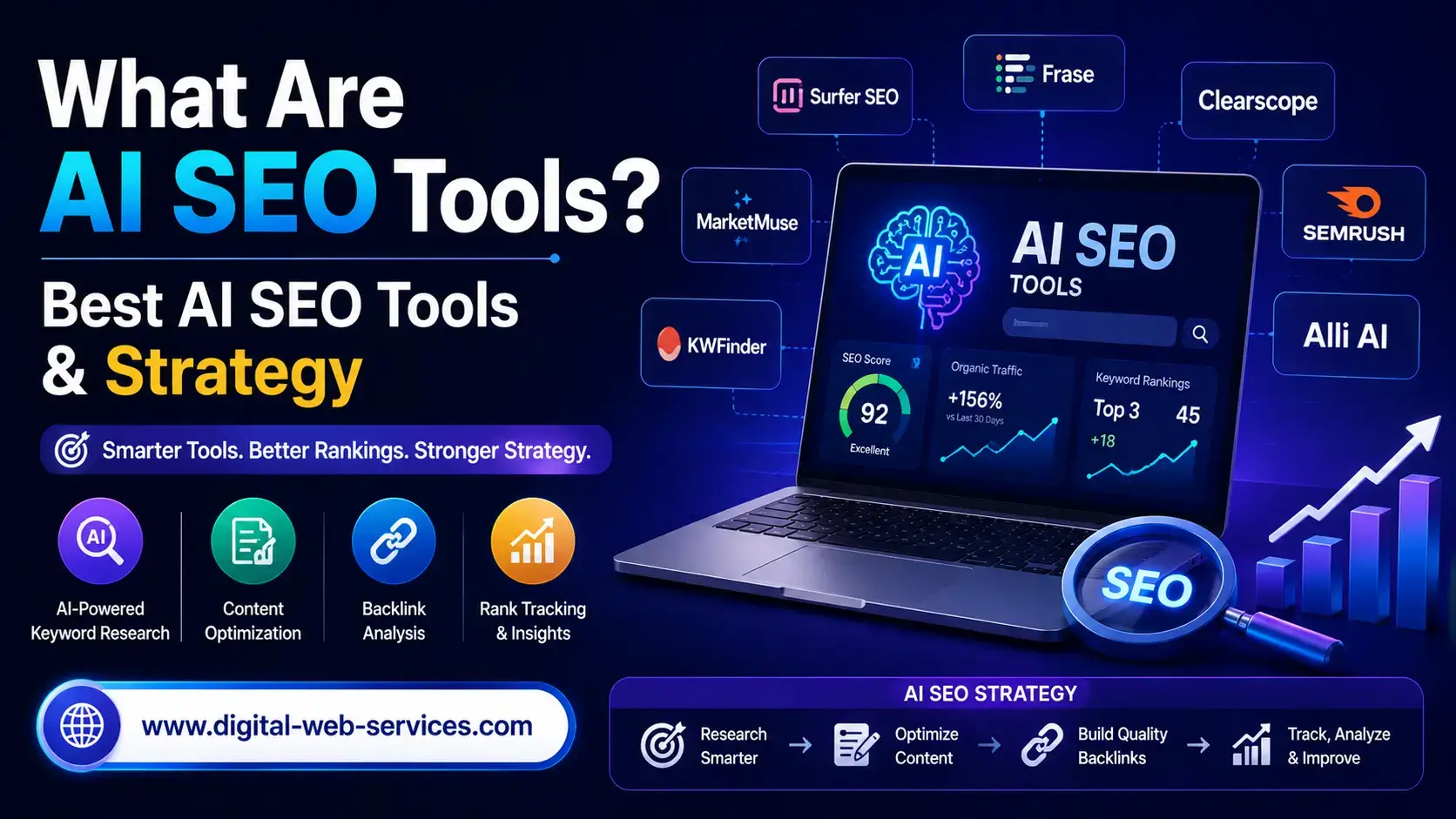
AI SEO tools are software platforms that use artificial intelligence to improve keyword research, content planning, on-page optimization, technical SEO, internal linking, schema markup, and search visibility. In simple words, these tools help businesses understand what users are searching for, what competitors are ranking for, and how to create better content that can perform in Google Search, AI Overviews, ChatGPT, Perplexity, Gemini, and other AI-powered search platforms.
SEO is no longer only about adding keywords to a page. Today, users ask detailed questions, compare options, and expect quick, useful answers. Google also says that its AI features are still rooted in core Search ranking and quality systems, which means traditional SEO best practices still matter for AI visibility. Google also mentions that helpful, reliable, people-first content and a clear technical structure remain important for appearing in AI search experiences.
This is why AI SEO tools have become useful for businesses, SEO agencies, bloggers, eCommerce brands, and service-based companies. The right AI SEO software can save time, reduce guesswork, improve content quality, and help your website appear for more relevant search queries.
What Are AI SEO Tools?
AI SEO tools are digital tools that use machine learning, natural language processing, automation, SERP analysis, and data insights to improve search engine optimization. These tools can help with:
- AI keyword research
- SEO content optimization
- Content brief creation
- Competitor analysis
- Search intent analysis
- Technical SEO audits
- Internal linking suggestions
- Schema markup recommendations
- AI Overviews optimization
- Answer engine optimization
- Generative engine optimization
- AI search visibility tracking
For example, a content optimization tool may analyze top-ranking pages and suggest related keywords, headings, FAQs, word count, and content gaps. A technical SEO automation tool may scan your website and suggest fixes for meta tags, schema, broken links, indexability, and page-level SEO issues. An AI visibility tool may track whether your brand appears in AI-generated answers.
The main goal of AI SEO tools is not to replace human strategy. Their real value is helping SEO experts work faster, make data-backed decisions, and create content that better matches user intent.
Why Do Businesses Search for AI SEO Tools?
People searching for “AI SEO tools” usually want one of four things:
- They want to find the best AI SEO tools for their website.
- They want to automate SEO tasks and save time.
- They want to improve Google rankings and organic traffic.
- They want to understand how to optimize for Google AI Overviews and AI search engines.
A business owner may search for “best AI SEO tools for small business” because they need a simple and affordable SEO system. A marketing manager may search for “AI SEO content optimization tool” because their blog traffic is declining. An agency may search for “SEO automation tools” because they manage many clients and need scalable workflows.
This article covers all of these needs with a practical AI SEO strategy, tool categories, examples, and FAQs.
How Do AI SEO Tools Help With Keyword Research?
AI keyword research tools help you discover search terms that real users type into Google. They can suggest primary keywords, long-tail keywords, LSI keywords, question-based keywords, semantic keywords, and related topics.
For the topic “AI SEO tools,” common high-intent keywords include:
- AI SEO tools
- best AI SEO tools
- AI SEO software
- SEO AI tools
- AI tools for SEO
- AI keyword research tools
- AI content optimization tools
- AI writing tools for SEO
- AI SEO audit tools
- technical SEO automation
- AI SEO for small business
- SEO automation tools
- AI search visibility tools
- AI Overviews optimization
- answer engine optimization
- generative engine optimization
- semantic SEO tools
- SEO content brief generator
- AI-powered SEO tools
- best SEO tools for content optimization
The best approach is to use one primary keyword and several supporting keywords naturally. For this article, the primary keyword is AI SEO tools. Supporting keywords like best AI SEO tools, AI SEO software, AI keyword research tools, SEO automation tools, and AI content optimization tools are used naturally in headings and body content.
Keyword density should never feel forced. A good SEO article should answer the user’s question first. Keywords should support the content, not damage readability.
How Do AI SEO Tools Improve Content Optimization?
AI content optimization tools study the top-ranking SERP results for a keyword and help you understand what your content should include. They may suggest:
- Important subtopics
- Related terms
- Missing entities
- Heading structure
- FAQs
- Readability improvements
- Internal link opportunities
- Search intent gaps
- Content score or optimization score
Surfer SEO, for example, says its Content Editor uses top-ranking pages and competitor analysis to provide guidelines for structure, relevant keywords, and real-time optimization scores. Clearscope positions itself as a platform for improving visibility across Google and AI search, with features for topic discovery, intent analysis, AI-assisted writing, content optimization, and monitoring.
However, content optimization should not mean blindly adding every suggested keyword. A human editor must still check whether the sentence makes sense, whether the information is accurate, and whether the article provides something better than competitors.
What Are the Best Types of AI SEO Tools?
The best AI SEO tools can be divided into different categories based on their main purpose.
1. AI Keyword Research Tools
These tools help find search terms, keyword difficulty, topic clusters, long-tail keywords, and question-based queries. They are useful before writing any page or blog post.
Use them for:
- Blog topic research
- Service page planning
- Product category optimization
- Content cluster creation
- Competitor keyword gap analysis
- Search intent mapping
2. AI Content Optimization Tools
These tools help improve blog posts, landing pages, service pages, and product pages. They are useful for writers, SEO teams, and content marketers.
Popular examples include Surfer SEO, Clearscope, and Frase. Frase describes itself as a content operating system for AI search that researches, writes, optimizes, publishes, and monitors content for Google and AI citations.
Use them for:
- Creating SEO content briefs
- Finding missing subtopics
- Improving topical relevance
- Adding FAQs
- Matching search intent
- Refreshing old content
3. AI Writing Tools for SEO
AI writing tools can help generate outlines, first drafts, meta descriptions, FAQs, and social media captions. They are helpful, but the final content should always be edited by a human.
A good SEO article needs real insights, examples, expert input, and brand-specific experience. If you publish generic AI content without editing, it may not stand out.
Use AI writing tools for:
- First drafts
- Content outlines
- Title ideas
- Meta descriptions
- FAQ ideas
- Content repurposing
Do not use them for:
- Publishing unedited content
- Making false claims
- Copying competitor structure too closely
- Replacing expert review
4. Technical SEO Automation Tools
Technical SEO automation tools help fix website-level issues. They can identify missing title tags, weak meta descriptions, schema opportunities, broken links, duplicate content, indexability issues, and internal linking gaps.
Alli AI describes itself as on-page SEO automation software that helps automate on-page SEO tasks, overcome CMS limitations, perform site audits, apply code-level changes, and generate AI-powered schema.
Use technical SEO automation tools for:
- Large websites
- eCommerce SEO
- Agency SEO projects
- Multi-location websites
- Bulk meta tag optimization
- Internal link improvements
- Schema markup scaling
5. AI Search Visibility Tools
AI search visibility tools track how your brand appears in AI-generated answers. This is becoming important because users are now searching inside Google AI Overviews, ChatGPT, Perplexity, Gemini, and other answer engines.
Semrush says its AI Visibility Toolkit helps brands measure visibility beyond traditional search, benchmark mentions, analyze sentiment, track daily AI visibility, discover relevant prompts, and find competitive gaps. ZipTie.dev says it tracks visibility across Google AI Overviews, ChatGPT, and Perplexity, including brand mentions, citations, sentiment, competitive benchmarking, and AI Overview coverage.
Use AI search visibility tools for:
- Brand mention tracking
- AI Overview monitoring
- Prompt tracking
- Competitor comparison
- AI citation analysis
- Generative engine optimization
6. Audience Research Tools
Audience research tools help you understand where your target customers spend time, what they read, what they search, and which platforms influence their decisions.
SparkToro says its audience research software shows customer demographics, preferred social networks, search and AI tool usage, websites visited, search keywords, media consumption, Reddit subscriptions, followed social accounts, and topics of interest.
Use audience research tools for:
- Building content strategy
- Finding customer pain points
- Planning social content
- Choosing influencer topics
- Improving B2B SEO campaigns
- Understanding buyer intent
How Can AI SEO Tools Help You Rank in Google AI Overviews?
To improve your chances of appearing in Google AI Overviews, your content should be clear, helpful, structured, and trustworthy. Google says there are no additional technical requirements to appear in AI Overviews or AI Mode beyond being indexed and eligible to show with a snippet, but foundational SEO best practices still matter.
AI SEO tools can help by improving the following areas:
Clear Question-Based Headings
AI Overviews often respond to direct questions. So your article should include headings like:
- What are AI SEO tools?
- How do AI SEO tools work?
- Which AI SEO tools are best for content optimization?
- Can AI SEO tools improve rankings?
- Are AI SEO tools good for small businesses?
These question-based headings make it easier for users and search systems to understand the page.
Short Direct Answers
After each question heading, add a short and direct answer. Then explain the topic in detail. This structure improves readability and can help with featured snippets.
Strong Topical Coverage
A strong article should cover the full topic, not just repeat the main keyword. For AI SEO tools, that means covering keyword research, content optimization, technical SEO, AI search visibility, workflows, examples, pricing considerations, and best practices.
Real Experience and Examples
Google’s helpful content guidance values content that is useful for real people. That is why your article should include practical insights, workflows, and examples instead of only generic definitions.
Structured Data
FAQ schema, article schema, and organization schema can help search engines understand your content. Structured data should match the visible content on the page.
Practical Workflow: How to Use AI SEO Tools Step by Step
Here is a simple workflow that businesses can follow.
Step 1: Define the Search Intent
Before using any AI SEO tool, understand why the user is searching.
For example, someone searching “AI SEO tools” may want a list of tools. Someone searching “AI SEO tools for small business” wants affordable and easy options. Someone searching “AI content optimization tools” wants writing and on-page help.
Search intent can be:
- Informational
- Commercial
- Transactional
- Navigational
- Comparative
Match the content format to the intent.
Step 2: Build a Keyword Cluster
Create a keyword cluster around the main topic. For this article, a keyword cluster may include:
- AI SEO tools
- best AI SEO tools
- AI SEO software
- AI tools for SEO
- AI keyword research tools
- AI SEO content optimization
- AI Overviews optimization
- SEO automation tools
Each keyword should support the main topic. Do not create separate thin pages for every similar keyword. Instead, build one strong page that answers the topic deeply.
Step 3: Analyze Competitor Pages
Use AI SEO software to study top-ranking pages. Look at:
- Their headings
- Their FAQs
- Their examples
- Their tool comparisons
- Their missing information
- Their content depth
- Their internal links
Your goal is not to copy them. Your goal is to create something more useful.
Step 4: Create a Content Brief
A good SEO content brief should include:
- Primary keyword
- Secondary keywords
- Search intent
- Suggested title
- H1 and H2 structure
- FAQs
- Internal links
- External references
- CTA
- Target audience
- Unique angle
For this topic, the unique angle can be: “How AI SEO tools help with both Google rankings and AI search visibility.”
Step 5: Write a Human-Edited Draft
AI can help draft content, but the final version must be checked by a human. Add:
- Real examples
- Brand experience
- Original opinions
- Clear explanations
- Accurate claims
- Useful recommendations
Avoid robotic lines, keyword stuffing, and repeated phrases.
Step 6: Optimize On-Page SEO
After writing, optimize:
- Meta title
- Meta description
- URL slug
- H1
- H2 and H3 headings
- Image alt text
- Internal links
- External links
- Schema markup
- Readability
- Page speed
A suggested URL slug for this article is:
/ai-seo-tools/
Step 7: Track Rankings and AI Visibility
After publishing, track performance in Google Search Console, rank tracking tools, and AI visibility tools. Monitor:
- Clicks
- Impressions
- CTR
- Average position
- Indexed status
- AI Overview mentions
- Brand citations
- Conversion rate
- Assisted leads
SEO is not a one-time task. AI SEO tools work best when used regularly.
Example: How a Small Business Can Use AI SEO Tools
Imagine a local digital marketing agency wants to rank for “SEO services for small businesses.” The team can use AI SEO tools like this:
- Use an AI keyword research tool to find related terms such as “local SEO services,” “affordable SEO services,” and “SEO company for small business.”
- Use a content optimization tool to analyze ranking pages and create a better service page.
- Use an AI writing tool to draft FAQs and meta descriptions.
- Use a technical SEO automation tool to fix missing schema and weak internal links.
- Use an AI search visibility tool to check if the agency appears in AI answers for service-related prompts.
- Refresh the page every 60 to 90 days based on performance data.
This workflow saves time and helps the business create content that matches real user intent.
Common Mistakes to Avoid When Using AI SEO Tools
Mistake 1: Depending Only on AI Content
AI-generated content without human editing can sound generic. It may miss real examples, brand voice, local details, expert insights, and trust signals.
Mistake 2: Keyword Stuffing
Using the keyword “AI SEO tools” too many times can make the article hard to read. Search engines and users both prefer natural writing.
Mistake 3: Ignoring Search Intent
A page can include many keywords and still fail if it does not answer the user’s real question.
Mistake 4: Not Checking Facts
AI tools can make mistakes. Always verify statistics, tool features, pricing, and technical claims before publishing.
Mistake 5: Forgetting Technical SEO
Content alone is not enough. Your page should be crawlable, indexable, fast, mobile-friendly, and easy to navigate.
Mistake 6: Not Updating Old Content
AI search and SEO tools change quickly. Refresh your content regularly to keep it useful and accurate.
How to Choose the Best AI SEO Tool
The best AI SEO tool depends on your goal.
Choose an AI keyword research tool if you need topic ideas and search demand.
Choose an AI content optimization tool if you publish blogs, landing pages, and service pages.
Choose a technical SEO automation tool if your website has many pages or CMS limitations.
Choose an AI visibility tool if your brand wants to appear in AI Overviews, ChatGPT, Perplexity, and Gemini.
Choose an audience research tool if you need to understand your buyers before creating content.
For most businesses, the ideal setup is a combination of tools:
- One keyword research tool
- One content optimization tool
- One technical SEO audit tool
- One analytics or rank tracking tool
- One AI search visibility tracker
Are AI SEO Tools Worth It?
Yes, AI SEO tools are worth it when they are used with a proper SEO strategy. They can save time, improve content quality, support technical SEO, and help businesses identify new ranking opportunities.
However, AI SEO software is not a magic solution. It cannot replace business knowledge, expert writing, strong branding, quality backlinks, technical website health, and real customer understanding.
The best results come when AI tools and human SEO expertise work together.
Need Expert SEO Services?
Want to improve your website rankings, organic traffic, and AI search visibility? Our SEO team can help you with keyword research, content optimization, technical SEO, local SEO, AI Overviews optimization, and complete SEO strategy.
Get in touch today to build an SEO plan that brings qualified traffic, better leads, and long-term search visibility for your business.
Conclusion
AI SEO tools are now an important part of modern search engine optimization. They help with keyword research, content writing, content optimization, technical SEO, schema markup, internal linking, competitor analysis, and AI search visibility.
But the real power of AI SEO tools comes from using them correctly. A successful SEO strategy still needs helpful content, strong technical foundations, human expertise, E-E-A-T signals, and regular performance tracking.
If your goal is to rank on Google, appear in AI Overviews, and stay visible across AI-powered search platforms, AI SEO tools can give you a strong advantage. Use them as smart assistants, not as complete replacements for human strategy.
FAQs About AI SEO Tools
1. What are AI SEO tools?
AI SEO tools are software platforms that use artificial intelligence to help with keyword research, content optimization, technical SEO, internal linking, schema markup, and search visibility.
2. Which are the best AI SEO tools?
Some popular AI SEO tools include Surfer SEO, Clearscope, Frase, Semrush, Alli AI, SparkToro, and ZipTie.dev. The best tool depends on whether you need keyword research, content optimization, technical SEO, audience research, or AI visibility tracking.
3. Can AI SEO tools improve Google rankings?
Yes, AI SEO tools can improve rankings by helping you create better content, target the right keywords, fix technical issues, and match search intent. However, results also depend on competition, website authority, backlinks, content quality, and technical performance.
4. Are AI SEO tools good for small businesses?
Yes, AI SEO tools can be useful for small businesses because they save time and make SEO easier to manage. Small businesses can use them for blog planning, local SEO pages, service pages, FAQs, and content updates.
5. Do AI SEO tools replace SEO experts?
No, AI SEO tools do not replace SEO experts. They support SEO experts by speeding up research, analysis, and optimization. Human strategy is still needed for accuracy, brand voice, content quality, and business goals.
6. How do AI SEO tools help with content optimization?
AI SEO tools analyze ranking pages and suggest keywords, headings, FAQs, related topics, readability improvements, and content gaps. This helps writers create more complete and search-friendly content.
7. What is AI Overviews optimization?
AI Overviews optimization means improving your content so it has a better chance of being used or cited in Google’s AI-generated answers. It includes clear headings, direct answers, helpful content, strong E-E-A-T signals, structured data, and technical SEO.
8. What is the difference between SEO and AEO?
SEO focuses on improving website visibility in search engines. AEO, or answer engine optimization, focuses on making content easy for AI answer engines to understand, summarize, and cite.
9. Are AI SEO tools safe to use?
Yes, AI SEO tools are safe when used responsibly. You should avoid spammy automation, keyword stuffing, fake claims, copied content, and publishing unedited AI-generated text.
10. How often should I use AI SEO tools?
You should use AI SEO tools during keyword research, content creation, publishing, and content updates. For active websites, reviewing SEO performance at least once a month is a good practice.
11. Can AI SEO tools help with technical SEO?
Yes, many AI SEO tools can help with technical SEO tasks such as missing meta tags, broken links, schema markup, crawl issues, duplicate content, internal linking, and page-level optimization.
12. What is the best AI SEO tool for content writing?
Surfer SEO, Clearscope, and Frase are commonly used for SEO content writing and optimization. They help with briefs, related keywords, content scoring, and search intent coverage.
13. Can AI SEO tools help with local SEO?
Yes, AI SEO tools can help local businesses create location pages, optimize service pages, improve FAQs, generate local keyword ideas, and identify content gaps.
14. What is generative engine optimization?
Generative engine optimization, or GEO, is the process of optimizing content so it can be found, understood, and cited by AI-powered search engines and answer platforms.
15. Should I use AI SEO tools for every blog post?
Yes, using AI SEO tools for every important blog post can improve planning and optimization. However, every article should still be reviewed by a human before publishing.

Maria Jain is a Senior Content Strategist and Tech Editor at Digital Web Services, with over 6+ years of experience covering digital marketing, website development, and search engine optimization. She specializes in WordPress site architecture, AI technologies, Web Hosting, topical authority models, and hands-on SaaS & affiliate tool reviews. Maria combines data-driven SEO practices with deep web design and technical insights to publish transparent guides, tool comparisons, and strategic tutorials for digital growth.