The AI Skills Divide Is Growing: What Employees and Businesses Need to Learn Next

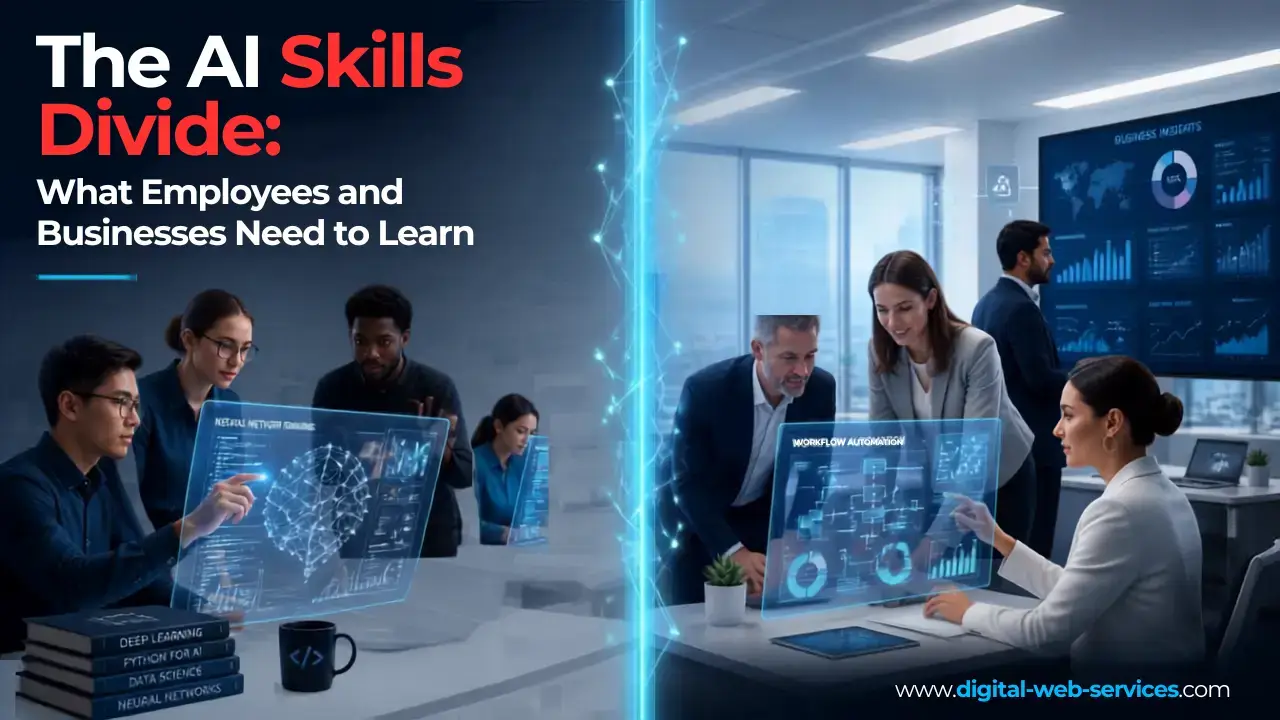
How about the case where two employees have access to similar AI tools, but one has the skills required to make good use of those tools? It turns out that the problem is mostly about skills and not technology. The increasing incorporation of AI into the day-to-day operations is making it apparent that the presence of an AI tool is not enough to ensure good performance.
The use of AI in professional settings is rapidly becoming a common practice in the UAE and across the Middle East. PwC states that 75% of surveyed Middle East workers have been using AI in their operations over the past 12 months, and 69% have acquired new skills over the same period. This growing adoption is creating a clear need for AI training for professionals that focuses on practical application rather than technology alone
The AI Skills Divide Is Becoming More Visible
There is no denying that artificial intelligence will become part and parcel of almost every department, although there is no necessity for all employees to adapt equally rapidly.
One individual will use AI to generate summaries, analyze information, and perform tasks automatically, while another might still be doing everything manually. This could influence efficiency, self-confidence, and even the way one sees his work. It does not mean that everyone should know a lot of technical details about AI.
Not Every Employee Needs the Same AI Skills
One of the greatest challenges that businesses face is approaching AI training in a one-size-fits-all manner.
For instance, a software engineer may require skills and knowledge related to machine learning, APIs, and AI architecture, while a marketer may find it more helpful to be able to use AI for research, creating content, and analyzing campaigns. HR professionals should know how to use AI for recruitment and analysis of the labor force.
The list of needs for the business executives includes strategy, implementation, risks, and governance of AI.
Therefore, it is much more beneficial to tailor the training to specific positions.
Why Practical Learning Matters
Understanding what a certain AI technology does is separate from understanding how to work with it.
While the professional might be aware of the capabilities of generative AI to develop a report, he/she would need to know how to give proper context, verify data, ensure its confidentiality, and enhance the end product.
Effective workplace learning would hence need to pay attention to cases like:
- Automating repetitive tasks
- Improving research and analysis
- Supporting decision-making
- Creating and reviewing content
- Working with business data
- Building efficient workflows
- Evaluating AI-generated information
This kind of practical method will assist workers in shifting from playing around with AI to incorporating it into their work.
AI Courses for Corporate Employees Need a Different Approach
Corporate learning has a different objective from individual career development. An independent professional may wish to increase his or her own productivity through learning, whereas a corporation should consider how its whole staff can integrate AI efficiently and ethically.
It is obvious that effective AI courses for corporate employees have to be designed taking into account the organization’s processes, functions, technology, and business goals.
Training can be structured at different levels. Beginners may need AI literacy, while experienced employees could move toward advanced applications. Strategic training may be required for managers, while technical staff may need skill development.
This creates a process of learning instead of viewing AI training as a one-time event.
Businesses Need More Than Tool Training
AI adoption can create another problem if employees are taught only how to operate specific tools.
Technology changes quickly. A platform that is popular today may be replaced or significantly updated tomorrow. Professionals who only learn button-by-button processes can quickly find their knowledge outdated.
A stronger approach is to teach underlying capabilities:
- How to identify useful AI applications
- How to evaluate outputs
- How to write effective instructions
- How to protect business information
- How to recognize potential risks
- How to combine AI with human judgment
These skills remain useful even as individual platforms and applications change.
The Human Side of AI Still Matters
There is a tendency to assume that technical skills will become more important while traditional workplace skills become less relevant. The reverse can also hold.
As artificial intelligence takes up routine tasks, professionals will have more time for expressing their thoughts, dealing with unknown situations, making decisions, working together with co-workers, and maintaining relationships.
Critical thinking will become very significant. AI will supply answers that appear to be appropriate but may actually be inappropriate. It is essential to critically analyze the data supplied.
How Companies Can Close the Skills Gap
Preparing for the workforce of the future using artificial intelligence does not necessarily need to be done all at once. Companies can first look at places where AI is being employed and areas where employees are struggling.
Some ways to do this might include:
Evaluate current skills: Find out who among the current workforce uses AI and where there is a lack of knowledge.
Identify needs for specific roles: Each department will need training relevant to its job function.
Start from practical experience: Give employees chances to resolve workplace issues through the use of AI.
Ensure responsible usage: Training should cover accuracy, privacy, security, and human oversight.
Evaluate the outcomes: Consider productivity, workflow, adoption, and skill acquisition beyond completing training.
This is where structured learning support can become valuable. Organizations working with AI training for professional providers should look for programs that connect learning with measurable workplace needs rather than focusing solely on course completion.
The Future Is Continuous Learning
There will not be an end to the artificial intelligence skills gap even after one training course. Due to developments in AI technology, there is a need for staff to update and improve their knowledge in the area.
This implies that AI education must be included in professional development for organizations.
Final Summary
It is not a question of whether or not employees are technical workers. It is a matter of whether or not they know how to use AI effectively or if they are yet to be given that chance.
Firms that offer the necessary AI courses for corporate employees will give them the chance to adapt and, at the same time, develop a more confident and competent workforce. With many businesses in the UAE continuing to prepare themselves for the use of AI, institutes like Acamind form part of the larger professional learning network that will make that possible.
Maria Jain is a Senior Content Strategist and Tech Editor at Digital Web Services, with over 6+ years of experience covering digital marketing, website development, and search engine optimization. She specializes in WordPress site architecture, AI technologies, Web Hosting, topical authority models, and hands-on SaaS & affiliate tool reviews. Maria combines data-driven SEO practices with deep web design and technical insights to publish transparent guides, tool comparisons, and strategic tutorials for digital growth.