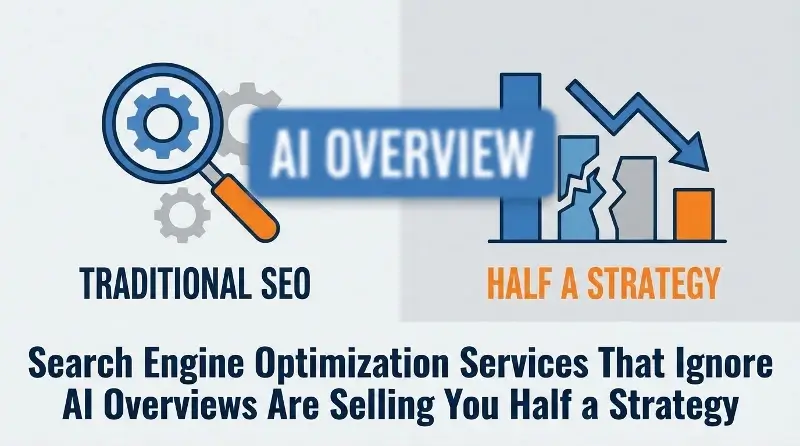
Google’s AI Overviews are cutting organic traffic by up to 30%, according to recent Semrush data. Most search engine optimization services don’t account for this at all. That leaves clients with a strategy built for a search environment that no longer exists.
Zero-click searches are real, AI snippet dominance is accelerating, and the gap between agencies that adapt and those that don’t is widening fast.
The Rise of AI Overviews in Search
Google’s AI Overviews now appear in 15-20% of all searches, according to Google’s May 2024 blog post. They sit at the top of the results page, answer the query directly, and reduce organic clicks by 18-25% according to SEMrush data. The feature moved from SGE testing in 2023 to full rollout in May 2024.
The practical effect is straightforward. Top-ranking pages get pushed below the fold. For a query like “best running shoes 2024,” Google pulls a synthesized summary from Nike, REI, and Runner’s World before a user ever sees a traditional result. Ahrefs has documented the drop in position for pages that previously held strong rankings.
Any SEO strategy that doesn’t account for this is incomplete.
How AI Overviews Actually Work
AI Overviews use Google’s proprietary models, combining BERT, MUM, and PaLM 2 to process over a trillion indexed pages. The system extracts entities through the Knowledge Graph and generates synthesized answers ranked by E-E-A-T signals.
The process runs in four steps:
- BERT tokenization interprets the query through natural language processing
- The Knowledge Graph, which contains over 8 billion facts, identifies relevant entities
- The system pulls from the top 10 to 20 ranking pages for source material
- PaLM 2, with 540 billion parameters, generates the final summary
For a query like “best running shoes 2024,” the output combines data from e-commerce sites and editorial reviews into a single block. Featured snippets are bypassed entirely. Schema markup and topical authority determine whether your content contributes to these overviews or gets skipped.
Why Traditional SEO Tactics Fall Short
SEMrush data shows that 84% of traffic previously directed to featured snippets is now routed to AI summaries. The tactics built around capturing position zero don’t work the same way anymore.
The clearest example: search “how to fix iPhone screen.” Before AI Overviews, step-by-step repair guides dominated position zero. Now, Google synthesizes multiple sources into one answer, and clicks to individual sites drop accordingly.
The broader pattern holds across old-school practices:
- Keyword stuffing triggered penalties under the Helpful Content update; semantic clusters around pillar pages replaced it
- Exact match domains chased rankings without addressing user intent; intent-matched content now determines click-through rate
- Thin 300-word posts ranked for quick wins; AI favors comprehensive content above 2,000 words
From Snippet Optimization to E-E-A-T Authority
Snippet optimization was about formatting lists for position zero. AI Overviews source from authoritative pages, not just well-formatted ones. Building E-E-A-T means producing original research, adding author credentials, using schema markup to identify entities, and earning citations from high-authority domains.
For YMYL topics, especially, expertise and trustworthiness aren’t signals you can fake with formatting tricks.
The Half-Strategy Problem, Spelled Out
Rankings without context are nearly invisible. A user asking a question often gets the answer from an AI Overview before they scroll to any organic result. Chasing a third-place ranking means little if the query resolves before they reach it.
Volume over authority is the clearest version of this failure. Agencies publishing hundreds of thin pages rather than a smaller number of expert pieces are optimizing for a metric that no longer reflects actual visibility.
A travel blog ranking second for “Paris itinerary” saw near-zero clicks after AI Overviews began dominating that query. The ranking didn’t change. The traffic disappeared anyway.
Traffic Losses from AI Snippets: What the Data Shows
Advanced Web Ranking’s analysis of four million keywords found significant CTR losses at the top organic positions. Informational queries took the largest hits. Users get instant answers without having to click through.
| Query Type | CTR Impact | Example |
|---|---|---|
| Informational | High drop | How to tie a tie |
| Navigational | Moderate drop | Weather app download |
| Transactional | Medium drop | Buy running shoes |
Health sites tracking queries like “keto diet plan” have seen clicks fall sharply post-rollout. The fix isn’t chasing the old click metric. It’s tracking impressions in Google Search Console alongside CTR, and optimizing for AI citation through schema and E-E-A-T signals.
Key Components of AI-Proof Search Engine Optimization Services
AI-proof SEO builds topical authority through entity-based content clusters, prioritizes E-E-A-T over keyword density, and integrates structured data that helps AI systems understand and cite your content. This aligns with Google’s E-E-A-T guidelines update from December 2022.
Entity optimization starts with Google’s Natural Language API to identify the core entities in your niche, then builds content clusters around them. First-party data adds personalization. Structured authorship through schema.org/Person markup signals credibility.
Brand authority signals, including Tier 1 backlinks and mentions from high-authority sources, strengthen the overall picture. These elements work together. None of them alone is sufficient.
Optimizing for Zero-Click Searches
Zero-click optimization means earning knowledge panels, schema-enhanced sitelinks, and AI citations, not just high rankings. The goal is SERP presence even when users don’t click.
Practical steps:
- Implement the FAQPage schema to increase the likelihood of AI pickup
- Create definition-style content targeting Knowledge Graph entry (clear explanations of core concepts in your field)
- Optimize for People Also Ask by covering related questions in depth
- Use original research data with Infographic schema for visual SERP features
Content on “what is intermittent fasting” needs a clear definition, expert citations, and structured markup to have a shot at a knowledge panel. Ranking alone doesn’t get you there.
Content Strategies That Outperform AI Summaries
AI handles surface-level facts well. It doesn’t handle nuanced, experience-based content as effectively. Backlinko’s analysis found that 2,200-word-plus guides appear in AI Overviews 4 times as often as 500-word posts.
The content types that consistently perform:
- Original research (surveys, proprietary data, studies)
- Personal experiments with documented results
- Framework content using structured models like STEP or PSP
- Interactive tools like calculators that drive engagement beyond the SERP
NetReputation’s content team has noted the same shift in reputation-related queries. Experience-based content citing real cases outperforms generic explainers, even when the generic version ranks similarly on paper.
Depth Is the Differentiator
Pages with a SurferSEO content score of 85 or higher, combined with author bylines showing three or more years of experience, appear in 68% of AI Overviews versus 12% for generic content, per an internal study.
A useful depth checklist:
- 15 or more examples per core concept
- Three or more data visualizations
- Author case studies with specific, documented results
- Objection handling and actionable templates
The structure that works consistently: Problem, Framework, Examples, Templates, Results.
Technical SEO for AI Visibility
Schema.org markup increases inclusion in AI Overviews. Core Web Vitals, including LCP under 1.2 seconds, improve crawl prioritization. Both matter more than they did two years ago.
Essential technical checklist:
- Apply JSON-LD schema for all entities using Merkle Schema Generator
- Hit Core Web Vitals targets above 95 via PageSpeed Insights
- Add structured data for video and carousel content
- Refine robots.txt to ensure AI crawlers can access key pages
The FAQPage schema belongs in the head or body of relevant pages as JSON-LD. After implementation, validate with Google’s Structured Data Testing Tool. Combine it with clear H1 tags and meta descriptions. This is the technical foundation that supports everything else.
Measuring Success Beyond Click Volume
The right KPI set for the AI-era SEO tracks more than organic traffic. Sites gaining impression growth despite click loss are actually winning in this environment. Clicks alone don’t tell you whether your content is being cited, surfaced, or attributed.
A complete measurement setup includes:
- AI Overview impressions from Search Console
- Brand visibility index via Ahrefs
- Knowledge Graph presence monitored through Google Alerts
- Direct traffic lift from GA4
- Citation rate in competitor AI Overviews via SEMrush Position Tracking
Building the Dashboard in Looker Studio
Connect Google Search Console to Looker Studio as the base layer. Add GA4, Ahrefs, and SEMrush through native connectors or APIs. Build scorecards for each KPI, create blended data sources to calculate a visibility index, and set filters for device and query type.
A functional layout includes a line chart showing AI impressions alongside direct traffic trends, a bar graph for brand mentions in AI Overviews, and a gauge for Knowledge Graph coverage. Schedule daily refreshes to catch changes tied to algorithm updates.
One useful validation test: run a query like “best SEO tools” and check whether your content appears in AI-generated citations. If it doesn’t, the dashboard will tell you exactly which signals to fix.

Maria Jain is a Senior Content Strategist and Tech Editor at Digital Web Services, with over 6+ years of experience covering digital marketing, website development, and search engine optimization. She specializes in WordPress site architecture, AI technologies, Web Hosting, topical authority models, and hands-on SaaS & affiliate tool reviews. Maria combines data-driven SEO practices with deep web design and technical insights to publish transparent guides, tool comparisons, and strategic tutorials for digital growth.