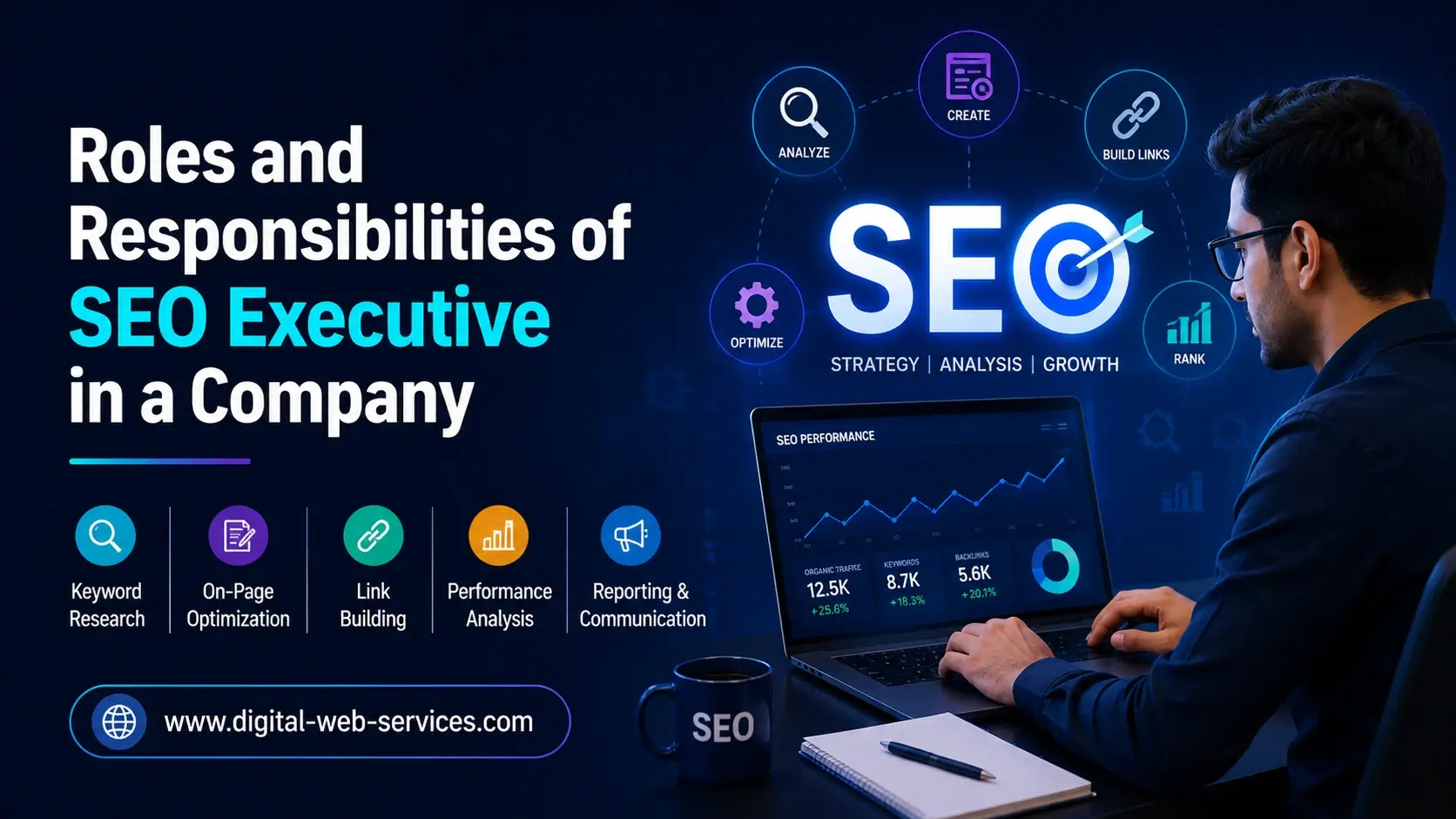
An SEO Executive is responsible for improving a company’s website visibility on search engines like Google. Their main job is to increase organic traffic, improve keyword rankings, optimize website pages, fix SEO issues, support content strategy, build quality backlinks, and track SEO performance. In a company, an SEO executive works with the marketing, content, development, and design teams to make sure the website is easy for users and search engines to understand.
The role includes keyword research, on-page SEO, technical SEO, off-page SEO, competitor analysis, SEO reporting, and regular website audits. A good SEO executive does not only focus on rankings; they also help bring the right visitors who can become leads, customers, or brand followers. In simple words, an SEO executive helps a company grow online through smart, ethical, and data-driven search engine optimization.
What Is an SEO Executive in a Company?
An SEO Executive is a digital marketing professional who works to improve a website’s position in organic search results. Organic search means traffic that comes naturally from search engines without paid ads.
For example, when someone searches “best digital marketing company near me” or “affordable accounting software,” the websites appearing on Google are often there because of strong SEO work. An SEO executive helps a company’s website appear for such useful search terms.
SEO is not only about adding keywords. It includes content planning, technical website checks, user experience improvement, link building, search intent understanding, and performance analysis. Google’s own SEO guidance explains that SEO helps search engines understand content and helps users decide whether to visit a site.
In small companies, one SEO executive may handle almost everything. In larger companies, the SEO executive may work under an SEO manager or digital marketing manager and focus on specific tasks like keyword research, audits, reporting, or link outreach.
Why Is an SEO Executive Important for Business Growth?
An SEO executive is important because most customers search online before buying a product, booking a service, or contacting a company. If a business website does not appear in search results, it may lose traffic, leads, and sales to competitors.
A skilled SEO executive helps a company:
- Improve online visibility
- Increase organic website traffic
- Rank for business-related keywords
- Reduce dependency on paid ads
- Improve user experience
- Build brand authority
- Generate better quality leads
- Understand customer search behavior
- Track SEO performance through data
SEO is a long-term growth channel. Paid ads stop when the budget stops, but strong SEO can continue bringing traffic for months or years if the website is maintained properly.
Google’s Search Essentials also highlights core best practices such as creating helpful, reliable content, using words people search for, making links crawlable, and improving how content appears in search results.
What Are the Main Roles and Responsibilities of an SEO Executive?
Here is an easy-to-read list of the main roles and responsibilities of an SEO executive in a company.
| SEO Executive Role | Main Responsibility |
|---|---|
| Keyword Research | Find relevant keywords that customers search on Google |
| On-Page SEO | Optimize titles, headings, URLs, images, and content |
| Technical SEO | Check website speed, crawling, indexing, and errors |
| Content Optimization | Improve blogs, service pages, and landing pages for SEO |
| Off-Page SEO | Build quality backlinks and improve website authority |
| Competitor Analysis | Study competitor keywords, content, and backlinks |
| SEO Audit | Find and fix SEO problems on the website |
| Reporting | Track traffic, rankings, clicks, impressions, and conversions |
| SEO Tools Management | Use tools like Google Search Console, GA4, Ahrefs, Semrush, and Screaming Frog |
| Algorithm Awareness | Stay updated with Google changes and SEO trends |
| Team Coordination | Work with writers, developers, designers, and marketers |
| Local SEO | Optimize Google Business Profile and local search visibility |
| E-E-A-T Improvement | Build trust through expert content, author details, reviews, and credibility signals |
How Does an SEO Executive Do Keyword Research?
Keyword research is one of the most important SEO executive duties. It means finding the words and phrases people use when searching online.
For example, if a company sells office chairs, useful keywords may include:
- best office chair
- ergonomic office chair
- office chair for back pain
- affordable office chair
- office chair near me
- office chair for work from home
An SEO executive studies keyword volume, competition, search intent, and business relevance. The goal is not just to find high-search keywords, but to find keywords that can bring the right visitors.
A good SEO keyword strategy includes:
- Primary keywords for main pages
- Long-tail keywords for blogs
- Commercial keywords for service or product pages
- Informational keywords for guides and articles
- Local keywords for city-based businesses
- LSI keywords and related search terms
For this article, examples of related keywords include “SEO executive job description,” “SEO executive roles and responsibilities,” “SEO executive skills,” “SEO duties,” “technical SEO,” “on-page SEO,” “off-page SEO,” and “SEO reporting.”
What Are the On-Page SEO Responsibilities of an SEO Executive?
On-page SEO means improving the elements present on a website page. An SEO executive makes sure every important page is properly optimized for both users and search engines.
Main on-page SEO tasks include:
- Writing SEO-friendly title tags
- Creating attractive meta descriptions
- Using proper H1, H2, and H3 headings
- Adding keywords naturally in content
- Optimizing image alt text
- Improving internal linking
- Creating clean and readable URLs
- Avoiding duplicate content
- Improving content structure
- Adding FAQs where useful
- Using schema markup when needed
For example, instead of a weak page title like “Services,” an SEO executive may suggest a better SEO title such as “Digital Marketing Services for Small Businesses.”
This helps users and search engines clearly understand the page topic.
Good on-page SEO is not keyword stuffing. It is about making content clear, useful, and relevant. Google recommends using words that people would search for and placing them in important locations like titles, headings, alt text, and link text.
What Are the Technical SEO Responsibilities of an SEO Executive?
Technical SEO focuses on the backend health of a website. Even if the content is good, technical problems can stop a website from ranking well.
An SEO executive regularly checks:
- Website crawling issues
- Indexing problems
- Broken links
- Page loading speed
- Mobile-friendliness
- XML sitemap
- Robots.txt file
- Canonical tags
- Redirect errors
- 404 pages
- Duplicate pages
- Core Web Vitals
- HTTPS security
- Structured data errors
For example, if Google cannot crawl an important service page, that page may not appear in search results. An SEO executive finds this issue and works with the development team to fix it.
Technical SEO is especially important for e-commerce websites, news websites, SaaS companies, and large business websites with many pages.
Google says a page must meet basic technical requirements to be eligible for Google Search, although indexing and ranking are not guaranteed.
How Does an SEO Executive Handle Content Optimization?
Content optimization means improving website content so it becomes more useful, readable, and search-friendly.
An SEO executive may not always write the full content, but they guide the content team with:
- Keyword suggestions
- Content briefs
- Heading structure
- Search intent
- Internal links
- FAQ ideas
- Meta title and description
- Content gaps
- Competitor content analysis
- Readability improvement
For example, if a blog post is ranking on page 2 of Google, the SEO executive may update it by adding fresh information, better examples, FAQs, images, internal links, and clearer headings.
Good content should answer the user’s question completely. Google’s helpful content guidance encourages original information, complete topic coverage, clear expertise, and content made for people rather than only for search rankings.
What Are the Off-Page SEO and Link-Building Duties?
Off-page SEO means improving a website’s reputation outside the website. The most common part of off-page SEO is link building.
Backlinks are links from other websites to your website. Quality backlinks can help search engines understand that your website is trusted and useful.
An SEO executive may work on:
- Guest posting
- Business listings
- Digital PR
- Resource page link building
- Broken link building
- Brand mentions
- Local citations
- Partnership links
- Social sharing support
- Content promotion
However, modern link building should focus on quality, not quantity. Spammy backlinks, paid link schemes, and irrelevant links can harm a website.
A good SEO executive builds links from relevant, trustworthy, and industry-related websites. The goal is to improve authority naturally and safely.
How Does an SEO Executive Perform Competitor Analysis?
Competitor analysis helps a company understand what other websites are doing better in search results.
An SEO executive studies:
- Competitor keywords
- Top-ranking pages
- Content topics
- Backlink sources
- Website structure
- Page speed
- Meta titles
- Internal linking
- Blog strategy
- Local SEO presence
For example, if three competitors have detailed blog posts about “how to choose CRM software,” but your company does not, that is a content gap. The SEO executive can suggest creating a better and more helpful article.
Competitor analysis is not about copying. It is about finding opportunities and creating better content, better pages, and better user experience.
What SEO Tools Should an SEO Executive Know?
An SEO executive should know how to use basic and advanced SEO tools. These tools help in research, tracking, auditing, and reporting.
Important SEO tools include:
- Google Search Console
- Google Analytics 4
- Google Keyword Planner
- Ahrefs
- Semrush
- Moz
- Screaming Frog
- Sitebulb
- PageSpeed Insights
- Looker Studio
- Yoast SEO or Rank Math
- Google Trends
- Google Business Profile Manager
Google Search Console is especially useful because it shows clicks, impressions, CTR, and average position from Google Search performance reports.
An SEO executive should not only collect data but also understand what the data means. For example, high impressions but low CTR may mean the page title or meta description needs improvement.
What Reports Does an SEO Executive Prepare?
SEO reporting is one of the most important responsibilities of an SEO executive in a company. Reports help managers, clients, and business owners understand whether SEO work is improving performance.
Common SEO report metrics include:
- Organic traffic
- Keyword rankings
- Clicks
- Impressions
- CTR
- Average position
- Backlinks
- Referring domains
- Indexed pages
- Technical errors
- Top landing pages
- Conversions
- Lead quality
- Bounce rate
- Engagement rate
A good SEO report should not only show numbers. It should also explain:
- What improved
- What dropped
- Why it happened
- What actions were taken
- What should be done next
For example, instead of saying “Traffic increased by 20%,” a better report says, “Organic traffic increased by 20% because three blog pages improved their rankings for long-tail keywords.”
How Does an SEO Executive Work With Other Teams?
An SEO executive rarely works alone. SEO needs teamwork.
They work with:
- Content writers to create optimized articles and landing pages
- Developers to fix technical SEO issues
- Designers to improve layout and user experience
- Social media teams to promote content
- Paid marketing teams to share keyword insights
- Sales teams to understand customer questions
- Management teams to align SEO with business goals
For example, if the sales team says Australian customers often ask “Which package is best for startups?”, the SEO executive or an experienced SEO freelancer in Sydney can suggest creating a blog post or landing page around that question.
This creates useful content based on real customer needs, not just keyword tools.
What Is the Daily Workflow of an SEO Executive?
A typical SEO executive workflow may look like this:
- Check Google Search Console for traffic drops or indexing issues
- Review keyword ranking changes
- Check website health and technical errors
- Research new keywords or content ideas
- Optimize existing pages
- Prepare content briefs for writers
- Build or review backlinks
- Analyze competitor pages
- Track completed SEO tasks
- Update SEO reports
- Coordinate with developers or content teams
Not every day is the same. Some days focus on audits. Some days focus on content. Some days focus on reporting or technical fixes.
A smart SEO executive always prioritizes tasks based on business impact.
What Is a Practical Example of SEO Executive Work?
Suppose a company offers website development services but is not getting enough leads from Google.
An SEO executive may follow this process:
- First, they audit the website and find that service pages have weak titles, missing meta descriptions, slow loading speed, and no clear internal links.
- Next, they research keywords such as “website development company,” “custom website development services,” “ecommerce website development,” and “business website design.”
- Then, they optimize the service pages with better headings, useful content, FAQs, testimonials, and strong calls to action.
After that, they create blog topics like:
- How Much Does Website Development Cost?
- What Is the Difference Between Web Design and Web Development?
- How to Choose the Best Website Development Company?
- They also build local citations, improve Google Business Profile, and track leads from organic traffic.
- This is how an SEO executive connects SEO tasks with business growth.
What Skills Are Required to Become a Good SEO Executive?
A good SEO executive needs both technical and creative skills.
Important SEO executive skills include:
- Keyword research
- Content optimization
- Basic HTML knowledge
- Google Search Console knowledge
- Google Analytics knowledge
- SEO audit skills
- Technical SEO understanding
- Link-building knowledge
- Competitor analysis
- Data analysis
- Communication skills
- Problem-solving ability
- Patience and consistency
- Understanding of search intent
- Basic copywriting skills
- SEO is always changing. A good SEO executive keeps learning and testing new strategies.
How Can an SEO Executive Improve E-E-A-T Signals?
E-E-A-T stands for Experience, Expertise, Authoritativeness, and Trustworthiness. These are quality concepts used in Google’s search quality systems and guidelines. Google explains that trust is the most important part of E-E-A-T.
An SEO executive can improve E-E-A-T by suggesting:
- Clear author names
- Author bio pages
- Expert-reviewed content
- Real case studies
- Original examples
- Customer reviews
- Business address and contact details
- Updated About Us page
- Privacy policy and terms pages
- Reliable sources
- Real images where possible
- Clear service information
- Testimonials and success stories
For example, a finance company should not publish generic money advice without expert review. A healthcare website should use medically reviewed content. A service business should show real experience, projects, reviews, and team details.
E-E-A-T is not a simple checklist, but it helps build trust with users and search engines.
How Can an SEO Executive Optimize for Google AI Overviews?
To increase chances of appearing in Google AI Overviews, an SEO executive should focus on clear, helpful, and well-structured content.
Google says there are no special technical requirements or special markup needed to appear in AI Overviews or AI Mode. The same SEO fundamentals still apply, such as helpful content, crawlability, internal links, page experience, text-based important content, useful images, and accurate structured data.
Practical steps include:
- Answer the main question in the first 100–150 words
- Use question-based headings
- Add short definitions
- Use tables and bullet points
- Include examples and workflows
- Add expert insights
- Cover related questions
- Use simple language
- Add FAQs
- Keep content updated
- Show real experience and trust signals
For example, instead of using a heading like “Keyword Research,” use a question-based heading like “How Does an SEO Executive Do Keyword Research?” This helps both readers and AI systems understand the content better.
What Is the Difference Between SEO Executive, SEO Analyst, and SEO Manager?
An SEO Executive usually handles execution tasks such as keyword research, page optimization, audits, link building, and reports.
An SEO Analyst focuses more on data analysis, traffic trends, ranking patterns, and performance insights.
An SEO Manager leads the full SEO strategy, manages teams, sets goals, approves campaigns, and reports to senior management.
In small companies, one person may do all three roles. In larger companies, these roles are usually separate.
What Are Common Mistakes an SEO Executive Should Avoid?
An SEO executive should avoid:
- Keyword stuffing
- Copying competitor content
- Building spammy backlinks
- Ignoring technical SEO
- Publishing thin content
- Not tracking conversions
- Using misleading meta titles
- Ignoring mobile users
- Forgetting internal links
- Not updating old content
- Depending only on tools
- Ignoring user intent
- Creating content only for search engines
- SEO should always focus on users first. Rankings are important, but helpful content, trust, and user satisfaction are more important for long-term success.
What Should Companies Expect From an SEO Executive?
A company should expect an SEO executive to improve organic visibility step by step. SEO is not instant. It takes research, testing, implementation, tracking, and continuous improvement.
Companies should expect:
- Regular SEO audits
- Keyword strategy
- Optimized pages
- Improved content quality
- Technical issue reports
- Better organic traffic
- Transparent reporting
- Competitor insights
- Long-term ranking improvement
- Better coordination with teams
However, no SEO executive can honestly guarantee the number one position on Google. Search rankings depend on many factors, including competition, website quality, content, backlinks, technical health, and search engine updates.
Conclusion: Why Does Every Company Need an SEO Executive?
The roles and responsibilities of an SEO executive in a company are important for online growth. An SEO executive improves website visibility, brings organic traffic, supports content strategy, fixes technical issues, builds authority, tracks performance, and helps the business attract better leads.
A good SEO executive understands both search engines and users. They know that SEO is not only about rankings, but also about trust, helpful content, smooth website experience, and business results.
For any company that wants long-term digital growth, hiring a skilled SEO executive can be one of the best investments in digital marketing.
FAQs About Roles and Responsibilities of SEO Executive in 2026
Q: What is the main role of an SEO executive?
The main role of an SEO executive is to improve a company’s website visibility in search engines. They do this through keyword research, on-page SEO, technical SEO, content optimization, link building, competitor analysis, and SEO performance reporting.
Q: What are the daily responsibilities of an SEO executive?
Daily responsibilities of an SEO executive include checking website traffic, monitoring keyword rankings, fixing SEO errors, researching keywords, optimizing pages, reviewing content, tracking backlinks, studying competitors, and preparing SEO reports.
Q: What skills are required for an SEO executive?
An SEO executive needs keyword research, on-page SEO, technical SEO, Google Search Console, Google Analytics, content optimization, link building, data analysis, communication, and problem-solving skills.
Q: Is SEO executive a good career?
Yes, SEO executive is a good career for people interested in digital marketing, websites, content, analytics, and online business growth. Demand for SEO professionals remains strong because companies need organic traffic and online visibility.
Q: What tools should an SEO executive know?
An SEO executive should know Google Search Console, Google Analytics 4, Google Keyword Planner, Ahrefs, Semrush, Screaming Frog, PageSpeed Insights, Google Trends, Looker Studio, Yoast SEO, and Rank Math.
Q: What is the difference between SEO executive and digital marketing executive?
An SEO executive focuses mainly on organic search traffic and website optimization. A digital marketing executive may handle SEO, social media, paid ads, email marketing, content marketing, and overall online campaigns.
Q: Does an SEO executive write content?
An SEO executive may write content in some companies, but usually they guide content writers. They provide keywords, headings, search intent, internal links, meta tags, and SEO suggestions to make the content search-friendly.
Q: What is technical SEO in an SEO executive job?
Technical SEO includes fixing website issues that affect crawling, indexing, speed, mobile usability, broken links, redirects, sitemaps, robots.txt, canonical tags, and structured data.
Q: How does an SEO executive help a company get leads?
An SEO executive helps a company get leads by ranking website pages for business-related keywords, improving landing pages, increasing organic traffic, optimizing calls to action, and tracking conversions from search visitors.
Q: Can an SEO executive guarantee Google rankings?
No, an SEO executive cannot guarantee Google rankings. They can improve the chances of ranking through ethical SEO practices, helpful content, technical optimization, and authority building, but final rankings depend on search engine algorithms and competition.

Maria Jain is a Senior Content Strategist and Tech Editor at Digital Web Services, with over 6+ years of experience covering digital marketing, website development, and search engine optimization. She specializes in WordPress site architecture, AI technologies, Web Hosting, topical authority models, and hands-on SaaS & affiliate tool reviews. Maria combines data-driven SEO practices with deep web design and technical insights to publish transparent guides, tool comparisons, and strategic tutorials for digital growth.