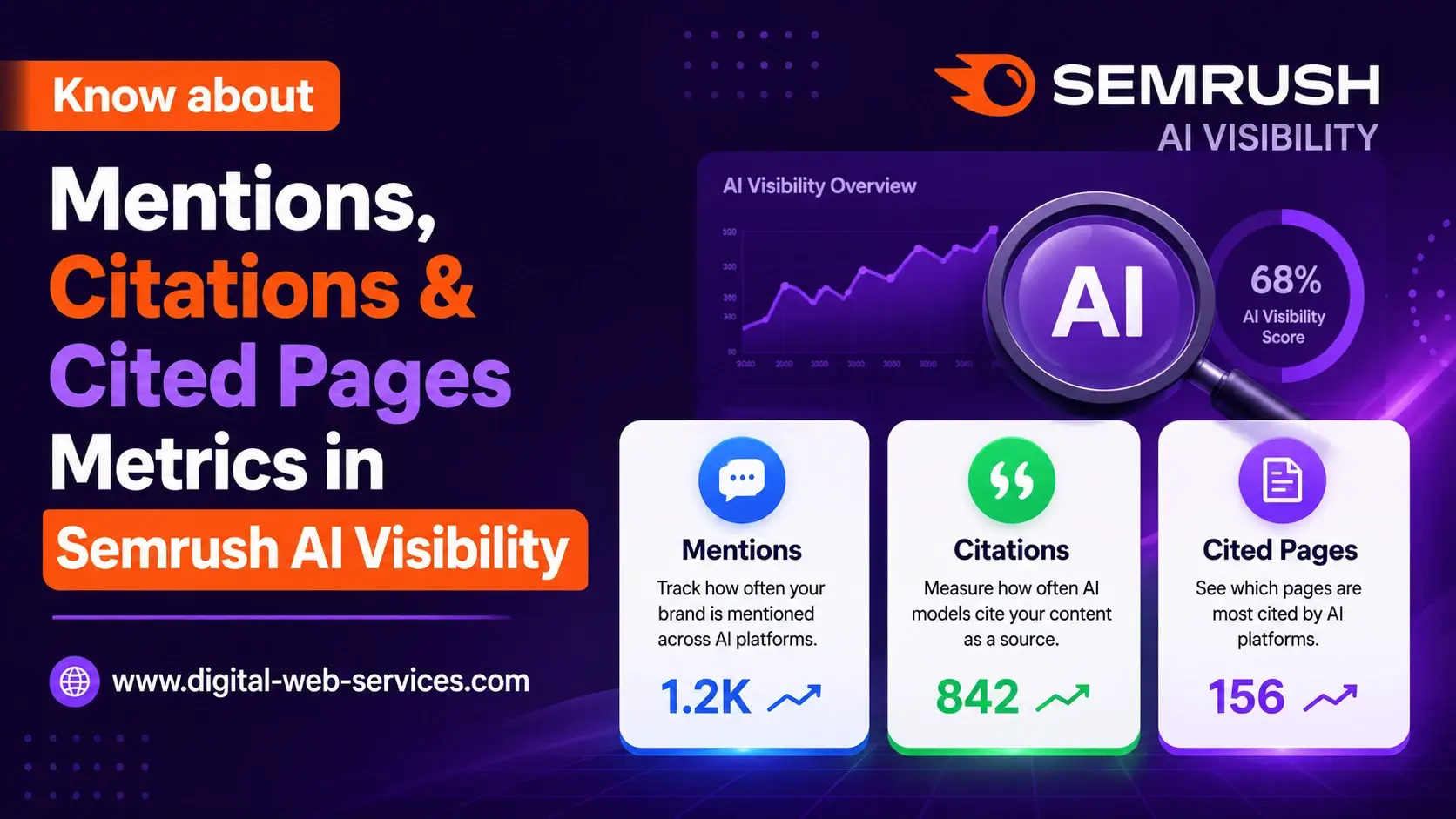
Mentions, Citations, and Cited Pages are three important Semrush AI Visibility metrics that help you understand how your brand appears in AI-generated answers. Mentions show how often your brand name appears in AI responses. Citations show how often AI platforms reference your domain as a source. Cited Pages show the exact URLs from your website that AI tools use in their answers. Together, these metrics help you measure your brand’s presence in AI search platforms like ChatGPT, Gemini, Perplexity, Google AI Overviews, and other generative search experiences. If you want to improve your AI SEO strategy, these metrics tell you whether AI systems simply know your brand, trust your website, or use your content as a reliable source.
Why Are Semrush AI Visibility Metrics Important for SEO?
Semrush AI Visibility metrics are important because search behavior is changing. Users are no longer only typing keywords into Google and clicking blue links. Many people now ask questions directly to AI tools and expect short, clear, and trusted answers.
For example, instead of searching:
“best SEO tools for AI search optimization”
A user may ask an AI platform:
“Which SEO tools can help me track brand visibility in AI search?”
If your brand appears in that answer, you gain visibility. If your website is cited as a source, you gain authority. If a specific page from your site is referenced, that page becomes an AI search asset.
This is why AI Visibility is becoming a serious part of modern SEO. Traditional SEO focuses on rankings, impressions, backlinks, and organic traffic. AI SEO focuses on whether AI platforms mention your brand, cite your domain, and use your pages to support generated answers.
In simple words, Semrush AI Visibility helps answer three key questions:
- Is AI talking about my brand?
- Is AI trusting my website as a source?
- Which pages are helping my brand appear in AI-generated answers?
Try Semrush Today With Free Trial To Check AI Visibility ..!
What Does the Mentions Metric Mean in Semrush AI Visibility?
The Mentions metric shows how many times your brand name appears in AI-generated answers. This does not always mean your website is linked. It simply means your brand is included in the response.
For example, if someone asks:
“What are the best tools for tracking AI search visibility?”
And the AI answer says:
“Popular tools include Semrush, Ahrefs, Profound, and other AI SEO platforms.”
Then Semrush receives a brand mention.
Mentions are useful because they show brand awareness inside AI conversations. If your brand is being mentioned often, it means AI systems recognize your company, product, service, or content as relevant to a topic.
However, a mention alone is not always enough. AI may mention your brand without citing your website. That means your brand has visibility, but your website may not yet be seen as a strong source.
Example of a Mention
Suppose a user asks:
“Which clinics offer skin treatments in Delhi?”
The AI answer includes:
“Zenderma Clinic is one option for skin and aesthetic treatments.”
That is a mention because the brand name appears in the AI answer.
But if there is no link to the Zenderma website, it is only a mention, not a citation.
What Does the Citations Metric Mean in Semrush AI Visibility?
The Citations metric shows how many AI-generated answers reference your domain as a source. This is more powerful than a mention because it means the AI platform is using your website to support the answer.
A citation usually happens when an AI system pulls information from a webpage and includes your domain as a reference. This can happen in AI search results, AI Overviews, answer engines, and other generative AI platforms.
For example, if a user asks:
“What is AI Visibility in SEO?”
And the AI answer uses your blog post as a source, your website receives a citation.
Citations are important because they show trust. AI platforms usually cite pages that are relevant, well-structured, easy to understand, and useful for the user’s question.
In AI SEO, earning citations is similar to earning organic rankings, but the process is slightly different. Your content must not only rank or exist online. It must also be clear enough for AI systems to extract, summarize, and reference.
Example of a Citation
A user asks:
“How do I improve my website visibility in Google AI Overviews?”
The AI answer includes information from your article and shows your domain as a source.
That counts as a citation.
This means the AI system did not just recognize your brand. It trusted your website enough to use it as supporting material.
What Does the Cited Pages Metric Mean in Semrush AI Visibility?
The Cited Pages metric shows the exact URLs from your website that AI platforms cite in their answers. This is one of the most useful metrics because it tells you which pages are driving your AI visibility.
For example, your cited pages may include:
- A blog post explaining AI SEO
- A service page about SEO consulting
- A product comparison page
- A guide about Google AI Overviews
- A case study with real data
- A pricing page
- A FAQ page
- A research-based article
If Semrush shows that a specific URL is being cited repeatedly, that page is important. It means AI systems find that page useful, relevant, and trustworthy for specific prompts.
Example of Cited Pages
Suppose your website has these pages:
/blog/what-is-ai-seo//services/seo-consulting//blog/google-ai-overviews-optimization/
If AI platforms cite these URLs in generated answers, Semrush will show them as Cited Pages.
This helps you understand which content should be updated, expanded, internally linked, and protected as a high-value AI SEO asset.
What Is the Difference Between Mentions, Citations, and Cited Pages?
Mentions, Citations, and Cited Pages are connected, but they measure different parts of AI Visibility.
Mentions mean AI talks about your brand.
Citations mean AI uses your domain as a source.
Cited Pages mean AI references specific URLs from your website.
Here is a simple way to understand the difference:
If AI says your brand name, that is a Mention.
If AI links to or references your website, that is a Citation.
If AI uses a specific blog, service page, or guide from your website, that URL becomes a Cited Page.
For strong AI Visibility, you need all three. Mentions help with brand awareness. Citations help with authority. Cited Pages show which content is working inside AI search.
Why Can a Brand Have Mentions but No Citations?
A brand can have Mentions but no Citations when AI systems know the brand but do not use its website as a source.
This can happen for several reasons:
- Your brand may be popular online, but your website content may be weak.
- Your brand may be discussed on third-party websites more than on your own domain.
- Your pages may not answer search questions clearly.
- Your content may lack structure, facts, examples, or useful explanations.
- Your website may have technical SEO issues that make crawling difficult.
- Your pages may not include clear author details, updated information, or trust signals.
For example, if people talk about your brand on review sites, directories, social media, and news platforms, AI tools may mention your brand. But if your own website does not provide strong, structured, and helpful content, AI may cite other websites instead.
This is a common AI SEO gap.
The solution is to improve your owned content. Create pages that directly answer user questions, add original insights, include examples, use clean headings, and make your content easy for AI systems to understand.
Why Can a Website Get Citations but Low Mentions?
A website can get Citations but low Mentions when AI platforms use the website as a source but do not strongly associate the content with the brand.
This often happens when the content is useful but the brand identity is weak.
For example, your blog may explain a topic very well, so AI cites it. But the AI answer may not mention your brand name clearly because your brand is not strongly connected to the topic.
This can happen when:
- Your brand name is missing from important pages.
- Your author bio is weak or missing.
- Your About page does not explain your expertise.
- Your service pages are not connected to your blog content.
- Your content sounds generic and does not include unique brand experience.
- Your website lacks case studies, examples, testimonials, or real-world proof.
To fix this, add stronger brand signals across your website. Mention your brand naturally in introductions, author sections, examples, case studies, service pages, and internal links. Make it clear who created the content, why they are qualified, and how the page helps users.
How Do These Metrics Help Improve AI SEO Strategy?
These metrics help you build a smarter AI SEO strategy because they show where your brand stands in AI search.
- If Mentions are low, you need stronger brand visibility.
- If Citations are low, you need better content authority.
- If Cited Pages are low, you need pages that directly answer high-intent questions.
- If competitors are mentioned but your brand is missing, you need to close topic gaps.
- If AI cites third-party websites instead of your domain, you need to improve your own content quality.
For example, if Semrush shows that your competitor is mentioned in prompts like:
“best digital marketing agencies for healthcare SEO”
But your brand is missing, you can create or improve content around healthcare SEO services, case studies, client results, and comparison-style educational pages.
AI Visibility metrics are not just reporting numbers. They are action points for content strategy, brand authority, and generative engine optimization.
How Can You Improve Mentions in AI Search?
To improve Mentions in AI search, your brand must become more visible and strongly associated with your main topics.
Here are practical ways to improve Mentions:
- Create topic clusters around your core services.
- Publish comparison pages, guides, and answer-based articles.
- Get listed on trusted industry websites and directories.
- Build brand mentions on third-party platforms.
- Create expert-led content with clear author profiles.
- Use consistent brand naming across your website and online profiles.
- Add case studies, client success stories, and original examples.
- Answer common search questions clearly and directly.
For example, if your business offers SEO services, do not only publish generic blogs like:
“What is SEO?”
Instead, create content such as:
“How to Track AI Visibility for SEO Campaigns”
“How AI Search Is Changing SEO Reporting”
“Best AI SEO Metrics to Track for Brand Visibility”
“How to Get Cited in Google AI Overviews”
These topics help AI systems connect your brand with specific search intent.
How Can You Improve Citations in AI-Generated Answers?
To improve Citations, your content must be strong enough for AI platforms to use as a source.
AI systems often prefer content that is clear, structured, updated, and directly useful. Your page should answer the question better than competing pages.
Here are practical ways to improve Citations:
- Use question-based headings.
- Start important sections with direct answers.
- Add definitions, examples, steps, and summaries.
- Include original insights or workflow-based explanations.
- Use schema markup where relevant.
- Add author details and editorial review information.
- Update old content with recent information.
- Include statistics, examples, and practical use cases.
- Improve page speed and crawlability.
- Use internal links to connect related pages.
- Avoid thin, generic, or copied content.
For example, if your article is about Semrush AI Visibility metrics, do not only define Mentions, Citations, and Cited Pages. Add examples, use cases, workflows, common mistakes, and optimization tips. That extra value increases information gain and improves the chance of being used in AI-generated answers.
How Can You Improve Cited Pages in Semrush AI Visibility?
To improve Cited Pages, you need to create pages that are highly relevant to user questions and easy for AI systems to quote, summarize, or reference.
Start by identifying which pages are already cited. Then improve those pages before creating new ones.
Here is a simple workflow:
Step 1: Find Your Cited Pages
Check which URLs are being cited in Semrush AI Visibility. Look for blog posts, service pages, product pages, comparison pages, and guides.
Step 2: Identify the Query Intent
Ask yourself: Why is AI citing this page? Is the page answering a definition, comparison, tutorial, pricing, local service, or product question?
Step 3: Improve the Page Structure
Add question-based H2 and H3 headings. Use direct answers under each heading. Make the content easy to scan.
Step 4: Add Information Gain
Include original examples, expert tips, workflows, mistakes, checklists, and real business use cases.
Step 5: Strengthen Trust Signals
Add author information, updated dates, sources, case studies, testimonials, and clear business details.
Step 6: Build Supporting Content
Create related pages that internally link to the cited page. This helps build topical authority.
This workflow helps your cited pages become stronger AI SEO assets.
What Is an Example of Using These Metrics in a Real SEO Audit?
Let’s say you are auditing a digital marketing agency’s AI Visibility in Semrush.
You notice:
- Mentions are low.
- Citations are very low.
- Only one blog page is listed under Cited Pages.
- Competitors are appearing in prompts related to “AI SEO agency,” “Google AI Overview optimization,” and “best SEO agency for AI search.”
- This tells you that the brand has three problems:
- First, AI platforms do not strongly associate the brand with AI SEO.
- Second, the website does not have enough authoritative content on AI search optimization.
- Third, only one page is useful enough to be cited.
- Now you can build an action plan.
- Create a pillar page on AI SEO services.
- Publish supporting blogs about AI Visibility, Google AI Overviews, ChatGPT SEO, Gemini SEO, and generative engine optimization.
- Add case studies showing real SEO results.
- Update service pages with FAQs and direct answers.
- Add schema markup and internal links.
- Get brand mentions from trusted industry websites.
- After a few weeks or months, you can check whether Mentions, Citations, and Cited Pages improve.
- This is how Semrush AI Visibility metrics can guide a practical SEO strategy.
What Are the Common Mistakes When Tracking AI Visibility?
Many businesses track AI Visibility incorrectly because they only look at one metric.
One common mistake is focusing only on Mentions. A brand mention is useful, but if AI never cites your website, your content authority may still be weak.
Another mistake is focusing only on Citations. A website may be cited, but if the brand is not mentioned clearly, users may not remember the company.
A third mistake is ignoring Cited Pages. These pages show what AI systems already trust. If you do not improve them, you may lose visibility to competitors.
Other common mistakes include:
- Publishing generic content with no original value.
- Not updating old pages.
- Ignoring technical SEO.
- Using unclear headings.
- Not adding FAQs.
- Not building topical authority.
- Not connecting blog content with service pages.
- Not tracking competitor mentions.
- AI Visibility is not only about being found. It is about being found, trusted, and remembered.
How Do Mentions, Citations, and Cited Pages Connect with E-E-A-T?
E-E-A-T stands for Experience, Expertise, Authoritativeness, and Trustworthiness. These signals matter because AI systems and search engines prefer reliable content.
- To improve Experience, include real examples, workflows, screenshots, case studies, and practical insights.
- To improve Expertise, use knowledgeable authors, explain concepts clearly, and cover the topic deeply.
- To improve Authoritativeness, earn backlinks, brand mentions, citations, and references from trusted websites.
- To improve Trustworthiness, include accurate information, transparent business details, updated content, clear contact information, and helpful sources.
For AI Visibility, E-E-A-T is important because AI systems are more likely to use pages that look reliable, complete, and useful.
A page with strong E-E-A-T can improve your chances of earning Citations and becoming a Cited Page.
How Should You Optimize Content for Google AI Overviews and AI Search?
To optimize content for Google AI Overviews and AI search, write content that directly answers real user questions.
Use this simple format:
- Start with a direct answer.
- Use question-based headings.
- Explain the topic in simple words.
- Add examples.
- Add step-by-step workflows.
- Include FAQs.
- Use structured data where relevant.
- Add internal links.
- Keep information updated.
- Show real expertise.
- Avoid fluff and keyword stuffing.
For example, instead of writing a vague heading like:
“Understanding Metrics”
Use a question-based heading like:
“What Does the Mentions Metric Mean in Semrush AI Visibility?”
This helps both users and AI systems understand the content quickly.
AI search platforms often summarize content. If your page is clear, structured, and helpful, it becomes easier for AI systems to extract the right answer.
How Can You Turn Semrush AI Visibility Data into an Action Plan?
Here is a practical AI Visibility action plan:
Week 1: Benchmark Your Current Visibility
Check Mentions, Citations, Cited Pages, prompts, and competitor visibility. Identify where your brand appears and where it is missing.
Week 2: Improve Existing Cited Pages
Update cited pages with better headings, FAQs, examples, schema, internal links, and fresh information.
Week 3: Build Missing Topic Pages
Create new content for prompts where competitors appear but your brand does not. Focus on high-intent questions.
Week 4: Strengthen Brand Authority
Improve author bios, About pages, service pages, case studies, testimonials, and third-party brand mentions.
Month 2: Track Changes
Review whether Mentions, Citations, and Cited Pages are improving. Compare your brand with competitors.
Month 3: Scale What Works
Create more content around topics where AI already cites your website. Build clusters around your strongest pages.
This process turns AI Visibility data into a repeatable SEO workflow.
What Is the Best Way to Explain These Metrics to a Client?
The easiest way to explain these metrics is:
- Mentions show whether AI knows your brand.
- Citations show whether AI trusts your website.
- Cited Pages show which pages AI uses as proof.
For a client, you can say:
“Mentions tell us how often AI platforms include your brand in answers. Citations tell us whether your website is being used as a trusted source. Cited Pages show the exact URLs that AI tools reference. If we improve these three metrics, we can increase your brand visibility across AI search platforms and improve your chances of being included in AI-generated answers.”
This explanation is simple, clear, and business-friendly.
Try Semrush To Check AI Visibility of Your Site ..!
FAQs About Semrush AI Visibility
Q: What are Mentions in Semrush AI Visibility?
Mentions are the number of times your brand appears in AI-generated answers. A mention can happen even if the AI response does not link to your website. It mainly measures brand awareness in AI search.
Q: What are Citations in Semrush AI Visibility?
Citations are the number of AI-generated answers that reference your domain as a source. A citation shows that an AI platform is using your website to support its answer.
Q: What are Cited Pages in Semrush AI Visibility?
Cited Pages are the exact URLs from your website that AI platforms reference in their answers. These can be blog posts, service pages, product pages, guides, or other important pages.
Q: What is the difference between Mentions and Citations?
Mentions mean AI includes your brand name in an answer. Citations mean AI references your website as a source. A mention gives brand visibility, while a citation gives source authority.
Q: Why are Cited Pages important for AI SEO?
Cited Pages are important because they show which pages AI platforms trust and use in generated answers. These pages can be optimized further to improve AI Visibility and topical authority.
Q: How can I increase Mentions in AI search?
You can increase Mentions by building brand authority, publishing topic-focused content, earning third-party mentions, creating expert content, and making your brand clearly associated with your main services or products.
Q: How can I increase Citations in AI-generated answers?
You can increase Citations by creating clear, helpful, well-structured, and trustworthy content. Add direct answers, examples, FAQs, schema markup, author details, updated information, and original insights.
Q: Can AI mention my brand without citing my website?
Yes. AI can mention your brand without citing your website. This means the AI system recognizes your brand but may not be using your domain as a source.
Q: Can AI cite my website without mentioning my brand?
Yes. AI can cite your website as a source without clearly mentioning your brand in the main answer. This usually means your content is useful, but your brand signals may need improvement.
Q: What is AI Visibility in SEO?
AI Visibility in SEO means how often and how prominently your brand, website, or content appears in AI-generated answers across platforms like ChatGPT, Gemini, Perplexity, Google AI Overviews, and other AI search tools.
Q: Is AI Visibility the same as traditional SEO ranking?
No. Traditional SEO ranking measures your position in search engine results. AI Visibility measures whether AI platforms mention your brand, cite your website, and use your pages in generated answers.
Q: What pages are most likely to become Cited Pages?
Pages that clearly answer user questions, provide original insights, include structured headings, show expertise, and offer trustworthy information are more likely to become Cited Pages.
Conclusion
Mentions, Citations, and Cited Pages are essential Semrush AI Visibility metrics for understanding your brand’s performance in AI search. Mentions show whether AI platforms talk about your brand. Citations show whether AI platforms trust your website as a source. Cited Pages show which specific URLs are being used in AI-generated answers.
To improve these metrics, focus on helpful content, strong topical authority, clear structure, original insights, and trust signals. AI SEO is not only about ranking on Google anymore. It is also about becoming visible, credible, and useful inside AI-generated answers.
Brands that understand and optimize these metrics early will have a stronger chance of appearing in Google AI Overviews, ChatGPT responses, Gemini answers, and other AI search experiences.

Maria Jain is a Senior Content Strategist and Tech Editor at Digital Web Services, with over 6+ years of experience covering digital marketing, website development, and search engine optimization. She specializes in WordPress site architecture, AI technologies, Web Hosting, topical authority models, and hands-on SaaS & affiliate tool reviews. Maria combines data-driven SEO practices with deep web design and technical insights to publish transparent guides, tool comparisons, and strategic tutorials for digital growth.