AI SEO is no longer only about adding keywords, writing long articles, or publishing more pages. Search engines and AI-powered search results are becoming better at understanding whether your content is actually helpful, trustworthy, and written by someone with real knowledge.
That is why E-E-A-T is so important.
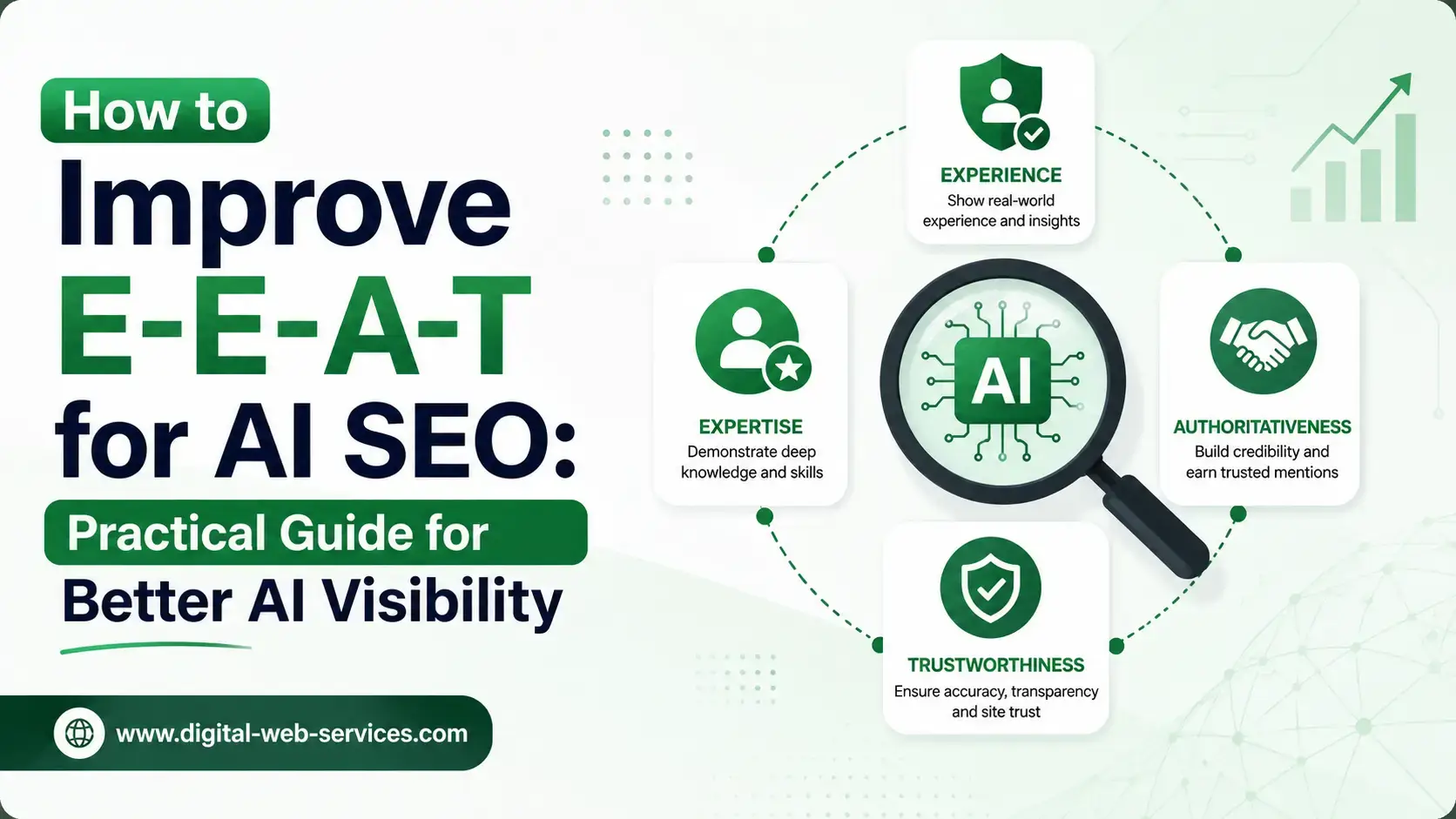
E-E-A-T stands for Experience, Expertise, Authoritativeness, and Trustworthiness. In simple words, it helps search engines and users understand whether your content deserves attention.
For AI SEO, E-E-A-T matters even more because AI search results often summarize information from different sources. If your website only repeats common information, it becomes easy to ignore. But if your content includes real experience, expert insights, examples, case studies, original data, and strong trust signals, it has a better chance of being noticed by users and search systems.
This guide explains how to improve E-E-A-T for AI SEO in a practical and simple way.
What Does E-E-A-T Mean in AI SEO?
E-E-A-T is a quality concept used to judge how reliable and helpful a page feels. It is not a single SEO score that you can check in a tool. Instead, it is a combination of signals across your content, authors, website, brand, and online reputation.
Here is what each part means:
Experience means the content shows real-world involvement. For example, a product review written by someone who actually used the product has stronger experience than a generic summary.
Expertise means the content is created or reviewed by someone who understands the topic deeply.
Authoritativeness means your website or author is known as a reliable source in the industry.
Trustworthiness means users can believe your content, contact your business, understand your policies, and feel safe using your website.
For AI SEO, the goal is not to “trick” AI systems. The goal is to make your content clear, useful, original, and reliable enough that both users and search engines can trust it.
Why Is E-E-A-T Important for AI SEO and Google AI Overviews?
E-E-A-T is important for AI SEO because AI-powered search experiences look for content that can answer user questions clearly and confidently.
When users search questions like:
- How do I improve E-E-A-T for SEO?
- What is AI SEO?
- How can my website appear in AI Overviews?
- How do I make AI content more trustworthy?
- What makes content helpful for Google?
They do not want thin answers. They want practical guidance, examples, and proof.
AI search systems also need content that is easy to understand. If your page has a clear structure, direct answers, helpful examples, strong author signals, and accurate information, it becomes easier for search engines to understand what your page is about.
This is where AI SEO and E-E-A-T work together.
AI SEO helps your content become discoverable in AI-driven search. E-E-A-T helps your content become trusted.
For a deeper foundation, you can internally link to your related post using this anchor text: what is AI SEO.
Suggested internal link sentence:
“To understand the basics before improving E-E-A-T, read our guide on what is AI SEO and why it matters for business growth.”
How Can You Show Real Experience in AI SEO Content?
Real experience is one of the strongest ways to make your content different from generic AI-written content.
Many websites publish the same advice. They say things like “write helpful content,” “use keywords,” and “build backlinks.” These points are not wrong, but they are too common. To improve E-E-A-T, you need to show what you have actually seen, tested, learned, or solved.
Ways to Add Experience to Your Content
Add real examples from client work, campaigns, audits, or internal experiments.
Use screenshots from tools like Google Search Console, Google Analytics, Ahrefs, Semrush, Screaming Frog, or your CMS.
Share before-and-after examples, such as how a page improved after adding author details, FAQs, schema, expert quotes, or original research.
Explain what did not work. This feels more human and more trustworthy than only sharing wins.
Add personal notes from the writer or expert, such as “In our SEO audits, we often see…” or “When we updated older content, we noticed…”
Example of Weak Content
“Add experience to your content to improve E-E-A-T.”
Better E-E-A-T Version
“In our SEO content audits, one common issue is that service pages sound too generic. For example, a page may say ‘we offer expert SEO services,’ but it does not show any proof. A stronger version includes a short case study, the problem solved, the process used, and the result achieved. This gives users a reason to trust the business.”
This type of writing feels more useful because it gives the reader a practical example.
How Can You Prove Expertise Without Making Content Complicated?
Expertise does not mean using difficult language. In fact, the best expert content is usually easy to understand.
A real expert can explain a complex topic in simple words.
To prove expertise in AI SEO content, you need to show depth, accuracy, and clarity.
Practical Ways to Show Expertise
Add author bios with the writer’s real name, role, experience, and social profile.
Mention who reviewed the content, especially for technical, legal, medical, financial, or high-impact topics.
Use clear definitions before giving advanced advice.
Link to trusted sources where needed.
Avoid unsupported claims like “this is the best SEO method” unless you can explain why.
Update content when information changes.
Add examples, templates, checklists, and workflows.
Example
Instead of saying:
“AI SEO improves ranking.”
Say:
“AI SEO improves how clearly your website communicates with search engines and AI-driven search systems. It does this through better content structure, stronger topical authority, clearer answers, entity optimization, schema markup, and helpful information that satisfies user intent.”
This version shows more expertise because it explains the concept properly.
How Can You Build Authoritativeness for AI SEO?
Authoritativeness is about becoming a trusted source in your topic area.
For AI SEO, authority is built through consistent publishing, strong internal linking, expert content, original research, and mentions from other trusted websites.
You cannot build authority with one article. You build it by creating a complete content ecosystem.
Ways to Build Authority
Create topic clusters around AI SEO, E-E-A-T, content optimization, technical SEO, schema markup, topical authority, and Google AI Overviews.
Link related posts together naturally.
Publish original research, surveys, reports, or expert opinions.
Get featured on podcasts, interviews, industry blogs, or news websites.
Add case studies that show real results.
Use consistent author profiles across your website and social platforms.
Create a strong About page that explains who you are, what you do, and why users can trust you.
Topic Cluster Example for AI SEO
Main pillar page:
What Is AI SEO and Why Is It Important for Businesses?
Supporting articles:
- How to Improve E-E-A-T for AI SEO
- AI SEO vs Traditional SEO
- How to Optimize Content for Google AI Overviews
- Best Schema Markup for AI SEO
- How to Build Topical Authority for AI Search
- How to Humanize AI Content for SEO
- AI SEO Checklist for Business Websites
This structure helps users and search engines understand that your website covers the topic deeply.
How Can You Improve Trustworthiness on Your Website?
Trust is one of the most important parts of E-E-A-T. If users do not trust your website, they will not contact you, buy from you, or believe your content.
Trust signals are not only about content. They also include your website design, policies, contact details, reviews, security, and transparency.
Important Trust Signals to Add
- Add a clear Contact page with email, phone number, address, or contact form.
- Add an About page with real business information.
- Use author bios on blog posts.
- Show customer reviews, testimonials, or client logos.
- Add Privacy Policy, Terms of Service, Refund Policy, and Editorial Policy pages.
- Use HTTPS for website security.
- Mention when the article was published and updated.
- Clearly disclose affiliate links, sponsorships, or AI assistance if used.
- Avoid fake claims, fake reviews, or exaggerated guarantees.
Trust Example for an SEO Agency Website
A weak trust signal is:
“We are the best SEO company.”
A stronger trust signal is:
“Our SEO team has worked with local businesses, ecommerce websites, and service-based companies. Our process includes technical SEO audits, content gap analysis, keyword research, on-page optimization, and monthly performance reporting. You can view our case studies and client reviews before booking a consultation.”
This gives users more proof and feels more honest.
What Type of Content Performs Better in AI SEO?
AI SEO content should be clear, complete, and easy to extract. This does not mean writing only for AI. It means writing in a way that helps users get answers quickly.
AI-Friendly Content Structure
- Use question-based headings.
- Give a short direct answer after each heading.
- Add step-by-step workflows.
- Use bullet points where helpful.
- Include examples and comparisons.
- Add FAQs at the end.
- Use schema markup where suitable.
- Avoid long paragraphs that hide the answer.
Add original insights that are not already available on every competitor page.
Good AI Overview-Friendly Heading Examples
- What is E-E-A-T in AI SEO?
- Why does E-E-A-T matter for Google AI Overviews?
- How do you show experience in SEO content?
- How can businesses build topical authority?
- What trust signals should every website include?
- How do you optimize AI-generated content for E-E-A-T?
Question-based headings match how users search and how AI systems understand intent.
What Is the Best Workflow to Improve E-E-A-T for AI SEO?
Here is a practical workflow you can use for any blog post, service page, or landing page.
Step 1: Check the Search Intent
Before writing, understand what users really want.
For the topic “how to improve E-E-A-T for AI SEO,” users likely want:
- A simple explanation of E-E-A-T
- Practical AI SEO tips
- Google AI Overview optimization ideas
- Examples of trust signals
- A checklist they can follow
- Content improvement steps
- FAQs and schema guidance
Your content must answer all of these needs.
Step 2: Study the SERP and AI Overview Style
Search your main keyword and related questions. Look at what type of content appears. Notice common questions, formats, and missing information.
Do not copy competitors. Instead, find what they are missing.
For example, many articles explain E-E-A-T but do not show a real workflow. You can add a workflow, checklist, examples, and service CTA to create information gain.
Step 3: Add First-Hand Insights
Include real observations, such as:
- What you notice during SEO audits
- Common mistakes businesses make
- What changes improved content quality
- How AI content can become more human
- What proof users expect before trusting a service provider
Step 4: Strengthen Author and Website Signals
Add:
- Author name
- Author bio
- LinkedIn profile
- Reviewer name if needed
- Company information
- Editorial standards
- Contact details
Step 5: Improve Content Accuracy
Review facts, update outdated claims, and cite reliable sources where needed. Remove vague statements and replace them with clear explanations.
Step 6: Add Internal Links
Link this article to related AI SEO and SEO service pages. Internal links help users explore the topic and help search engines understand your topical authority.
Suggested internal links:
- what is AI SEO
- AI SEO services
- SEO content optimization
- technical SEO audit
- topical authority strategy
- schema markup services
Step 7: Add FAQ and Schema
Add FAQs that answer real user questions in short, clear language. Then add FAQ schema code if suitable for your website.
Step 8: Update the Page Regularly
AI SEO changes fast. Review your article every few months. Add new examples, update screenshots, improve FAQs, and refresh outdated information.
What Are Real Examples of E-E-A-T Improvements?
Here are simple examples that show how to turn weak content into stronger E-E-A-T content.
| Weak Content | E-E-A-T Improved Content |
|---|---|
| “AI SEO helps businesses rank better.” | “AI SEO helps businesses improve visibility in AI-powered search by making content clearer, more structured, more trustworthy, and better aligned with user intent.” |
| “We are SEO experts.” | “Our SEO team has 10+ years of experience in technical SEO, content strategy, local SEO, and AI SEO optimization for service-based and ecommerce websites.” |
| “Use schema markup.” | “Use Article, Organization, Breadcrumb, FAQ, and Service schema where relevant to help search engines understand your page content more clearly.” |
| “Write helpful content.” | “Add original examples, screenshots, expert quotes, updated facts, and a clear answer within the first few lines of each important section.” |
| “Build authority with backlinks.” | “Build authority by publishing original research, earning brand mentions, creating topic clusters, and getting cited by relevant websites in your industry.” |
How Can You Optimize AI-Generated Content for E-E-A-T?
AI tools can help with outlines, research organization, content briefs, and first drafts. But AI-generated content should not be published without human review.
AI content often lacks personal experience, original examples, emotional understanding, and industry-specific judgment. That is why human editing is important.
How to Humanize AI Content for SEO
- Add your own examples and observations.
- Replace generic lines with specific advice.
- Check facts carefully.
- Add expert review where needed.
- Use natural language.
- Remove repeated phrases.
- Add screenshots, case studies, or data.
- Make the content match your brand voice.
- Answer the user’s real problem, not just the keyword.
Example
Generic AI-style sentence:
“E-E-A-T is important because it helps improve SEO performance.”
Human and expert-style sentence:
“E-E-A-T improves SEO performance indirectly by making your content more useful, credible, and easier to trust. This matters because users are more likely to stay, read, share, and convert when they feel the content is written by someone who understands their problem.”
What On-Page SEO Elements Support E-E-A-T?
E-E-A-T is not only about writing. On-page SEO also helps improve clarity and trust.
Important On-Page Elements
- Use one clear H1.
- Add question-based H2 and H3 headings.
- Include the primary keyword naturally in the title, introduction, headings, and conclusion.
- Add semantic keywords throughout the content.
- Use short paragraphs.
- Add internal links to related pages.
- Add external links to trusted sources when needed.
- Add image alt text.
- Use schema markup.
- Add author and reviewer details.
- Keep the page updated.
- Avoid keyword stuffing.
The goal is not to force keyword density. The goal is to use keywords naturally where they help the reader.
What Technical SEO Signals Help AI SEO and E-E-A-T?
Technical SEO makes sure your trusted content can actually be found, crawled, indexed, and understood.
Even the best article may not perform well if the website has technical problems.
Technical SEO Checklist
- Make sure important pages are indexable.
- Fix broken links.
- Improve page speed.
- Use mobile-friendly design.
- Add XML sitemap.
- Use clean URL structure.
- Fix duplicate content.
- Add canonical tags where needed.
- Use structured data.
- Make navigation simple.
- Keep important content visible in HTML.
- Use breadcrumbs.
- Improve Core Web Vitals.
Technical SEO supports trust because a fast, clean, and easy-to-use website gives users a better experience.
How Can Service-Based Businesses Use E-E-A-T for AI SEO?
Service businesses need strong E-E-A-T because users want proof before they contact a company.
If you offer SEO services, digital marketing, legal services, healthcare services, consulting, finance, education, or local services, your website must clearly show why users can trust you.
What to Add on Service Pages
- Clear service description.
- Real process.
- Team experience.
- Client reviews.
- Case studies.
- FAQs.
- Pricing guidance if possible.
- Industries served.
- Contact details.
- Certifications or partnerships.
- Before-and-after results.
- Strong CTA.
Example CTA for SEO Services
Want to improve your website’s E-E-A-T and AI search visibility? Our SEO team can audit your content, fix trust gaps, build topical authority, optimize pages for AI SEO, and create a content strategy designed for long-term organic growth. Contact us today to get a custom SEO audit and growth plan.
What Are Common E-E-A-T Mistakes to Avoid?
Many websites try to improve E-E-A-T but make mistakes that reduce trust.
Avoid these common issues:
- Publishing AI content without human editing.
- Using fake author names.
- Adding expert claims without proof.
- Using outdated information.
- Writing only for keywords.
- Copying competitor headings and ideas.
- Adding too many ads or popups.
- Hiding contact details.
- Not showing who owns the website.
- Not updating old content.
- Using fake reviews.
- Making promises like “guaranteed ranking.”
- Ignoring technical SEO issues.
These mistakes make your website look less reliable to both users and search engines.
What Is a Simple E-E-A-T Checklist for AI SEO?
Use this checklist before publishing or updating any page.
Experience Checklist
- Have you added real examples?
- Have you included screenshots, case studies, or personal insights?
- Does the content show practical knowledge?
- Does it explain what actually works and what does not?
Expertise Checklist
- Is the author qualified to write on the topic?
- Is the content accurate and detailed?
- Are important claims supported?
- Is the language clear and easy to understand?
Authority Checklist
- Does the website cover this topic deeply?
- Are related articles internally linked?
- Has the brand earned mentions or backlinks?
- Does the author have a visible online presence?
Trust Checklist
- Is contact information easy to find?
- Are policies visible?
- Are reviews or testimonials included?
- Is the page updated?
- Is the website secure?
- Are claims honest and realistic?
How Often Should You Update E-E-A-T Content?
You should update important SEO and AI SEO content every few months, especially when search behavior, Google features, tools, or best practices change.
For service pages, review content at least every quarter.
For blog posts, update them when:
- Search intent changes
- Rankings drop
- New Google features appear
- Data becomes outdated
- FAQs need improvement
- New examples or case studies are available
- Competitors publish better content
Freshness alone is not enough. The update must add real value.
Final Thoughts: How Do You Improve E-E-A-T for AI SEO?
To improve E-E-A-T for AI SEO, focus on one simple goal: become the most helpful and trustworthy answer for your target audience.
Do not publish content just because a keyword has search volume. Publish content that solves the user’s problem better than other pages.
Add real experience. Prove your expertise. Build authority with topic clusters and trusted mentions. Improve trust with clear author details, contact information, reviews, policies, and honest claims.
AI search is making generic content less useful. But it is also creating a big opportunity for websites that share original insights, real proof, and helpful answers.
If your website needs better AI SEO visibility, stronger E-E-A-T signals, and content that builds trust, our SEO team can help. Get in touch today for a complete SEO audit, content strategy, and AI SEO optimization plan.
FAQs About Improving E-E-A-T for AI SEO
What is E-E-A-T in AI SEO?
E-E-A-T in AI SEO means Experience, Expertise, Authoritativeness, and Trustworthiness. It helps users and search engines understand whether your content is reliable, useful, and created by someone with real knowledge of the topic.
Why is E-E-A-T important for AI SEO?
E-E-A-T is important for AI SEO because AI-powered search results need trustworthy and helpful sources. Content with real examples, expert insights, clear structure, and strong trust signals is more useful for users and easier for search engines to understand.
How do I improve E-E-A-T on my website?
You can improve E-E-A-T by adding author bios, expert reviews, case studies, original insights, trusted sources, contact details, customer reviews, clear policies, updated content, and strong internal links to related topics.
Q: Does AI-generated content hurt E-E-A-T?
AI-generated content does not automatically hurt E-E-A-T, but publishing generic AI content without human review can reduce quality. Add human experience, fact-checking, examples, expert input, and brand voice before publishing AI-assisted content.
Q: How can I make my content appear in Google AI Overviews?
There is no guaranteed way to appear in Google AI Overviews. However, you can improve your chances by creating helpful, original, well-structured, trustworthy content that answers user intent clearly and is crawlable, indexable, and supported by strong SEO foundations.
Q: What are the best trust signals for E-E-A-T?
The best trust signals include clear contact information, author bios, expert reviewers, About page, Privacy Policy, Terms of Service, customer reviews, testimonials, secure website, updated content dates, and honest claims.
Q: Is E-E-A-T a direct Google ranking factor?
E-E-A-T is not a simple direct ranking score. It is a quality framework that helps evaluate whether content is helpful, reliable, and trustworthy. Many signals connected to E-E-A-T can support better SEO performance.
Q: How does topical authority help AI SEO?
Topical authority helps AI SEO by showing that your website covers a subject deeply. When you publish connected content around one topic and link it properly, search engines can better understand your expertise and relevance.

Maria Jain is a Senior Content Strategist and Tech Editor at Digital Web Services, with over 6+ years of experience covering digital marketing, website development, and search engine optimization. She specializes in WordPress site architecture, AI technologies, Web Hosting, topical authority models, and hands-on SaaS & affiliate tool reviews. Maria combines data-driven SEO practices with deep web design and technical insights to publish transparent guides, tool comparisons, and strategic tutorials for digital growth.