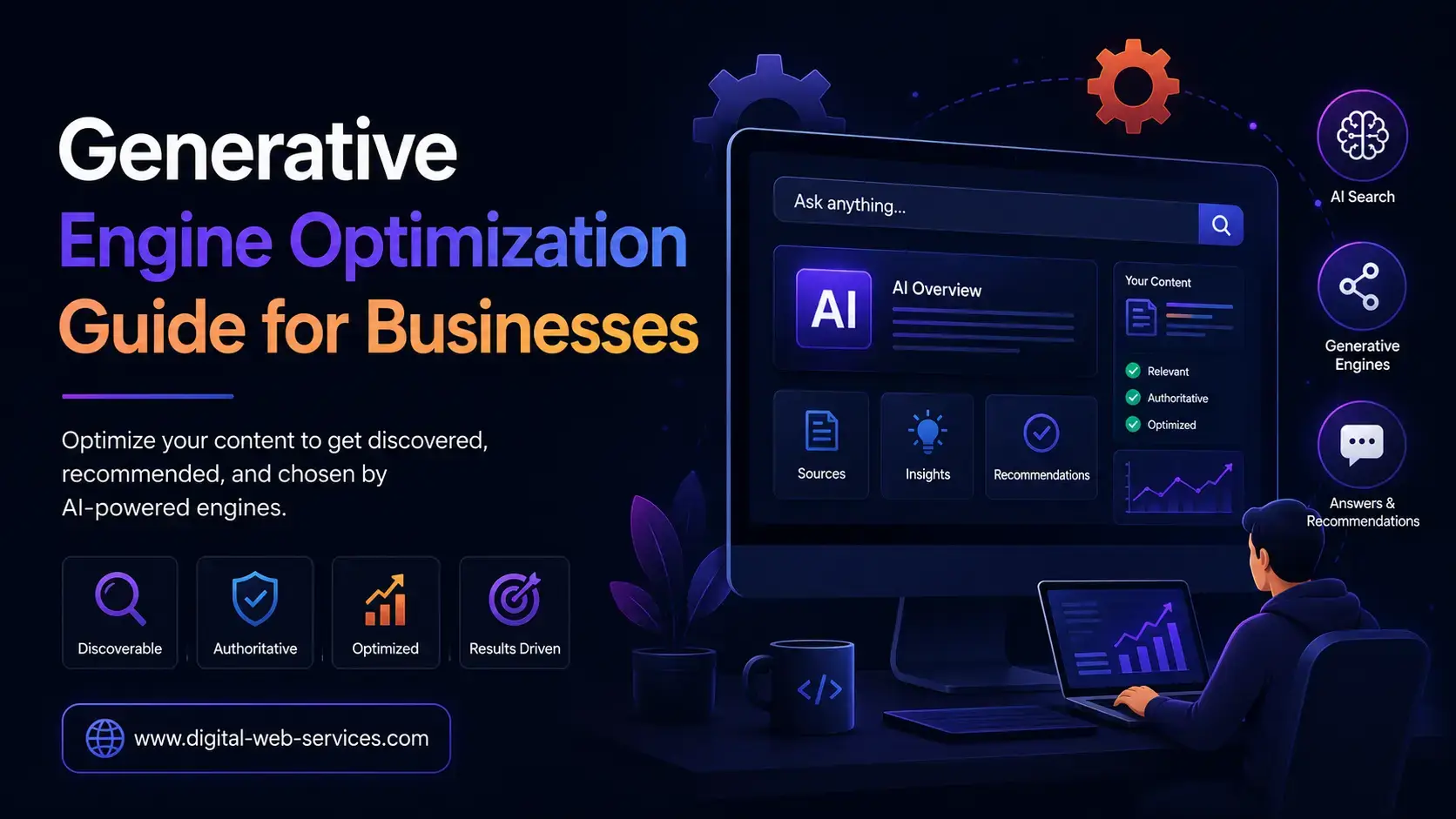
Generative Engine Optimization, also known as GEO, is the process of optimizing your website content so AI-powered search engines and answer platforms can understand, trust, summarize, and recommend your business.
In simple words, GEO helps your brand appear in AI-generated answers.
Traditional SEO focuses on ranking your website in search engine result pages. Generative Engine Optimization focuses on making your content clear and trustworthy enough to be selected, cited, or mentioned by AI search platforms such as Google AI Overviews, ChatGPT, Gemini, Perplexity, Copilot, and other answer engines.
Today, users are not only searching with short keywords. They are asking complete questions like:
- What is the best SEO strategy for small businesses?
- How can I optimize my website for AI search?
- Which company offers Generative Engine Optimization services?
- How can my brand appear in Google AI Overviews?
- What is the difference between SEO, AI SEO, GEO, and AEO?
GEO helps your website answer these questions in a clear, natural, and useful way.
For businesses, this is important because search is moving from keyword-based results to answer-based experiences. If your content is easy to understand, helpful, and trustworthy, your business has a better chance of becoming part of the answer.
What Is Generative Engine Optimization in Simple Words?
Generative Engine Optimization is the practice of improving your online content so generative AI platforms can easily read, understand, and recommend it.
A generative engine is an AI system that creates answers for users. Instead of only showing links, it summarizes information from different sources and gives users a direct response.
GEO helps your business become one of those trusted sources.
Generative Engine Optimization includes:
- Writing helpful and original content
- Answering user questions clearly
- Using conversational keywords
- Structuring content with proper headings
- Adding summaries, lists, tables, and FAQs
- Improving brand authority
- Building topical authority
- Adding structured data where suitable
- Improving technical SEO
- Making pages crawlable and indexable
- Showing expertise and trust signals
- Getting brand mentions and quality backlinks
- Updating old content with fresh information
GEO is not about tricking AI systems. It is about making your business content easier to understand, easier to verify, and more useful for real users.
How Is GEO Different from Traditional SEO?
GEO and traditional SEO are closely connected, but they focus on different search experiences.
Traditional SEO helps your website rank in Google search results. GEO helps your content become useful for AI-generated summaries and answer engines.
| Traditional SEO | Generative Engine Optimization |
| Focuses on ranking web pages | Focuses on being included in AI-generated answers |
| Targets search engine results pages | Targets AI Overviews, ChatGPT, Gemini, Perplexity, and answer engines |
| Uses keywords, backlinks, and technical SEO | Uses keywords, entities, trust signals, answer clarity, and topic depth |
| Measures rankings and clicks | Measures mentions, citations, visibility, traffic, and conversions |
| Optimizes pages for search crawlers | Optimizes content for users, search engines, and AI systems |
| Works for keyword-based search | Works for conversational and question-based search |
The best strategy is not SEO vs GEO. The best strategy is SEO plus GEO.
A website still needs strong technical SEO, helpful content, good page speed, internal links, backlinks, and proper indexing. GEO builds on top of these SEO foundations.
Why Is Generative Engine Optimization Important for Businesses?
Generative Engine Optimization is important because AI-powered search is changing how customers discover brands.
Earlier, a user searched a keyword, clicked a website, and compared information manually. Now, AI search tools often summarize the answer first. This means businesses need to optimize not only for ranking but also for being recognized as a trusted answer source.
GEO can help businesses:
- Improve visibility in AI-powered search
- Increase chances of being cited in AI-generated answers
- Build stronger brand authority
- Reach users who ask long, conversational questions
- Improve content quality
- Support Google AI Overviews optimization
- Strengthen AI SEO performance
- Generate more qualified leads
- Compete with larger brands
- Improve trust and credibility
- Create content that works for both users and search engines
If your competitors are creating clear, expert-led, AI-friendly content and your website is still using thin or outdated pages, your business may lose visibility in the new search landscape.
How Do Generative AI Search Engines Choose Content?
AI search engines look for content that can help answer a user’s question with clarity and confidence.
While every platform works differently, most AI-powered search systems prefer content that is:
- Relevant to the user’s query
- Clear and easy to understand
- Written in natural language
- Supported by expertise
- Well structured with headings
- Fresh and updated
- Trustworthy and accurate
- Connected to a known brand or entity
- Easy to crawl and index
- Helpful beyond basic definitions
- Supported by external mentions or links
- Consistent across the website and other platforms
For example, if someone asks, “How can a small business optimize for AI search?” an AI system will look for content that gives a complete, practical, and trustworthy answer.
A generic 300-word blog may not be enough. A detailed guide with steps, examples, FAQs, schema, internal links, and expert insights has a better chance of being useful.
What Are the Main Benefits of GEO for Businesses?
Generative Engine Optimization gives businesses a stronger chance to stay visible as search behavior changes.
1. GEO Helps Your Brand Appear in AI Answers
AI platforms often create direct answers instead of only showing website links. GEO improves your chances of being mentioned, summarized, or cited as a source.
This is valuable because users often trust answers that appear directly in AI-powered search results.
2. GEO Improves Visibility for Conversational Search
People now ask longer questions online. They search in a natural way, almost like speaking to a consultant.
Examples:
- What is the best digital marketing strategy for startups?
- How can I make my website appear in AI Overviews?
- Which SEO agency can help with AI SEO?
- What is Generative Engine Optimization for businesses?
GEO helps your content match these natural language queries.
3. GEO Builds Brand Trust and Authority
AI engines prefer content from sources that appear reliable. If your website shows expertise, real examples, author details, case studies, testimonials, and updated information, users and search systems can trust it more.
Trust is not built from one page. It is built through a complete content ecosystem.
4. GEO Supports Better Lead Generation
When your content answers high-intent questions, it attracts users who are already looking for a solution.
For example, a user searching “Generative Engine Optimization services for my business” is closer to taking action than someone searching only “SEO.”
GEO helps capture these users with useful information and strong CTAs.
5. GEO Makes Your Content More Useful
A good GEO strategy improves content structure, clarity, readability, and depth. This helps both humans and AI systems.
Users stay longer when content is easy to read. AI systems understand your page better when content is well organized.
6. GEO Helps Small Businesses Compete
Small businesses may not have the budget of large companies, but they can still win with focused content.
By answering specific questions, targeting long-tail search intent, and building topical authority, smaller businesses can become visible for valuable niche topics.
What Types of Businesses Need Generative Engine Optimization?
GEO is useful for almost every business that depends on online visibility.
It is especially important for:
- Digital marketing agencies
- Local service businesses
- SaaS companies
- E-commerce websites
- Real estate companies
- Healthcare and wellness businesses
- Education and coaching websites
- Finance and consulting firms
- Legal service providers
- B2B companies
- IT service providers
- Travel and hospitality brands
- Startups and personal brands
If your customers search online before contacting you, your business can benefit from Generative Engine Optimization.
How Can Businesses Optimize for Conversational Queries?
Conversational queries are natural questions people ask in search engines and AI tools.
Instead of targeting only short keywords like “SEO services,” businesses should also target complete questions such as:
- What are the best SEO services for small businesses?
- How do I optimize my website for AI search?
- Why is GEO important for business growth?
- How can I appear in Google AI Overviews?
- What is the difference between GEO and AEO?
To optimize for conversational queries:
- Use question-based headings.
- Give a direct answer in the first few lines.
- Write in simple language.
- Add examples and use cases.
- Include FAQs.
- Use natural keywords.
- Avoid keyword stuffing.
- Add internal links to related content.
- Update content regularly.
- Match the search intent behind the question.
A good GEO article should feel like a helpful conversation with an expert, not a keyword-stuffed page.
How Should Businesses Structure Content for GEO?
Content structure is very important for Generative Engine Optimization.
AI systems can understand content better when it is organized clearly.
Use this structure:
1. Start with a Clear Answer
Place a short and direct answer near the beginning of the page.
Example:
“Generative Engine Optimization is the process of optimizing business content so AI-powered search platforms can understand, summarize, cite, and recommend it in AI-generated answers.”
This helps users and AI systems quickly understand the page.
2. Use Question-Based Headings
Question-based headings match how people search.
Good examples:
- What is Generative Engine Optimization?
- Why is GEO important for businesses?
- How does GEO improve AI search visibility?
- What are the best GEO strategies?
- How can small businesses start with GEO?
3. Add Lists and Tables
Bullet points, numbered steps, and comparison tables make content easier to scan.
They also help summarize key information clearly.
4. Include Real Examples
Examples add information gain. They make your content more practical and unique.
Example:
A basic keyword is:
“digital marketing agency”
A conversational GEO query is:
“Which digital marketing agency can help my business appear in AI search results?”
Your content should answer the second type of query.
5. Add FAQs
FAQs help answer common user questions directly. They also support voice search, featured snippet targeting, and AI answer optimization.
6. Use Internal Links
Internal links connect related content and build topical authority.
Suggested internal link for this article:
Use the anchor text “What Is AI SEO and Why Is It Important for Businesses?” and link it to your AI SEO article.
You can place it naturally in this sentence:
“To understand the bigger picture, read our complete guide on What Is AI SEO and Why Is It Important for Businesses?”
Other internal link anchor suggestions:
- AI SEO guide
- AI SEO for businesses
- AI search optimization
- AI SEO services
- Answer Engine Optimization guide
- Google AI Overviews optimization
What Is a Practical GEO Workflow for Businesses?
A successful GEO strategy needs a clear process.
Step 1: Audit Your Existing Content
Start by reviewing your current website pages and blog posts.
Check:
- Are the pages answering real user questions?
- Is the content updated?
- Are headings clear?
- Is the page easy to read?
- Are FAQs included?
- Is schema markup added where suitable?
- Are important pages internally linked?
- Are service pages conversion-focused?
- Is the content original and useful?
This audit helps you identify weak, outdated, or thin content.
Step 2: Research Questions Your Customers Ask
GEO starts with user questions.
Find questions from:
- Google People Also Ask
- Google Search suggestions
- Search Console queries
- Customer emails
- Sales calls
- Chat support logs
- Social media comments
- Competitor FAQs
- Reddit and Quora discussions
- AI search prompts
Example questions for a digital marketing business:
- What is Generative Engine Optimization?
- How does GEO help businesses?
- Can GEO improve AI search visibility?
- Is GEO better than SEO?
- How can I optimize my website for ChatGPT search?
- How do I make my business appear in Google AI Overviews?
These questions can become blog posts, FAQs, service page sections, or content clusters.
Step 3: Build Topic Clusters
Topic clusters help search engines and AI systems understand your authority.
For example, your main topic can be:
AI SEO
Supporting topics can include:
- What Is AI SEO and Why Is It Important for Businesses?
- Generative Engine Optimization: Complete Guide for Businesses
- What Is Answer Engine Optimization?
- AI SEO vs Traditional SEO
- How to Optimize for Google AI Overviews
- How Schema Markup Helps AI SEO
- How to Build Topical Authority for AI Search
- AI SEO Checklist for Businesses
Each post should link to the main AI SEO learning page and to related articles.
This builds topical authority and improves internal linking.
Step 4: Optimize Content for Entities
Entity SEO is important for GEO.
An entity is a clear concept, brand, person, place, service, or topic that search systems can understand.
For a digital marketing website, important entities may include:
- Digital Web Services
- AI SEO
- Generative Engine Optimization
- Answer Engine Optimization
- Google AI Overviews
- ChatGPT
- Gemini
- Perplexity
- SEO services
- Content marketing
- Schema markup
- Technical SEO
- Local SEO
Use these entities naturally across your website so search systems understand what your brand is related to.
Step 5: Improve E-E-A-T Signals
E-E-A-T stands for Experience, Expertise, Authoritativeness, and Trustworthiness.
To improve E-E-A-T for GEO, add:
- Author bios
- Expert review notes
- Case studies
- Client testimonials
- Real examples
- Clear service pages
- About page
- Contact details
- Privacy policy
- Updated content dates
- Business credentials
- Portfolio or results
- Helpful original insights
AI search systems and users both need trust signals.
Step 6: Add Structured Data
Structured data helps search engines understand your content.
Useful schema types may include:
- Organization schema
- LocalBusiness schema
- Article schema
- WebPage schema
- Service schema
- FAQPage schema
- BreadcrumbList schema
- Product schema, if applicable
- Review schema, if applicable
Schema markup is not a shortcut to rankings, but it supports clarity and search understanding.
Step 7: Strengthen Technical SEO
Your content must be easy to crawl and index.
Check:
- Page speed
- Mobile friendliness
- HTTPS security
- Crawl errors
- Indexing issues
- Broken links
- XML sitemap
- Robots.txt settings
- Canonical tags
- Core Web Vitals
- Clean URL structure
- Proper heading hierarchy
If AI systems and search engines cannot access your content, GEO will not work well.
Step 8: Monitor Performance
Track GEO performance through multiple signals.
You can monitor:
- Organic traffic
- Search impressions
- Keyword rankings
- Search Console queries
- Brand searches
- Referral traffic
- AI search mentions
- Leads and conversions
- Featured snippet visibility
- Content engagement
- Internal link performance
GEO is still evolving, so tracking should combine SEO data, brand visibility, and conversion performance.
What Is an Example of GEO Content Optimization?
Here is a simple example.
Weak Content
“GEO helps businesses rank better in AI search.”
Better GEO-Optimized Content
“Generative Engine Optimization helps businesses improve visibility in AI-powered search by making website content clear, structured, trustworthy, and easy for AI systems to understand. A strong GEO strategy includes conversational keywords, direct answers, schema markup, expert insights, topical authority, technical SEO, and helpful content that answers real customer questions.”
The second version is better because it:
- Explains the topic clearly
- Uses relevant keywords naturally
- Gives more context
- Includes helpful details
- Matches search intent
- Supports AI-generated summaries
How Can GEO Help with Google AI Overviews?
Google AI Overviews are AI-generated summaries that appear for some search queries. GEO can help improve your content readiness for this type of search experience.
To optimize for Google AI Overviews:
- Create helpful and original content
- Answer questions clearly
- Use strong headings
- Add examples and unique insights
- Keep content updated
- Improve crawlability
- Use structured data where suitable
- Build topical authority
- Strengthen E-E-A-T
- Avoid copied or thin content
- Make sure your page is indexable
- Add useful images or videos where relevant
No business can guarantee inclusion in AI Overviews. However, a strong GEO and SEO strategy can improve your content quality and search visibility.
How Is GEO Connected to AI SEO and AEO?
GEO, AI SEO, and AEO are connected.
AI SEO
AI SEO is the broad strategy of optimizing websites for AI-powered search experiences.
GEO
Generative Engine Optimization focuses on helping AI systems generate answers using your content as a trusted source.
AEO
Answer Engine Optimization focuses on answering user questions directly for featured snippets, voice search, People Also Ask, and answer engines.
Together, they help your business become more visible in modern search.
You can think of it like this:
- AI SEO = complete strategy
- GEO = optimization for generative AI summaries
- AEO = optimization for direct answers
For best results, businesses should use all three together.
What Are the Most Important GEO Ranking Factors?
There is no official single “GEO ranking factor” list for every AI platform, but these elements are important for search and AI visibility:
- Helpful content
- Search intent match
- Topic depth
- Clear content structure
- Brand authority
- External mentions
- Quality backlinks
- Crawlability
- Indexability
- Technical SEO
- Schema markup
- Entity clarity
- Updated information
- E-E-A-T signals
- User experience
- Internal linking
- Content originality
- Natural language answers
- Consistent business information
The more trustworthy and useful your content is, the stronger your GEO foundation becomes.
What GEO Mistakes Should Businesses Avoid?
Many businesses make mistakes when trying to optimize for AI search.
Avoid these common GEO mistakes:
1. Writing Only for AI Systems
Do not write robotic content just to target AI platforms. Write for people first.
2. Keyword Stuffing
Using “Generative Engine Optimization” too many times can make your content unnatural. Use related terms naturally, such as GEO, AI SEO, AI search optimization, and answer engine optimization.
3. Ignoring Technical SEO
If your pages are not crawlable or indexable, they may not perform well in search or AI experiences.
4. Publishing Generic Content
AI-generated search experiences need strong and useful information. Generic content does not build authority.
5. Not Showing Expertise
Add examples, experience, expert review, author details, case studies, and service proof.
6. Forgetting Internal Links
Internal links help connect your content cluster and build authority around AI SEO topics.
7. Using Misleading Schema
Structured data should match the visible content on the page. Do not add schema for content that users cannot see.
8. Ignoring Brand Reputation
AI systems may consider information from across the web. Reviews, mentions, backlinks, social profiles, and brand consistency matter.
How Can Small Businesses Start with Generative Engine Optimization?
Small businesses can start GEO without a huge budget.
Here is a simple plan:
- Create one main AI SEO or GEO service page.
- Write blog posts answering customer questions.
- Add FAQs to important service pages.
- Use question-based headings.
- Optimize old blogs with fresh examples.
- Add internal links between related pages.
- Improve page speed and mobile experience.
- Add Organization, Service, and Breadcrumb schema.
- Get customer reviews and testimonials.
- Publish case studies or success stories.
- Update Google Business Profile.
- Track performance in Google Search Console.
Small businesses should focus on specific, high-intent queries instead of broad keywords.
Example:
Instead of targeting:
“SEO”
Target:
“Generative Engine Optimization services for small businesses”
This type of keyword is more specific and can attract better leads.
How Can Digital Web Services Help with GEO?
Digital Web Services helps businesses improve search visibility through SEO, AI SEO, Generative Engine Optimization, Answer Engine Optimization, content strategy, technical SEO, and digital marketing services.
Our GEO services can help you:
- Audit your current website
- Find AI search opportunities
- Optimize content for conversational queries
- Build AI SEO content clusters
- Improve E-E-A-T signals
- Add schema markup
- Strengthen internal linking
- Improve technical SEO
- Update old content
- Create service pages and blog posts
- Track organic growth and leads
We focus on making your website easier for users, search engines, and AI systems to understand.
Ready to Optimize Your Business for AI Search?
Search is changing from simple keywords to intelligent answers.
If your business wants to stay visible in Google, AI Overviews, ChatGPT-style search, Gemini, Perplexity, and answer engines, Generative Engine Optimization is no longer optional.
A strong GEO strategy can help your brand become clearer, more trusted, and more discoverable online.
Get Generative Engine Optimization Services
Digital Web Services can help you create a complete AI SEO and GEO strategy for your business.
Contact us today to optimize your website for AI-powered search and future-ready SEO.
Suggested CTA buttons:
- Get Free GEO Audit
- Talk to an AI SEO Expert
- Optimize My Website for AI Search
- Start Generative Engine Optimization
- Improve My AI Search Visibility
FAQ About Generative Engine Optimization
Q: What is Generative Engine Optimization?
Generative Engine Optimization is the process of optimizing website content so AI-powered platforms can understand, summarize, cite, and recommend your business in AI-generated answers.
Q: Why is GEO important for businesses?
GEO is important because customers are using AI-powered search tools to ask detailed questions. Businesses need GEO to stay visible in AI answers, Google AI Overviews, ChatGPT-style search, and answer engines.
Q: Is GEO the same as SEO?
No. GEO is connected to SEO, but it focuses more on AI-generated answers, conversational search, source citations, and brand recommendations. Traditional SEO focuses more on search rankings and organic clicks.
Q: What is the difference between GEO and AI SEO?
AI SEO is the broader strategy for optimizing a website for AI-powered search. GEO is one part of AI SEO that focuses specifically on generative AI engines and AI-generated summaries.
Q: What is the difference between GEO and AEO?
GEO focuses on being included in AI-generated answers. AEO focuses on directly answering user questions for featured snippets, voice search, People Also Ask, and answer engines.
Q: Can GEO help my website appear in Google AI Overviews?
GEO can improve your content quality, structure, trust, and search visibility, which may improve your chances. However, no agency can guarantee inclusion in Google AI Overviews.
Q: What are the best GEO strategies?
The best GEO strategies include helpful content, question-based headings, conversational keywords, schema markup, strong E-E-A-T, technical SEO, internal linking, topic clusters, and brand authority building.
Q: Which keywords are important for GEO?
Important GEO keywords include Generative Engine Optimization, GEO, AI SEO, AI search optimization, Google AI Overviews optimization, ChatGPT SEO, answer engine optimization, semantic SEO, schema markup, and topical authority.
Q: Does schema markup help Generative Engine Optimization?
Schema markup helps search engines understand your content better. It can support GEO by improving content clarity, but it is not a guaranteed ranking factor for AI-generated answers.
Q: How long does GEO take to show results?
GEO usually takes time. Many businesses may see early improvements within a few weeks or months, depending on website quality, competition, content depth, technical SEO, and publishing consistency.
Q: Can small businesses use GEO?
Yes. Small businesses can use GEO to target specific questions, long-tail keywords, local search intent, service-based queries, and niche topics where larger competitors may not have detailed content.
Q: How do I start with Generative Engine Optimization?
Start with a content audit, customer question research, topic cluster planning, question-based headings, schema markup, technical SEO improvements, E-E-A-T optimization, and internal linking.

Maria Jain is a Senior Content Strategist and Tech Editor at Digital Web Services, with over 6+ years of experience covering digital marketing, website development, and search engine optimization. She specializes in WordPress site architecture, AI technologies, Web Hosting, topical authority models, and hands-on SaaS & affiliate tool reviews. Maria combines data-driven SEO practices with deep web design and technical insights to publish transparent guides, tool comparisons, and strategic tutorials for digital growth.