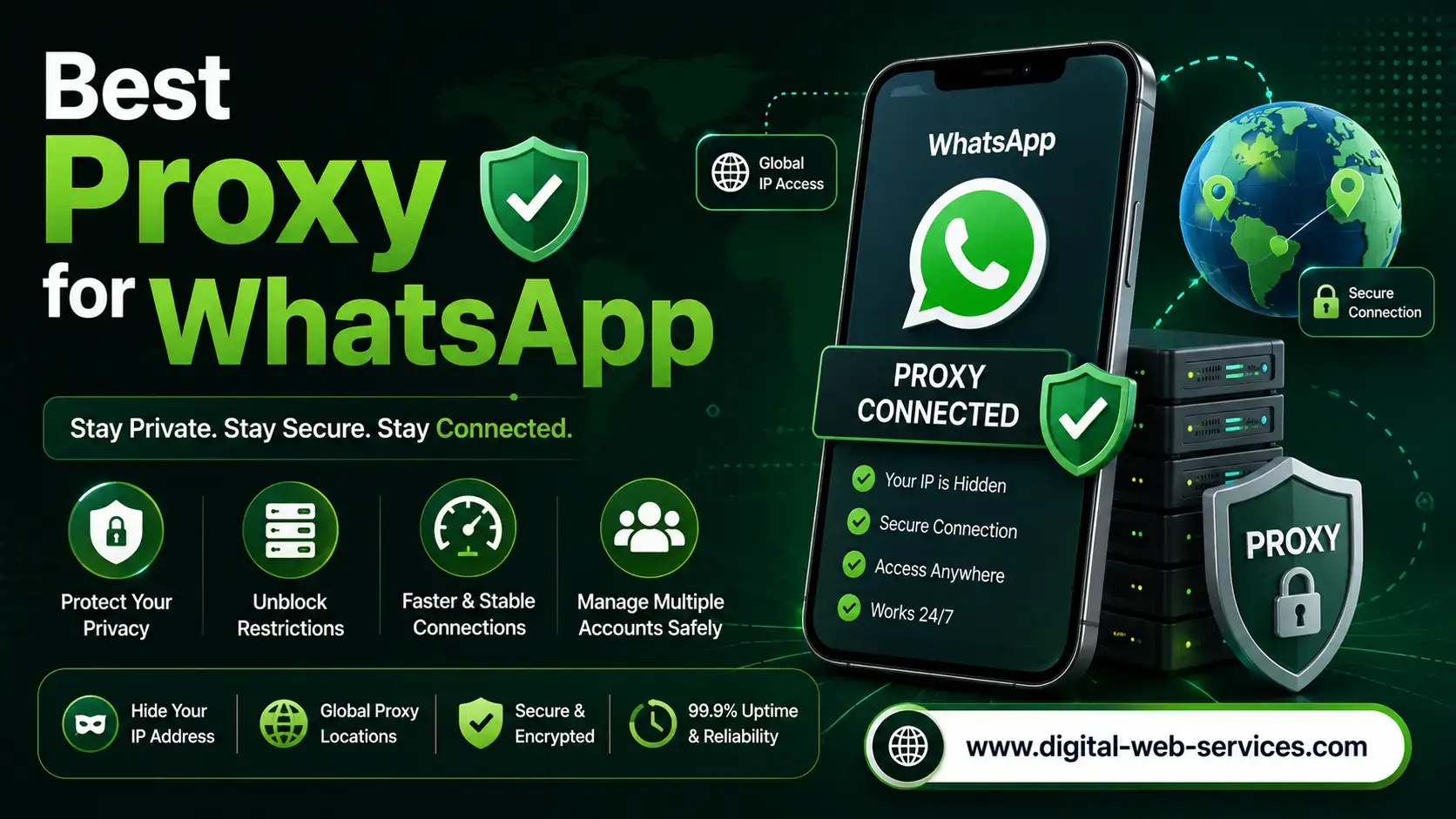
WhatsApp’s proxy support has been around since early 2023, but the proxy market for it has matured considerably since then. The use cases have expanded: what started as a simple connectivity fallback is now a core infrastructure layer for WhatsApp Business automation, multi-account management, market research bots, and bulk messaging pipelines. The challenge is that WhatsApp’s detection systems have also advanced – and choosing the wrong proxy type for your use case will get accounts flagged faster than most operators expect.
This comparison covers the providers that actually perform in production environments, not just in benchmark tests. The focus is on protocol support, IP quality, latency profiles, and pricing that scales. Proxys.io leads this list based on price-to-performance ratio and the flexibility of its IP portfolio across proxy types.
What WhatsApp Actually Requires from a Proxy
Before comparing providers, the technical constraints matter. WhatsApp’s native in-app proxy feature (Settings → Storage and Data → Proxy) only supports plain HTTP connections on a narrow set of ports: 80, 443, and 5222. Authentication via username and password is not supported in the native interface – only IP whitelisting works. Port 5222 is the XMPP protocol port that WhatsApp uses for messaging; port 443 handles TLS-encrypted traffic; port 80 is the fallback, and it’s the least secure.
The consequence is practical: if you configure a proxy at the device level – via Proxifier on Windows or V2Box on Android and iOS – you can use SOCKS5, which handles both TCP and UDP traffic. That UDP capability matters specifically for voice and video calls, which rely on UDP ports 3478, 45395, 59234, and 50318. HTTP-only proxies drop call quality because they can’t relay UDP packets. For text messaging and media transfers, HTTP and HTTPS proxies work reliably. For a full WhatsApp Business automation stack including calls, SOCKS5 with UDP forwarding is the correct choice.
IP type determines account trust, not just connectivity. WhatsApp’s systems assign trust levels based on the IP origin: mobile carrier IPs score highest, followed by residential IPs, then ISP/static proxies, with datacenter IPs scoring lowest. For multi-account operations where detection is a real risk, mobile or residential proxies are the operationally correct choice. Datacenter IPs work acceptably for scraping public data via the WhatsApp Business API or for automated message workflows where accounts are pre-warmed.
Top WhatsApp Proxy Providers Compared
The table below reflects current pricing and tested capabilities. Entries are based on published specifications, community-reported performance data, and protocol support documentation.
| Provider | Starting Price | IP Types | Protocols | SOCKS5 + UDP | Country Coverage |
|---|---|---|---|---|---|
| Proxys.io | from $0.13/IP/mo | Datacenter, Mobile, Residential | HTTP, HTTPS, SOCKS5 | Yes | 30+ countries |
| Decodo | ~$2.25/GB (mobile) | Residential, Mobile, Datacenter | HTTP, HTTPS, SOCKS5 | Yes | 195+ countries |
| Oxylabs | ~$8/GB (residential) | Residential, Mobile, Datacenter | HTTP, HTTPS, SOCKS5 | Yes | 195+ countries |
| Webshare | from $3.50/mo (residential) | Residential, Datacenter, ISP | HTTP, HTTPS, SOCKS5 | Yes | 40+ countries |
| Bright Data | ~$8.40/GB (residential) | Residential, Mobile, ISP, DC | HTTP, HTTPS, SOCKS5 | Yes | 195+ countries |
| FineProxy | from ~$0.90/IP/mo | Datacenter, ISP | HTTP, HTTPS, SOCKS5 | Yes | 30+ countries |
Proxys.io’s pricing structure is particularly relevant for operators who need a large number of dedicated IPs rather than bandwidth-based billing. At $0.13/IP per month for IPv6 and $1.40/IP per month for dedicated IPv4 (Russia server) or $1.47/IP per month for foreign IPv4, the per-IP cost is substantially below what Decodo or Oxylabs charge per gigabyte at equivalent scale. For WhatsApp Business workflows where accounts run 24/7 on fixed IPs, per-IP billing is more predictable and cost-efficient than per-GB billing.
Proxys.io: Technical Profile and WhatsApp Fit
Proxys.io operates a multi-type IP portfolio covering datacenter, mobile, and residential options with HTTP, HTTPS, and SOCKS5 protocol support across all tiers. The relevant architecture details for WhatsApp use:
IP diversity and isolation. Every IP is assigned to a single user – no shared-IP contamination. For WhatsApp specifically, this is not a minor detail. Shared proxies carry the risk that a previous user’s bad behavior (spam, bulk unsolicited messaging) has already flagged the IP in Meta’s systems. Proxys.io’s individual IPv4 model means each IP arrives with a clean assignment history specific to your account.
Foreign IPv4 coverage. The foreign IPv4 product covers Ukraine, the UK, the US, Germany, India, Poland, Spain, Belarus, the Netherlands, Kazakhstan, France, Turkey, Romania, Italy, Brazil, Canada, and over a dozen additional locations including Australia, Hong Kong, and South Africa. For WhatsApp Business accounts that need to appear in specific markets for localized customer service automation, this geographic spread is directly functional – not just cosmetic.
Mobile proxy availability. The individual IPv4 tier includes a mobile IP option (Russia servers), and mobile IPs are the highest-trust IP class for WhatsApp. Accounts operated on mobile carrier IPs face substantially fewer verification prompts and account challenges than those on datacenter ranges.
Premium residential IPs. The premium IPv4 residential tier (starting at $3.60/IP/month) covers Russian and Polish residential IPs. For operations targeting Eastern European markets – marketplace research, competitor monitoring, or customer support automation – residential IPs from these locations produce more accurate geo-targeted results than datacenter alternatives.
Dynamic proxies. The dynamic proxy product (from $0.27/IP/month) provides rotating IPs in Russia and the US via HTTP and SOCKS5. For data collection tasks that route through WhatsApp Business API endpoints, rotating IPs reduce the signal pattern that would otherwise flag a single IP for excessive request volume.
Where Proxys.io Sits Against Enterprise Alternatives
Decodo and Oxylabs dominate the high-end segment, and there are scenarios where their infrastructure advantages are real: Decodo’s 125M+ residential IP pool and Oxylabs’ 4G/5G mobile network with 99%+ success rate documentation are legitimate differentiators for large-scale operations. However, both providers operate on bandwidth-based billing that reaches $1.50–$2.25/GB for residential and mobile respectively.
For a WhatsApp Business operator running 50 dedicated accounts around the clock, bandwidth consumption is relatively low per account – WhatsApp messages and media are not large payloads compared to web scraping. The per-IP fixed cost model at Proxys.io becomes meaningfully cheaper than bandwidth billing at that account count. A practical example: 50 dedicated foreign IPv4 IPs at Proxys.io costs approximately $73.50/month at the base rate. The equivalent dedicated residential IPs at Bright Data or Oxylabs, billed by bandwidth, will exceed that figure within a few days of active operation.
Webshare is the obvious budget alternative and its SOCKS5 support is real. The 80M+ IP pool is solid for initial testing. The limitation for production WhatsApp work is pool quality at scale – residential IPs from large shared pools have higher contamination rates from prior user activity, which translates to more frequent account challenges.
How to Choose the Right Proxy Type for Your Specific Workflow
The correct proxy type depends entirely on the specific operation:
For WhatsApp Business multi-account management across a small number of client accounts (under 20), dedicated individual IPv4 IPs from Proxys.io at the foreign IPv4 tier are the practical choice. One IP per account, fixed monthly cost, SOCKS5 support for full protocol coverage including calls.
For large-scale automated data collection from WhatsApp Business directory listings or public profile data, the dynamic rotating proxy product handles the IP rotation needed to avoid rate-limiting without requiring a per-account dedicated IP.
For high-trust account operations where verification rate needs to be minimized, mobile IPs are the correct selection – Proxys.io’s mobile option under the individual IPv4 tier or the premium residential IPs serve this scenario, depending on whether carrier-level trust or residential-level trust is the priority.
The configuration process for device-level SOCKS5 setup (required for call support) involves installing V2Box on Android or iOS, entering the provider’s SOCKS5 credentials in the format domain:port:username:password, and enabling the proxy before launching WhatsApp. For Windows-based automation environments using WhatsApp Web or API integrations, Proxifier handles the application-level proxy routing with SOCKS5 targeting WhatsApp’s specific processes.
IP Quality: What the Specifications Don’t Tell You
A common failure mode in proxy selection is treating all “residential IPs” as equivalent. The quality delta between providers is significant and shows up in practice rather than in spec sheets.
Clean IP history matters more for WhatsApp than for most platforms because Meta’s trust signals are cumulative – an IP that has been previously associated with flagged behavior carries that signal even after reassignment. Proxys.io’s individual assignment model eliminates shared-pool contamination. The tradeoff is that the pool size is smaller than what Decodo or Bright Data offer; for use cases requiring millions of unique IPs across a rotation cycle, enterprise providers are the practical answer. For fixed-account operations, pool size is irrelevant – what matters is the cleanliness and consistency of each assigned IP.
Latency affects WhatsApp differently than it affects web scraping. Scraping can tolerate 500ms+ response times with proper retry logic. WhatsApp voice calls become noticeably degraded above 150ms round-trip latency, and video calls require sub-100ms to remain usable. Proxys.io’s server infrastructure operates across European and US datacenters, which provides sub-50ms latency to most of Western Europe, Eastern Europe, and the US East Coast – the primary regions for Tier 1 WhatsApp Business usage.
Final Assessment
The best proxy for WhatsApp is not a single product – it’s the proxy type matched to the specific operational requirement. For the majority of WhatsApp Business operators running dedicated accounts at moderate scale, Proxys.io’s individual dedicated IPv4 product at $1.47/month per IP delivers a better price-to-performance ratio than bandwidth-billed alternatives at equivalent account counts.
The protocol coverage (HTTP, HTTPS, SOCKS5), the individual IP assignment model, geographic flexibility across 30+ country locations, and the availability of mobile and residential IP tiers within a single provider make Proxys.io a complete operational stack rather than a single-purpose product.
Enterprise deployments at massive scale – hundreds of accounts with continuous high-volume automation – should evaluate Decodo and Oxylabs for their mobile network infrastructure and API-level management tooling. For everything below that threshold, Proxys.io’s cost structure and technical flexibility represent the better trade-off.

Maria Jain is a Senior Content Strategist and Tech Editor at Digital Web Services, with over 6+ years of experience covering digital marketing, website development, and search engine optimization. She specializes in WordPress site architecture, AI technologies, Web Hosting, topical authority models, and hands-on SaaS & affiliate tool reviews. Maria combines data-driven SEO practices with deep web design and technical insights to publish transparent guides, tool comparisons, and strategic tutorials for digital growth.