Answer Engine Optimization: How to Rank for Questions

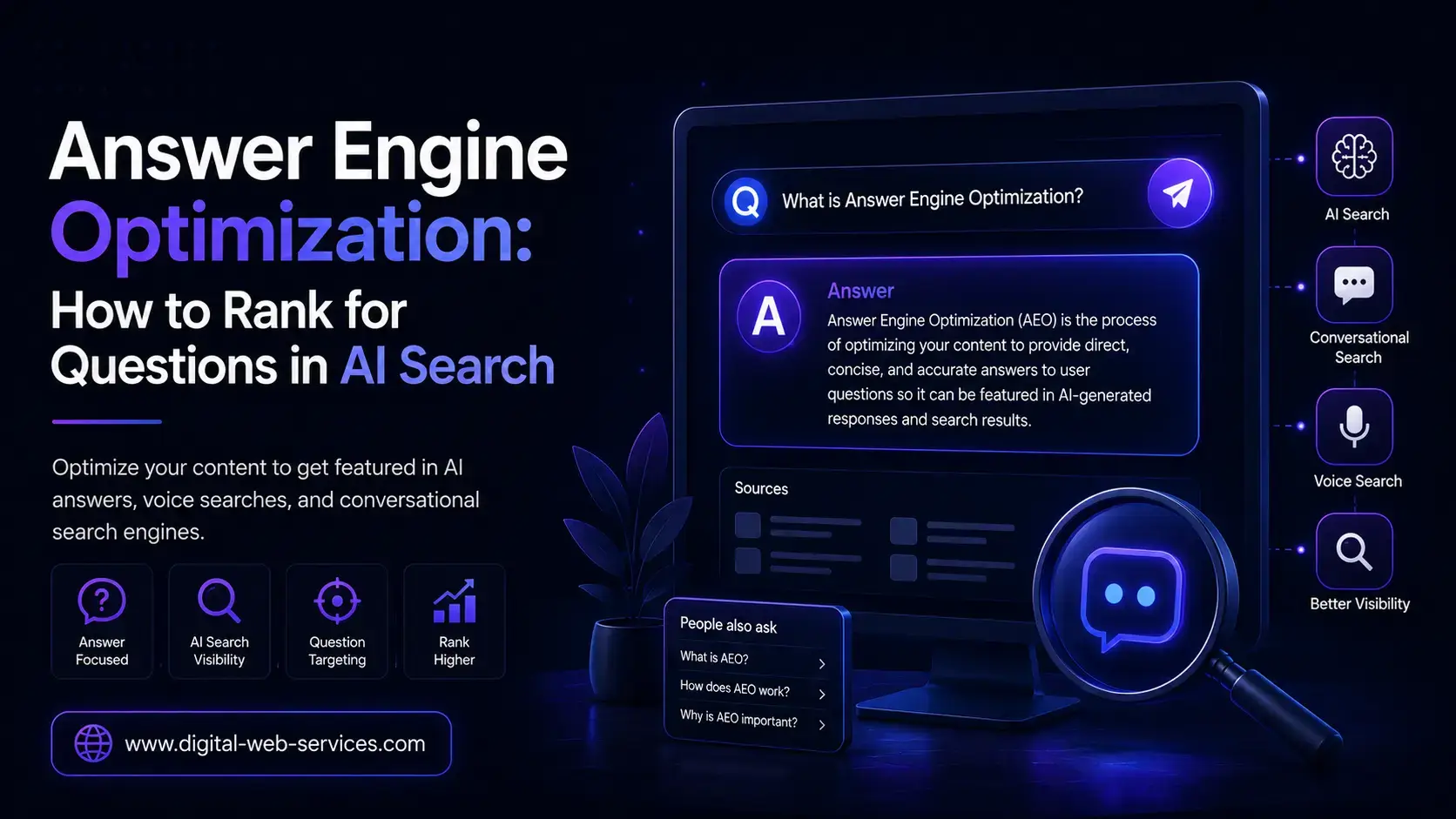
Answer Engine Optimization, or AEO, is the process of optimizing your content so search engines and AI tools can understand it, summarize it, and use it as a direct answer for user questions. Instead of only ranking for blue links, AEO helps your website appear in featured snippets, voice search answers, Google AI Overviews, ChatGPT-style responses, and other answer-based search experiences.
Today, people do not always search with short keywords. They ask full questions like “How does Answer Engine Optimization work?” or “How can I rank in AI Overviews?” This shift has changed SEO. Your content must now answer questions clearly, build trust, and provide information in a format that both humans and AI systems can easily understand.
If your business wants visibility in modern search, you need more than traditional SEO. You need content that answers real questions better than your competitors.
What Is Answer Engine Optimization?
Answer Engine Optimization is a content strategy that helps your website become the best possible source for direct answers. It focuses on clear definitions, question-based headings, short explanations, structured data, and trustworthy information.
Traditional SEO mainly focuses on ranking pages in search engine results. AEO focuses on helping search engines and AI answer engines extract useful information from your page.
For example, if someone searches “What is AEO in SEO?”, an answer engine wants a simple, direct, and reliable response. If your page explains the answer clearly in the first few lines, your content has a better chance of being used in search results, AI Overviews, featured snippets, or voice responses.
AEO is important for:
- Google AI Overviews
- Featured snippets
- People Also Ask results
- Voice search
- ChatGPT-style search experiences
- Gemini and other AI tools
- Zero-click search results
- Question-based SEO campaigns
In simple words, AEO helps your content become the answer, not just another search result.
Why Is AEO Important for Modern SEO?
AEO is important because search behavior is becoming more conversational. Users now search with complete questions, follow-up prompts, and natural language queries.
Earlier, a user might search:
“SEO services Delhi”
Now, the same user may search:
“What is the best SEO strategy for a small business in Delhi?”
This means your content must match user intent, not just keywords. Search engines want to show answers that are helpful, accurate, easy to read, and trustworthy.
Answer Engine Optimization improves your chances of appearing in:
- AI-generated search summaries
- Featured snippets
- FAQ sections
- Voice assistant answers
- Long-tail question searches
- Conversational search results
- High-intent informational queries
AEO is also useful because many users do not click multiple links anymore. They want fast answers. If your brand is cited, summarized, or shown as a trusted source, you can build authority even before the user visits your website.
How Does Answer Engine Optimization Work?
Answer Engine Optimization works by making your content easy for search engines, AI crawlers, and users to understand. It uses clear structure, direct answers, schema markup, and topic depth.
AEO works through five main steps:
- Understand the question users are asking.
- Give a short answer immediately.
- Explain the topic in simple language.
- Support the answer with examples, data, and experience.
- Use structure and schema so machines can understand the page.
For example, if your H2 heading is “How do you rank for questions?”, the first sentence below it should answer the question directly.
A weak answer starts with a long introduction.
A strong AEO answer starts like this:
“To rank for questions, use the exact question as a heading, give a clear answer in the first two sentences, and then expand with examples, lists, and supporting details.”
This format helps both users and AI systems.
How Can You Rank for Question-Based Searches?
To rank for question-based searches, create content around real user questions and answer each question clearly in a structured format. Use question keywords, short paragraphs, FAQ sections, internal links, and schema markup.
Question-based SEO works best when your content follows the way users naturally search. People usually ask questions starting with:
- What
- How
- Why
- When
- Where
- Which
- Can
- Should
- Is
- Does
Examples of AEO-friendly keywords include:
- What is Answer Engine Optimization?
- How does AEO work?
- Why is AEO important for SEO?
- How do I rank in Google AI Overviews?
- What is the difference between SEO and AEO?
- How can I optimize content for voice search?
- What is FAQ schema?
When you use these questions as H2 or H3 headings, your page becomes easier to scan. It also gives search engines a clear signal about the topic of each section.
The goal is not to add random questions. The goal is to answer the exact questions your audience already has.
What Is the Best Content Structure for AEO?
The best content structure for AEO is a question-first format. Each section should begin with a question, followed by a direct answer, then a deeper explanation.
A strong AEO structure looks like this:
H1: Main question or topic
Intro: Short answer and user pain point
H2: Question-based heading
First sentence: Direct answer
Body: Explanation, examples, steps, and proof
FAQ: Short answers to related questions
Schema: Structured data for better understanding
This structure helps answer engines quickly identify the most useful part of your content.
Here is a simple example:
Question: What is AEO?
Direct answer: AEO is the process of optimizing content so search engines and AI tools can use it as a direct answer.
Expansion: It improves visibility in featured snippets, AI Overviews, voice search, and conversational search results.
This format is simple, but powerful.
Why Should You Put the Answer First?
You should put the answer first because users and AI systems both look for quick clarity. This is called the inverted pyramid method, where the most important answer appears at the top.
Many websites lose ranking opportunities because they take too long to answer the question. They start with background, history, or promotional text. That may work for storytelling, but it is not ideal for Answer Engine Optimization.
For AEO, place the direct answer in the first one or two sentences.
Example:
Poor answer:
“In today’s digital world, many businesses are exploring new ways to improve online visibility as search technology continues to change.”
Better answer:
“Answer Engine Optimization helps your content appear as a direct answer in AI search, featured snippets, and voice search results.”
The second version is clearer. It gives the answer first. Then the rest of the section can explain the details.
How Do You Find the Right Questions for AEO?
To find the right questions for AEO, research what your audience asks before they buy, compare, learn, or solve a problem. Use search data, customer conversations, sales calls, competitor pages, People Also Ask, and keyword research tools.
Good question research should include three types of questions:
1. Informational Questions
These are early-stage questions.
Examples:
- What is Answer Engine Optimization?
- How does AI search work?
- What is question-based SEO?
2. Comparison Questions
These help users compare options.
Examples:
- AEO vs SEO: What is the difference?
- Is AEO better than traditional SEO?
- ChatGPT SEO vs Google SEO: What should businesses focus on?
3. Commercial Questions
These show buying intent.
Examples:
- Do I need AEO services for my business?
- How much does AI SEO cost?
- Which SEO agency offers AEO strategy?
AEO works best when you cover all stages of user intent. This builds topical authority and helps your website become a trusted source.
What Is the Difference Between SEO and AEO?
SEO helps your website rank in search engine results, while AEO helps your content become a direct answer to user questions. Both strategies work together.
Here is a simple comparison:
| Feature | SEO | AEO |
|---|---|---|
| Main Goal | Rank webpages | Answer questions directly |
| Search Style | Keywords | Natural language questions |
| Best Formats | Blogs, landing pages, guides | FAQs, definitions, lists, snippets |
| Visibility Area | Search results pages | AI Overviews, snippets, voice search |
| Content Focus | Ranking and traffic | Clarity, trust, and answer extraction |
| User Intent | Broad and specific | Highly specific questions |
SEO is still important. AEO does not replace SEO. It improves SEO by making your content clearer, more structured, and easier for AI systems to understand.
The best strategy is to combine traditional SEO, Answer Engine Optimization, and AI SEO.
How Can You Optimize Content for Google AI Overviews?
To optimize content for Google AI Overviews, write helpful content that answers complex questions clearly, uses original insights, and makes important information easy to find in text format.
AI Overviews usually appear when a query needs a helpful summary or explanation. This means your content should not only answer a question but also explain the topic in a useful way.
To improve your chances:
- Use question-based H2 and H3 headings.
- Add short answer blocks at the start of each section.
- Include examples, workflows, and practical steps.
- Make sure important content is visible as text, not only inside images.
- Add internal links to related topic pages.
- Use schema markup where relevant.
- Build topical authority with supporting articles.
- Keep your content updated.
- Show real expertise and business experience.
Do not write thin content just to target AI Overviews. AI search systems are designed to reward helpful, reliable, and complete information.
How Can You Optimize for Featured Snippets?
To optimize for featured snippets, answer the target question in 40 to 60 words, use clean formatting, and support the answer with lists, tables, or steps.
Featured snippets often appear for questions like:
- What is AEO?
- How does Answer Engine Optimization work?
- What are the benefits of AEO?
- How do you optimize for voice search?
A good featured snippet answer should be:
- Direct
- Simple
- Accurate
- Short
- Easy to quote
- Placed near the top of the section
Example:
What is Answer Engine Optimization?
Answer Engine Optimization is the process of creating and structuring content so search engines and AI tools can use it to answer user questions directly. It helps websites appear in featured snippets, AI Overviews, voice search, and conversational search results.
This answer is short, clear, and complete.
How Does Voice Search SEO Connect With AEO?
Voice search SEO connects with AEO because voice assistants also provide direct answers to spoken questions. When users ask voice-based queries, they usually expect one clear answer, not a list of links.
Voice searches are often longer and more natural than typed searches.
Examples:
- “What is the best way to optimize my website for AI search?”
- “How can a small business rank for questions on Google?”
- “Why is Answer Engine Optimization important?”
To optimize for voice search:
- Use conversational language.
- Write short answers.
- Add FAQ sections.
- Include local intent when relevant.
- Use clear definitions.
- Make your content mobile-friendly.
- Improve page speed and user experience.
AEO and voice search both reward clarity.
What Role Does E-E-A-T Play in AEO?
E-E-A-T stands for Experience, Expertise, Authoritativeness, and Trustworthiness. It helps users and search engines understand whether your content is reliable.
For AEO, E-E-A-T is very important because AI systems need trustworthy sources. If your content gives advice, explains a technical topic, or helps users make decisions, your page should show why readers can trust you.
You can improve E-E-A-T by adding:
- Author name and expertise
- Real examples from client work
- Updated publishing date
- Clear sources and references
- Case studies or practical experience
- Transparent service information
- Contact details and business information
- Internal links to related expert content
- Clear explanations without exaggeration
For example, instead of saying “AEO will guarantee AI rankings,” say “AEO can improve your chances of being understood, summarized, and cited by answer engines.”
Trust matters more than hype.
How Do Topic Clusters Help You Rank for Questions?
Topic clusters help you rank for questions by showing search engines that your website covers a subject deeply. Instead of writing one blog and stopping, you create a group of connected articles around one main topic.
For example, if your main topic is Answer Engine Optimization, your topic cluster can include:
- What is Answer Engine Optimization?
- AEO vs SEO: What is the difference?
- How to optimize for Google AI Overviews
- How to use FAQ schema for SEO
- How to write question-based content
- What is AI SEO and why is it important for businesses?
- How to optimize for voice search
- How to build topical authority
Each article should link to the others naturally. This helps users explore the topic and helps search engines understand your expertise.
A strong internal linking strategy also improves crawlability and topic relevance.
Suggested internal link placement:
“Businesses that want to grow in AI-driven search should also understand AI SEO for businesses, because AEO and AI SEO work together to improve visibility in modern search experiences.”
What Is a Practical AEO Workflow?
A practical AEO workflow starts with question research and ends with content testing, schema validation, and regular updates.
Here is a simple workflow businesses can follow:
Step 1: Find Real User Questions
Collect questions from Google Search Console, People Also Ask, sales calls, support tickets, Reddit, Quora, competitor blogs, and keyword tools.
Step 2: Group Questions by Intent
Separate questions into informational, commercial, comparison, and transactional intent.
Step 3: Create Question-Based Headings
Turn important questions into H2 and H3 headings.
Step 4: Answer First
Write a direct answer in the first one or two sentences of every section.
Step 5: Add Depth
Include examples, steps, tables, use cases, mistakes, and expert insights.
Step 6: Add Internal Links
Link to related blogs, service pages, case studies, and pillar pages.
Step 7: Add Schema Markup
Use FAQ schema, Article schema, Organization schema, or other relevant structured data.
Step 8: Improve Trust Signals
Add author details, update dates, proof, testimonials, and clear brand information.
Step 9: Monitor Performance
Track rankings, impressions, featured snippets, AI Overview visibility, click-through rate, and conversions.
Step 10: Refresh Content
Update old answers when search behavior, tools, or industry information changes.
This workflow helps your content stay useful for both users and search engines.
What Are Some Real Examples of AEO Content?
AEO content is usually clear, structured, and focused on solving one question at a time.
Here are a few examples:
Example 1: SaaS Business
Question: “What is the best CRM for small businesses?”
AEO format: Short answer, comparison table, feature breakdown, pricing notes, FAQs, and internal links to CRM guides.
Example 2: Healthcare Website
Question: “What are the symptoms of vitamin D deficiency?”
AEO format: Direct answer, symptom list, when to consult a doctor, medical reviewer details, and trusted references.
Example 3: Local Service Business
Question: “How much does SEO cost for a small business?”
AEO format: Price range, cost factors, service comparison, local examples, and CTA to request a quote.
Example 4: Digital Marketing Agency
Question: “How do I rank in AI search?”
AEO format: Definition, steps, AI Overview optimization tips, schema guidance, topical authority plan, and SEO service CTA.
The best AEO content does not only define a topic. It solves the next question the user is likely to ask.
What Are Common AEO Mistakes to Avoid?
Common AEO mistakes include writing vague introductions, ignoring user intent, using complex language, and adding FAQ schema that does not match visible content.
Avoid these mistakes:
- Writing long intros before answering the question
- Targeting keywords without understanding search intent
- Using generic AI-written content with no original insight
- Adding too many keywords unnaturally
- Forgetting internal links
- Ignoring schema markup
- Publishing thin FAQ pages
- Hiding important answers inside images
- Not updating old content
- Making claims without proof
- Using complex language when simple wording is better
AEO is not about tricking AI tools. It is about making your content genuinely useful, clear, and trustworthy.
How Can Businesses Measure AEO Success?
Businesses can measure AEO success by tracking visibility, engagement, and conversions from question-based searches.
Important AEO metrics include:
- Ranking for question keywords
- Featured snippet wins
- People Also Ask visibility
- Google AI Overview mentions
- Search Console impressions
- Click-through rate
- Organic traffic from long-tail queries
- Voice search visibility
- Engagement time
- Leads and conversions
- Branded search growth
- Internal link clicks
- FAQ section engagement
AEO results may not always look like traditional SEO results. Sometimes users discover your brand inside an AI summary before they click. This means brand visibility and authority are also important success signals.
How Often Should You Update AEO Content?
You should update AEO content every three to six months, or sooner if the topic changes quickly. AI search and SEO trends change often, so old content can lose accuracy.
Update your content when:
- Search intent changes
- Google updates search features
- New AI tools become popular
- Your competitors publish better answers
- Your service details change
- Your examples become outdated
- New customer questions appear
- Search Console shows falling impressions
Fresh content helps maintain trust. It also shows users and search engines that your website is active and reliable.
How Can AEO Help Service-Based Businesses?
AEO helps service-based businesses attract users who are asking problem-solving and buying-intent questions. These users are often closer to taking action.
For example, a business owner may search:
- “Why is my website not ranking on Google?”
- “How can I improve local SEO?”
- “Do I need AI SEO services?”
- “What is the best SEO strategy for lead generation?”
If your website answers these questions clearly, users are more likely to trust your brand. This can lead to more calls, form submissions, consultations, and service inquiries.
AEO is especially useful for:
- SEO agencies
- SaaS companies
- healthcare businesses
- legal firms
- finance companies
- real estate brands
- ecommerce websites
- education companies
- B2B service providers
- local businesses
The more clearly you answer user questions, the more useful your website becomes.
What Is the Future of Answer Engine Optimization?
The future of Answer Engine Optimization is closely connected to AI search, conversational search, and zero-click experiences. Users will continue asking longer, more specific questions, and search engines will continue looking for clear, trustworthy answers.
This does not mean websites will become less important. It means websites must become better sources.
Future-ready content will need:
- Strong topical authority
- Clear answer blocks
- Original insights
- Expert review
- Better structured data
- Natural language formatting
- Multimedia support
- Strong internal linking
- Updated information
- Real brand trust signals
Businesses that start AEO early can build authority before competition becomes stronger.
Final Thoughts: How Do You Start With Answer Engine Optimization?
To start with Answer Engine Optimization, choose one important topic, find the real questions users ask, and create a helpful page that answers those questions clearly. Use question-based headings, short answers, examples, internal links, and schema markup.
AEO is not a replacement for SEO. It is the next layer of SEO. It helps your content perform better in AI search, featured snippets, voice search, and question-based queries.
If your website already has blog posts, service pages, or FAQ pages, start by improving them. Add direct answers. Rewrite unclear sections. Add structured data. Build topic clusters. Link related pages together.
The businesses that win in AI search will be the ones that explain topics better, answer questions faster, and build trust consistently.
Need Help Ranking for Questions in AI Search?
Want your website to appear in question-based searches, featured snippets, Google AI Overviews, and AI-powered search results?
Our SEO experts can help you build a complete Answer Engine Optimization strategy with keyword research, question mapping, AI SEO content, technical SEO, schema markup, and topic authority planning.
Get a custom SEO and AEO strategy for your business today and turn your website into a trusted answer source.
FAQs About Answer Engine Optimization
1. What is Answer Engine Optimization?
Answer Engine Optimization is the process of optimizing content so search engines and AI tools can use it as a direct answer to user questions. It helps improve visibility in AI Overviews, featured snippets, voice search, and question-based search results.
2. How is AEO different from SEO?
SEO focuses on ranking webpages in search results, while AEO focuses on helping content become a direct answer. AEO uses clear answers, question headings, schema markup, and structured formatting to improve visibility in answer-based search experiences.
3. How do I rank for questions on Google?
To rank for questions on Google, use the question as a heading, answer it clearly in the first few sentences, add helpful details, use simple formatting, include related keywords naturally, and support the page with internal links and schema markup.
4. Does FAQ schema help with AEO?
FAQ schema can help search engines understand the question-and-answer content on your page. It does not guarantee rich results, but it can improve content clarity when the schema matches the visible content on the page.
5. Can AEO help my website appear in AI Overviews?
AEO can improve your chances of being understood and cited by AI-powered search systems. To increase your chances, publish helpful content, answer complex questions clearly, use original insights, add internal links, and keep important information visible in text format.
6. Is AEO useful for small businesses?
Yes, AEO is useful for small businesses because it helps them answer customer questions before a sales conversation starts. It can improve visibility for local, informational, and buying-intent searches.
7. What type of content works best for AEO?
The best AEO content includes FAQs, how-to guides, comparison posts, definition articles, step-by-step tutorials, service explainers, and topic clusters. Content should be clear, trustworthy, and easy to scan.
8. How long does it take to see results from AEO?
AEO results depend on website authority, content quality, competition, technical SEO, and keyword difficulty. Some improvements may appear in weeks, while stronger topic authority usually takes several months of consistent optimization.
Maria Jain is a Senior Content Strategist and Tech Editor at Digital Web Services, with over 6+ years of experience covering digital marketing, website development, and search engine optimization. She specializes in WordPress site architecture, AI technologies, Web Hosting, topical authority models, and hands-on SaaS & affiliate tool reviews. Maria combines data-driven SEO practices with deep web design and technical insights to publish transparent guides, tool comparisons, and strategic tutorials for digital growth.