What is Schema Markup and Why Does It Matter for AI Visibility?
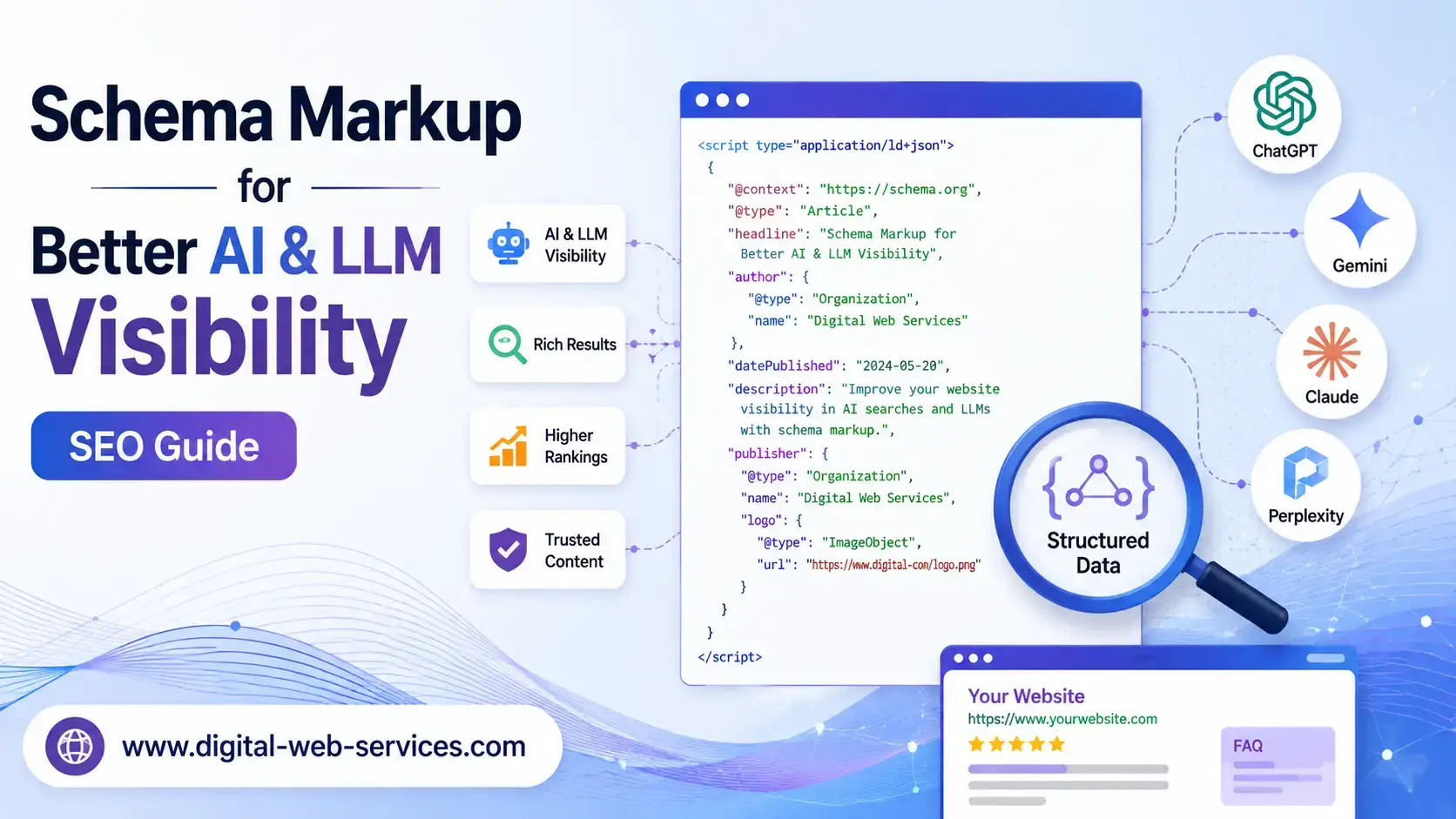
Schema markup is a type of structured data that helps search engines and AI systems understand your website content in a clear, machine-readable format. Instead of relying only on keywords, schema provides context—such as what your page is about, who created it, and how different elements are connected.
In today’s AI-driven search ecosystem, including Google AI Overviews, ChatGPT browsing, Perplexity AI, and Claude-based retrieval systems, schema markup plays a critical role in improving LLM visibility, SEO performance, and content citation rates.
Simply put, schema markup bridges the gap between human-readable content and AI-readable meaning. Websites that use structured data properly are more likely to appear in rich snippets, knowledge panels, and AI-generated answers.
How Does Schema Markup Improve LLM and AI Search Visibility?
Schema markup improves AI visibility by giving large language models (LLMs) a structured roadmap of your content. Instead of guessing meaning from raw text, AI systems can directly extract factual data.
Key Benefits for AI SEO and LLM Optimization:
- Improves semantic understanding of your content
- Increases chances of citations in AI Overviews
- Supports Generative Engine Optimization (GEO)
- Enhances Retrieval-Augmented Generation (RAG) accuracy
- Boosts rich results in Google Search
- Strengthens entity recognition for your brand
For example, when a page includes Article or FAQ schema, AI tools can instantly identify authors, topics, publication dates, and structured answers—making your content more trustworthy and retrievable.
Why Do LLMs Depend on Structured Data Like Schema Markup?
Large Language Models (LLMs) such as ChatGPT or Claude do not “browse” websites like humans. Instead, they rely on patterns, embeddings, and retrieval systems. Schema markup supports this by reducing ambiguity.
1. Reduces Hallucinations in AI Responses
Schema provides explicit facts. This helps AI systems avoid guessing or misinterpreting content, improving response accuracy.
2. Improves RAG (Retrieval-Augmented Generation) Performance
When AI tools fetch live or indexed web content, structured data acts like a map. It allows faster and more accurate extraction of key information.
3. Strengthens Entity Recognition
Schema connects your website to real-world entities like brands, authors, organizations, and products. This improves authority signals in AI search ecosystems.
4. Increases AI Citation Probability
Studies and SEO observations suggest that pages with strong structured data are significantly more likely to appear in AI-generated answers and summaries.
Which Schema Types Are Most Important for AI SEO and LLM Visibility?
Not all schema types have equal impact. For AI visibility and Generative Engine Optimization (GEO), some formats are more powerful than others.
1. Organization Schema
This establishes your brand identity, trust signals, and official entity information.
- Business name
- Logo
- Contact details
- Social profiles
Helps AI systems verify who you are.
2. Article Schema
Used for blog posts, guides, and informational pages.
- Author name
- Publish date
- Main topic
- Content structure
Improves content indexing and AI summarization.
3. FAQPage Schema
One of the most powerful schema types for AI Overviews.
- Converts content into Q&A format
- Increases featured snippet chances
- Improves voice search visibility
Pages with FAQ schema often perform strongly in AI-generated answers.
4. Product Schema
Essential for eCommerce and service-based websites.
- Pricing
- Availability
- Ratings
- Reviews
Helps AI tools recommend your products in comparison responses.
How to Implement Schema Markup Using JSON-LD?
The most recommended format for schema implementation is JSON-LD (JavaScript Object Notation for Linked Data). It is easy to implement and fully supported by Google and modern AI crawlers.
Step-by-Step Workflow:
- Identify your page type (Article, FAQ, Product, etc.)
- Choose the correct schema type from Schema.org
- Write JSON-LD structured data
- Embed it inside the
<script type="application/ld+json">tag - Validate using Google Rich Results Test
- Update schema whenever page content changes
What Tools Can Help You Create and Validate Schema Markup for AI Visibility?
Schema markup creation becomes much easier when you use the right tools. Instead of writing complex JSON-LD manually, modern SEO tools help you generate, test, and optimize structured data for better AI visibility, LLM SEO, and Google rich results.
These tools are especially useful for improving accuracy, reducing errors, and ensuring your schema is properly interpreted by search engines like Google and AI systems such as ChatGPT, Perplexity, and Claude.
Google Rich Results Test for Schema Validation
One of the most important tools for schema markup is the Google Rich Results Test. It allows you to check whether your structured data is eligible for rich results and AI-powered search features.
With this tool, you can:
- Validate JSON-LD schema code
- Detect errors and warnings
- Preview how your page may appear in Google search
This ensures your schema markup is technically correct and ready for AI-driven indexing.
Schema.org Validator for Technical Accuracy
The Schema.org Validator is the official tool used to verify structured data against schema standards.
It helps you:
- Confirm correct schema types (Article, FAQPage, Product, etc.)
- Identify missing or invalid properties
- Ensure compliance with structured data guidelines
This tool is essential for maintaining high-quality schema that improves LLM understanding and semantic SEO performance.
Schema Markup Generators for Fast Implementation
If you are not comfortable coding JSON-LD manually, schema generators can save a lot of time.
Tools like Merkle Schema Generator and TechnicalSEO.com Schema Builder allow you to:
- Generate FAQ, Article, Product, and Organization schema
- Fill in simple form fields instead of coding
- Instantly copy ready-to-use JSON-LD code
These tools are widely used by SEO professionals to speed up Generative Engine Optimization (GEO) workflows and ensure consistent structured data across websites.
Google Structured Data Markup Helper for Beginners
For users who are new to schema markup, the Google Structured Data Markup Helper is very useful.
It works by allowing you to:
- Highlight elements on your webpage
- Assign schema properties visually
- Automatically generate structured data
This tool is ideal for beginners who want to improve AI SEO visibility without coding experience.
WordPress SEO Plugins for Automated Schema
If your website is built on WordPress, plugins like Rank Math SEO and Yoast SEO can automatically handle schema markup.
These plugins allow you to:
- Add Article, FAQ, Product, and Local Business schema easily
- Auto-generate structured data for every post
- Maintain consistent schema across your entire website
This is one of the easiest ways to scale schema implementation for large SEO-driven websites and content platforms.
What Are the Best Practices for Schema Markup in 2026?
To improve AI visibility and SEO performance, schema markup must be implemented correctly and consistently.
1. Match Schema With Visible Content
Never add hidden or misleading data. AI systems validate consistency between schema and page content.
2. Use Complete Metadata
Add optional fields like:
- dateModified
- author
- publisher
- imageThese strengthen trust signals for LLMs.
3. Keep Schema Updated
Whenever content changes, update schema instantly. Outdated structured data can reduce AI trust.
4. Validate Before Deployment
Use tools like:
- Google Rich Results Test
- Schema.org Validator
5. Focus on Entity SEO
Connect schema to real-world entities such as your brand, founders, or products to build authority.
What Are Common Mistakes in Schema Markup?
Many websites fail to gain AI visibility due to incorrect schema usage.
Common Errors:
- Missing required fields
- Incorrect schema type selection
- Duplicate or conflicting schema
- Not updating structured data after content changes
- Overloading irrelevant properties
Avoiding these mistakes significantly improves your chances of appearing in AI-powered search results.
How Does Schema Fit Into SEO, GEO, and AEO?
Modern search optimization is no longer just SEO. It includes:
- SEO (Search Engine Optimization) → Ranking in Google search
- AEO (Answer Engine Optimization) → Featured snippets and voice search
- GEO (Generative Engine Optimization) → AI-generated answers and LLM citations
Schema markup supports all three by making your content machine-readable, structured, and context-aware.
FAQs: Schema Markup for AI and LLM Visibility
1. What is schema markup in simple terms?
Schema markup is structured data added to a website that helps search engines and AI understand the content more clearly.
2. Does schema markup help with AI SEO?
Yes, schema improves AI SEO by enhancing content understanding, increasing visibility in AI Overviews, and improving citation chances.
3. Which schema is best for LLM visibility?
FAQPage, Article, Organization, and Product schema are most effective for LLM visibility and generative search optimization.
4. How does schema help Google AI Overviews?
It organizes content into structured formats that AI can easily extract, improving chances of being included in AI-generated summaries.
5. Is JSON-LD required for schema markup?
JSON-LD is the recommended format because it is easy to implement and fully supported by Google and AI systems.
6. Can schema improve website rankings?
Yes, indirectly. Schema improves indexing, CTR, rich results, and AI visibility, all of which support better rankings.
Final Thoughts
Schema markup is no longer optional in modern SEO. It is a core foundation of AI visibility, LLM optimization, and Generative Engine Optimization (GEO). Websites that implement structured data correctly gain a significant advantage in search engines and AI-driven platforms.
By combining JSON-LD schema, entity optimization, and structured content design, you can make your website more understandable for both search engines and AI systems—leading to higher visibility, better rankings, and increased citation potential in AI answers.

Maria Jain is a Senior Content Strategist and Tech Editor at Digital Web Services, with over 6+ years of experience covering digital marketing, website development, and search engine optimization. She specializes in WordPress site architecture, AI technologies, Web Hosting, topical authority models, and hands-on SaaS & affiliate tool reviews. Maria combines data-driven SEO practices with deep web design and technical insights to publish transparent guides, tool comparisons, and strategic tutorials for digital growth.