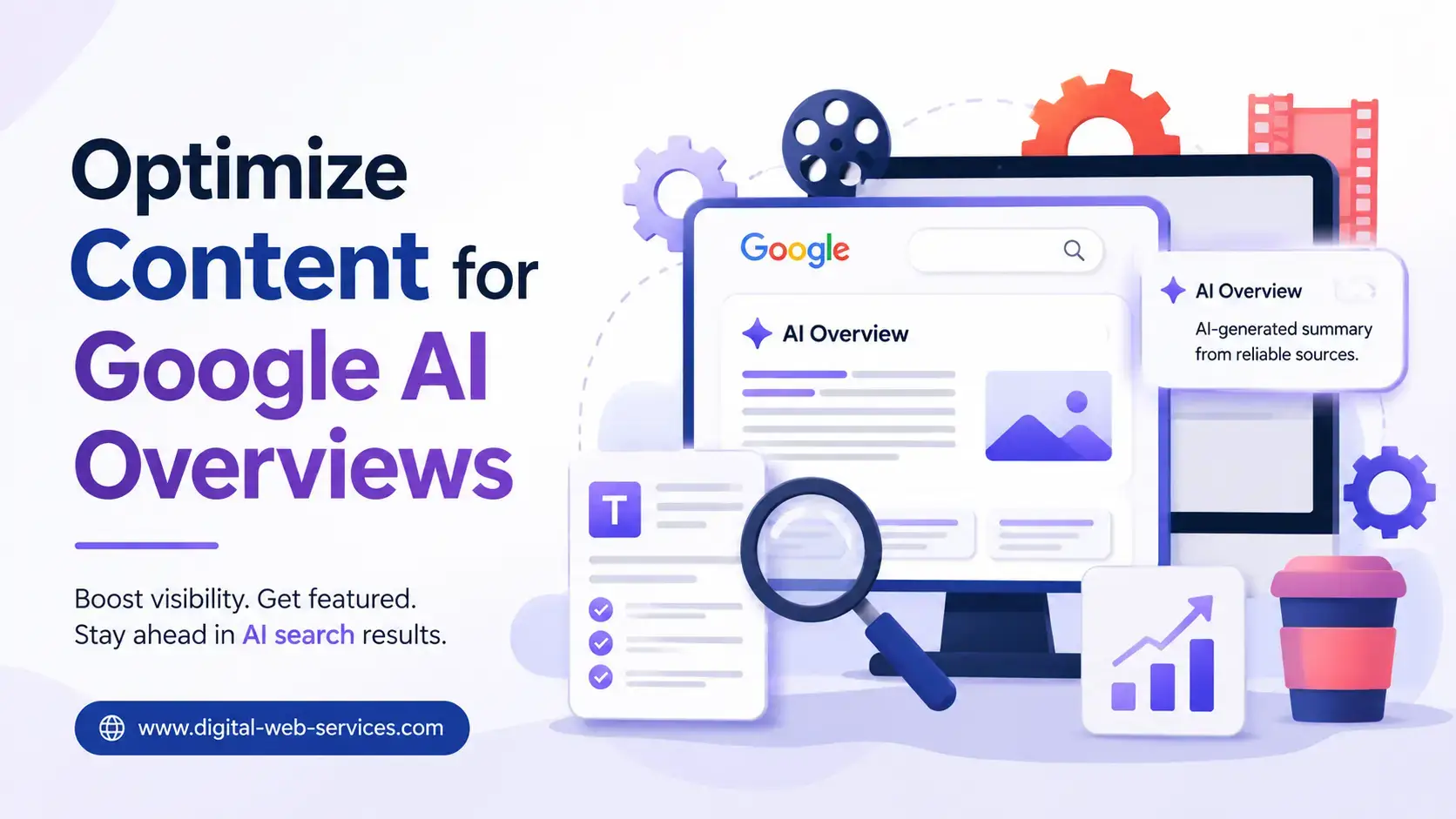
To optimize content for Google AI Overviews, write clear answers, use question-based headings, cover search intent deeply, and make your page easy for both users and search engines to understand. Your content should be helpful, trustworthy, well-structured, and based on real expertise.
Google AI Overviews do not simply pick content because it has keywords. They look for useful information that answers a search query in a simple and complete way. This means your content must give direct answers, explain the topic clearly, and show why your page is reliable.
If your content is thin, copied, confusing, or only written for ranking, it may struggle. But if your content is clear, original, experience-based, and easy to scan, it has a better chance of being used in AI-powered search results.
What Are Google AI Overviews?
Google AI Overviews are AI-generated summaries that appear in Google Search for some queries. They help users understand a topic quickly by combining helpful information from different web sources.
For example, when someone searches “how to optimize content for Google AI Overviews,” Google may show a short AI summary with key steps such as:
- Answer the question directly.
- Use clear headings.
- Add helpful examples.
- Build trust with author details and sources.
- Improve technical SEO.
- Add structured data where useful.
AI Overviews are especially common for informational searches, comparison searches, how-to searches, and complex questions. This is why businesses, bloggers, and SEO teams now need to think beyond traditional SEO and optimize for AI-driven search experiences.
Why Is AI Overview Optimization Important for SEO?
AI Overview optimization is important because search behavior is changing. Users now ask longer, more detailed, and more conversational questions. Instead of typing only short keywords, they search things like:
- “How can I optimize my blog for Google AI Overviews?”
- “What makes content appear in AI search results?”
- “How do I structure content for AI SEO?”
- “Does schema markup help AI Overviews?”
- “How can businesses rank in AI-powered Google Search?”
This means your content must answer real questions, not just target keywords.
AI Overview SEO can help your website:
- Increase visibility in AI-powered search results.
- Build topical authority.
- Improve organic traffic quality.
- Attract users with stronger search intent.
- Make your content easier to understand.
- Support featured snippet and answer-based rankings.
- Strengthen brand trust and expertise.
AI SEO is not about tricking Google. It is about making your content more helpful, clear, and reliable.
What Type of Content Gets Picked for Google AI Overviews?
Content that gets picked for Google AI Overviews usually has one strong quality: it answers the user’s question better than other pages.
Good AI Overview-friendly content often includes:
- A direct answer near the top.
- Simple language.
- Short paragraphs.
- Clear H2 and H3 headings.
- Step-by-step explanations.
- Helpful examples.
- Fresh and accurate information.
- Original insights or first-hand experience.
- Trust signals like author name, credentials, sources, and update date.
- Good technical SEO and crawlability.
Google’s AI systems try to understand which pages are useful, relevant, and reliable. So your content should not feel generic. It should offer something extra that users cannot easily find everywhere else.
How Should You Start Content for AI Overviews?
Start with the answer first. This is one of the most important rules for AI Overview optimization.
Many websites take too long to answer the main question. They begin with a long introduction, background story, or general explanation. This can make it harder for users and search systems to quickly understand the value of the page.
A better structure is:
Question: How do you optimize content for Google AI Overviews?
Direct Answer: To optimize content for Google AI Overviews, write clear answers, use question-based headings, match search intent, add original insights, improve E-E-A-T, and make your content easy to scan.
This style is called “bottom line up front.” It gives the answer first, then explains the details.
Use this format in every important section of your article:
- Ask a question in the heading.
- Give the short answer in the first 1–2 sentences.
- Explain with examples, steps, or bullet points.
This makes your content easier to read and easier to extract for AI-powered answers.
How Do Question-Based Headings Help AI Overviews?
Question-based headings help because many AI Overview results are triggered by question-style searches. When your headings match real user questions, Google can better understand which part of your content answers which query.
Instead of writing vague headings like:
- “Content Strategy”
- “SEO Tips”
- “Best Practices”
- “Technical Factors”
Use clear question-based headings like:
- “How Do You Optimize Content for Google AI Overviews?”
- “What Type of Content Appears in AI Overviews?”
- “Does Schema Markup Help AI Overview SEO?”
- “How Can You Build E-E-A-T for AI Search?”
- “How Often Should You Update AI SEO Content?”
This format improves readability and helps your content match natural search queries.
Question-based headings also work well for featured snippets, People Also Ask, voice search, and answer engine optimization.
How Can You Match Search Intent for AI Overview SEO?
To match search intent, understand what the user really wants before writing. Search intent is the reason behind a search query.
For this topic, the user may want to know:
- What Google AI Overviews are.
- How to optimize content for AI Overviews.
- Which SEO techniques still work.
- How to structure headings and answers.
- Whether schema markup helps.
- How to improve E-E-A-T.
- How to measure AI search visibility.
A strong article should cover all these points in one helpful flow.
There are four main types of search intent:
1. Informational Intent
The user wants to learn something.
Example: “What are Google AI Overviews?”
2. How-To Intent
The user wants a process or step-by-step guide.
Example: “How to optimize content for Google AI Overviews?”
3. Commercial Intent
The user is comparing services or looking for expert help.
Example: “Best AI SEO services for businesses.”
4. Problem-Solving Intent
The user has a problem and wants a fix.
Example: “Why is my content not appearing in AI Overviews?”
Your content should satisfy the main intent first, then support related intents naturally.
What Is the Best Content Structure for Google AI Overviews?
The best content structure for Google AI Overviews is simple, logical, and easy to scan. AI systems and users both prefer content that is organized clearly.
Use this structure:
1. Short Introduction
Explain the topic and answer the main question quickly.
2. Direct Answer Section
Give a quick summary of the solution in simple words.
3. Step-by-Step Guide
Break the process into clear steps.
4. Examples
Show how the advice works in real content.
5. E-E-A-T Section
Show experience, expertise, authority, and trust.
6. Technical SEO Section
Explain crawlability, schema, page speed, and indexing.
7. FAQ Section
Answer common questions in short, featured-snippet-friendly language.
8. CTA Section
Guide users to take the next action.
This structure improves user experience and makes the page more useful.
How to Optimize Content for Google AI Overviews Step by Step
Here is a simple workflow you can follow.
Step 1: Research Real User Questions
Start by collecting questions your audience is already asking. AI Overviews often respond to natural questions, so your content should be built around real search behavior.
You can find questions from:
- Google autocomplete.
- People Also Ask.
- Related searches.
- Search Console queries.
- Customer support questions.
- Sales team questions.
- Reddit and Quora discussions.
- Competitor FAQ sections.
- Internal website search data.
Example questions for this topic:
- How do I optimize content for Google AI Overviews?
- What is AI Overview SEO?
- Does schema help AI Overviews?
- How do I make content AI-friendly?
- What content format works best for AI search?
- How can I improve E-E-A-T for AI SEO?
Once you collect the questions, group them by theme. Then use them as H2 and H3 headings.
Step 2: Give a Clear Answer First
After every heading, answer the question directly. Do not make the reader wait.
Example:
Bad Answer:
There are many changes happening in SEO today. Google has introduced new features, and marketers must understand them carefully.
Better Answer:
To optimize content for Google AI Overviews, give a direct answer first, then support it with steps, examples, expert insights, and trusted sources.
The second answer is clearer. It gives value immediately.
This helps readers. It also makes your content easier to understand for search systems.
Step 3: Use Simple English
Simple writing is powerful for AI SEO. If your content is hard to understand, users may leave quickly.
Use:
- Short sentences.
- Common words.
- Clear examples.
- Active voice.
- Short paragraphs.
- Bullet points where helpful.
Avoid:
- Unnecessary jargon.
- Long blocks of text.
- Complicated explanations.
- Keyword stuffing.
- Repeating the same idea again and again.
For example, instead of writing:
“Implement semantic enrichment methodologies to facilitate machine-readable topical comprehension.”
Write:
“Use related terms and clear explanations so Google can understand your topic better.”
Simple content does not mean basic content. It means expert content explained clearly.
Step 4: Add Original Insights
Original insights are one of the biggest differences between average content and AI Overview-friendly content.
Many SEO articles repeat the same advice. They say, “Write helpful content,” “Use keywords,” and “Add headings.” That is not enough anymore.
To make your content stronger, add information gain.
Information gain means your page gives something extra that users cannot easily find on other websites.
You can add information gain through:
- Real examples.
- First-hand experience.
- Case studies.
- Screenshots.
- Expert opinions.
- Original data.
- Before-and-after comparisons.
- Templates.
- Checklists.
- Mistakes to avoid.
- Industry-specific advice.
Example:
Instead of only saying, “Use clear headings,” show this:
Weak Heading: SEO Tips
Better Heading: How Do You Write Headings for Google AI Overviews?
This small example gives practical value. It helps the reader understand exactly what to do.
Step 5: Build Topical Authority
Topical authority means your website covers a subject deeply, not just with one article.
If you want to rank for AI SEO and Google AI Overviews, publish a group of related articles. Then link them together naturally.
For example, create supporting articles like:
- What Is AI SEO and Why Is It Important for Businesses?
- How Schema Markup Helps AI SEO
- How to Write Content for Answer Engine Optimization
- What Is Generative Engine Optimization?
- AI SEO vs Traditional SEO
- How to Track AI Search Visibility
- How to Improve E-E-A-T for SEO
This helps Google understand that your website is not just writing one random article. It shows that your site has depth around the topic.
Use internal links with descriptive anchor text.
Examples:
- AI SEO for businesses
- schema markup for AI SEO
- content optimization for AI search
- answer engine optimization strategy
- Google AI search optimization
Avoid generic anchor text like “click here” or “read more.”
Step 6: Optimize for Semantic SEO
Semantic SEO means covering the full meaning of a topic, not just repeating one keyword.
For example, if your main keyword is “Google AI Overviews optimization,” related terms may include:
- AI Overview SEO
- generative AI search
- AI-powered search results
- search intent
- answer-based content
- topical authority
- featured snippets
- structured data
- entity SEO
- E-E-A-T
- helpful content
- content freshness
- crawlability
Use these terms naturally in your content. Do not force them.
Google understands related words and concepts. So instead of repeating the same keyword too many times, explain the topic fully.
A good keyword strategy for AI Overview SEO should include:
- Main keyword in title.
- Main keyword in introduction.
- Related keywords in headings.
- Natural keyword use in body text.
- Keywords in image alt text.
- Descriptive internal link anchors.
- Clear meta title and meta description.
The goal is not high keyword density. The goal is strong topic coverage.
Step 7: Improve E-E-A-T Signals
E-E-A-T stands for Experience, Expertise, Authoritativeness, and Trustworthiness. It is especially important for content that gives advice, explains important decisions, or affects money, health, business, or safety.
To improve E-E-A-T for AI Overview optimization, add visible trust signals.
Experience
Show that the content is based on real work or practical knowledge.
Examples:
- “Based on our SEO audits…”
- “In our content optimization process…”
- “From reviewing business blogs…”
- “After analyzing Search Console data…”
Expertise
Show that the author understands the topic.
Add:
- Author bio.
- Job title.
- Industry experience.
- Certifications.
- LinkedIn profile.
- Portfolio or case studies.
Authoritativeness
Build authority through strong content and external recognition.
Use:
- Expert quotes.
- Brand mentions.
- Case studies.
- Research references.
- Quality backlinks.
- Topic clusters.
Trustworthiness
Make the page transparent and reliable.
Add:
- Updated date.
- Clear sources.
- Contact details.
- Privacy policy.
- Editorial policy.
- No exaggerated claims.
- Honest limitations.
For example, do not say, “We guarantee your content will appear in Google AI Overviews.” No one can guarantee that.
A better statement is: “These steps can improve your chances of being understood, trusted, and selected by AI-powered search systems.”
Step 8: Use Structured Data and Schema Markup
Structured data helps search engines understand your page more clearly. It does not guarantee AI Overview placement, but it can support better content understanding and rich result eligibility where supported.
Useful schema types may include:
- Article schema.
- BlogPosting schema.
- Organization schema.
- Person schema.
- BreadcrumbList schema.
- Product schema.
- LocalBusiness schema.
- VideoObject schema.
- FAQPage schema, where still relevant for your content ecosystem.
For this topic, you can use Article schema and FAQPage schema if the FAQs are visible on the page.
Important rule: your schema should match the visible content. Do not add fake FAQs, fake reviews, fake authors, or hidden information.
Schema should support the page, not manipulate search results.
Step 9: Add Helpful Images and Videos
Images and videos can make your content more useful. They also help explain complex ideas quickly.
For an article about Google AI Overviews, you can add:
- A flowchart showing the AI content optimization process.
- A checklist image for AI SEO.
- A screenshot-style example of question-based headings.
- A short video explaining how to structure content.
- A visual comparison of traditional SEO vs AI SEO.
Use descriptive file names and alt text.
Example image file name:
google-ai-overviews-content-optimization-checklist.png
Example alt text:
Checklist showing how to optimize content for Google AI Overviews using clear answers, E-E-A-T, schema markup, and internal links.
Good visuals improve user engagement and make your content easier to understand.
Step 10: Make Your Content Crawlable and Indexable
Your content cannot appear in Google AI Overviews if Google cannot properly crawl and index it.
Check these basics:
- The page is not blocked by robots.txt.
- The page is indexable.
- The canonical tag is correct.
- Internal links point to the page.
- The page loads properly on mobile.
- Important content is visible in HTML.
- JavaScript is not hiding key content.
- Images have alt text.
- The page has a clear title tag and meta description.
- The page is included in the XML sitemap.
Technical SEO is still important. Even the best content can fail if Google cannot access it properly.
Step 11: Keep Content Fresh
AI Overview optimization is not a one-time task. Search results, user questions, and Google features change over time.
Update your content regularly.
Refresh:
- Statistics.
- Screenshots.
- Examples.
- FAQs.
- Internal links.
- External references.
- Author bio.
- CTA.
- Schema markup.
- Search Console query data.
Add a “Last Updated” date near the top of the article. This helps users know the content is current.
For fast-changing topics like AI SEO, review the article every 2–3 months.
Step 12: Measure Performance
You cannot directly control whether Google uses your content in an AI Overview. But you can track signs that your AI SEO strategy is working.
Monitor:
- Organic impressions.
- Organic clicks.
- Average position.
- Queries with question words.
- Featured snippet wins.
- People Also Ask visibility.
- Brand search growth.
- Engagement rate.
- Scroll depth.
- Conversions.
- Internal link clicks.
- Ranking improvements for long-tail queries.
Use Google Search Console to find questions people use to reach your site. Then improve your content around those questions.
Example:
If Search Console shows impressions for “how to optimize for AI Overviews” but low clicks, update your title, meta description, intro, and answer section.
Real Example: Before and After AI Overview Optimization
Here is a simple example of how to improve a weak section.
Before
AI SEO Tips
AI SEO is important because Google is changing. Businesses need to optimize content for better results. Use keywords and write good content.
After
How Do You Optimize Content for AI SEO?
To optimize content for AI SEO, answer user questions clearly, use natural keywords, build topical authority, add E-E-A-T signals, and make your page easy for search engines to crawl.
Start by finding real user questions. Then create sections that answer each question in simple words. Add examples, internal links, author details, and schema markup to make the page more useful and trustworthy.
Why the second version is better:
- It uses a question-based heading.
- It gives a direct answer first.
- It includes related SEO terms naturally.
- It explains what to do next.
- It is easier to read.
- It better matches search intent.
This is the kind of improvement that supports AI Overview optimization.
Common Mistakes to Avoid When Optimizing for Google AI Overviews
Many websites fail because they focus on shortcuts instead of real value.
Avoid these mistakes:
1. Writing Only for Keywords
Keywords matter, but they are not enough. Your content must answer the query fully.
2. Copying Competitor Content
If your article says the same thing as every other page, it has low information gain.
3. Using Long Introductions
Answer the main question quickly. Do not delay the value.
4. Ignoring E-E-A-T
Add author details, sources, update dates, and real examples.
5. Adding Weak FAQs
FAQs should answer real questions. Do not add them only for SEO.
6. Overusing AI Content
AI tools can help with structure, but human review, experience, and accuracy are essential.
7. Forgetting Technical SEO
Your page must be crawlable, indexable, mobile-friendly, and fast.
8. No Internal Links
Internal links help build topical authority and guide users to related pages.
9. No Original Examples
Examples make content more useful and easier to trust.
10. Making Claims Without Proof
Avoid big promises. Support your points with experience, data, or trusted sources.
Practical AI Overview Content Optimization Workflow
Use this workflow before publishing any blog post.
Research Stage
- Find the main keyword.
- Collect People Also Ask questions.
- Review Search Console queries.
- Identify user intent.
- Check competitor content gaps.
- Build a topic outline.
Writing Stage
- Use a question-based H1.
- Add a direct answer in the introduction.
- Use short paragraphs.
- Add bullet points and numbered steps.
- Include semantic keywords.
- Add examples and insights.
- Include internal links.
- Add a strong CTA.
Trust Stage
- Add author name and bio.
- Mention experience where relevant.
- Add sources.
- Include last updated date.
- Check facts.
- Avoid exaggerated claims.
Technical Stage
- Optimize title tag.
- Write meta description.
- Add schema markup.
- Compress images.
- Add alt text.
- Check indexability.
- Add the page to sitemap.
- Test mobile experience.
Update Stage
- Review rankings.
- Check new queries.
- Add missing answers.
- Update old information.
- Improve weak sections.
- Add new internal links.
This process helps your content perform better in traditional SEO and AI-powered search.
How Long Should AI Overview-Friendly Content Be?
There is no perfect word count for Google AI Overviews. The right length depends on the topic and user intent.
A simple question may need only 500–800 words. A complex topic like AI SEO may need 1,500–3,000 words or more.
Instead of asking, “How long should the article be?” ask:
- Did I answer the main question?
- Did I cover related questions?
- Did I add examples?
- Did I explain the process clearly?
- Did I add unique insights?
- Did I remove repeated or unnecessary text?
- Did I make it easy to scan?
Helpful content should be complete, but not bloated.
How Can Businesses Benefit from AI Overview Optimization?
Businesses can benefit from AI Overview optimization by becoming more visible when users search for solutions, comparisons, and expert advice.
For example:
- A SaaS company can answer product comparison questions.
- A local business can answer service-area questions.
- An ecommerce brand can answer buying guide questions.
- A healthcare website can answer patient education questions.
- A finance website can explain complex topics in simple language.
- A digital marketing agency can rank for AI SEO and SEO service queries.
AI Overview optimization helps businesses attract users earlier in the decision journey. It also builds trust before the user even clicks.
When your content answers questions clearly, users are more likely to see your brand as helpful and reliable.
Need Help Optimizing Your Content for Google AI Overviews?
Want your website content to perform better in Google Search, AI Overviews, and AI-powered search results?
Our SEO team can help you create clear, helpful, and search-optimized content that matches user intent, improves topical authority, and builds trust with your audience.
From AI SEO strategy and content optimization to schema markup, technical SEO, and blog content planning, we help businesses grow organic visibility with a practical and result-focused approach.
Contact us today to get an AI SEO content audit and start improving your website for the future of search.
FAQs About Optimizing Content for Google AI Overviews
1. What is Google AI Overview optimization?
Google AI Overview optimization is the process of improving your content so it can be better understood, trusted, and selected by Google’s AI-powered search features. It includes clear answers, simple structure, helpful information, E-E-A-T signals, semantic SEO, and technical SEO.
2. How do I optimize my content for Google AI Overviews?
To optimize content for Google AI Overviews, answer the main question early, use question-based headings, write in simple language, add original examples, improve E-E-A-T, use internal links, add structured data, and make sure your page is crawlable and indexable.
3. Does schema markup help with AI Overviews?
Schema markup can help search engines understand your content more clearly, but it does not guarantee placement in Google AI Overviews. Use schema only when it matches visible page content and supports the user experience.
4. Are keywords still important for AI SEO?
Yes, keywords are still important, but they should be used naturally. AI SEO works best when you combine primary keywords with related terms, user questions, search intent, and complete topic coverage.
5. Can AI-generated content appear in Google AI Overviews?
AI-assisted content can perform well if it is accurate, helpful, original, and reviewed by humans. Content should not be published only to manipulate rankings. Add human experience, examples, expert review, and trust signals before publishing.
6. How often should I update content for AI Overview SEO?
For fast-changing topics like AI SEO, review and update your content every 2–3 months. Update examples, FAQs, internal links, sources, schema markup, and search intent coverage to keep the page useful and current.

Maria Jain is a Senior Content Strategist and Tech Editor at Digital Web Services, with over 6+ years of experience covering digital marketing, website development, and search engine optimization. She specializes in WordPress site architecture, AI technologies, Web Hosting, topical authority models, and hands-on SaaS & affiliate tool reviews. Maria combines data-driven SEO practices with deep web design and technical insights to publish transparent guides, tool comparisons, and strategic tutorials for digital growth.