
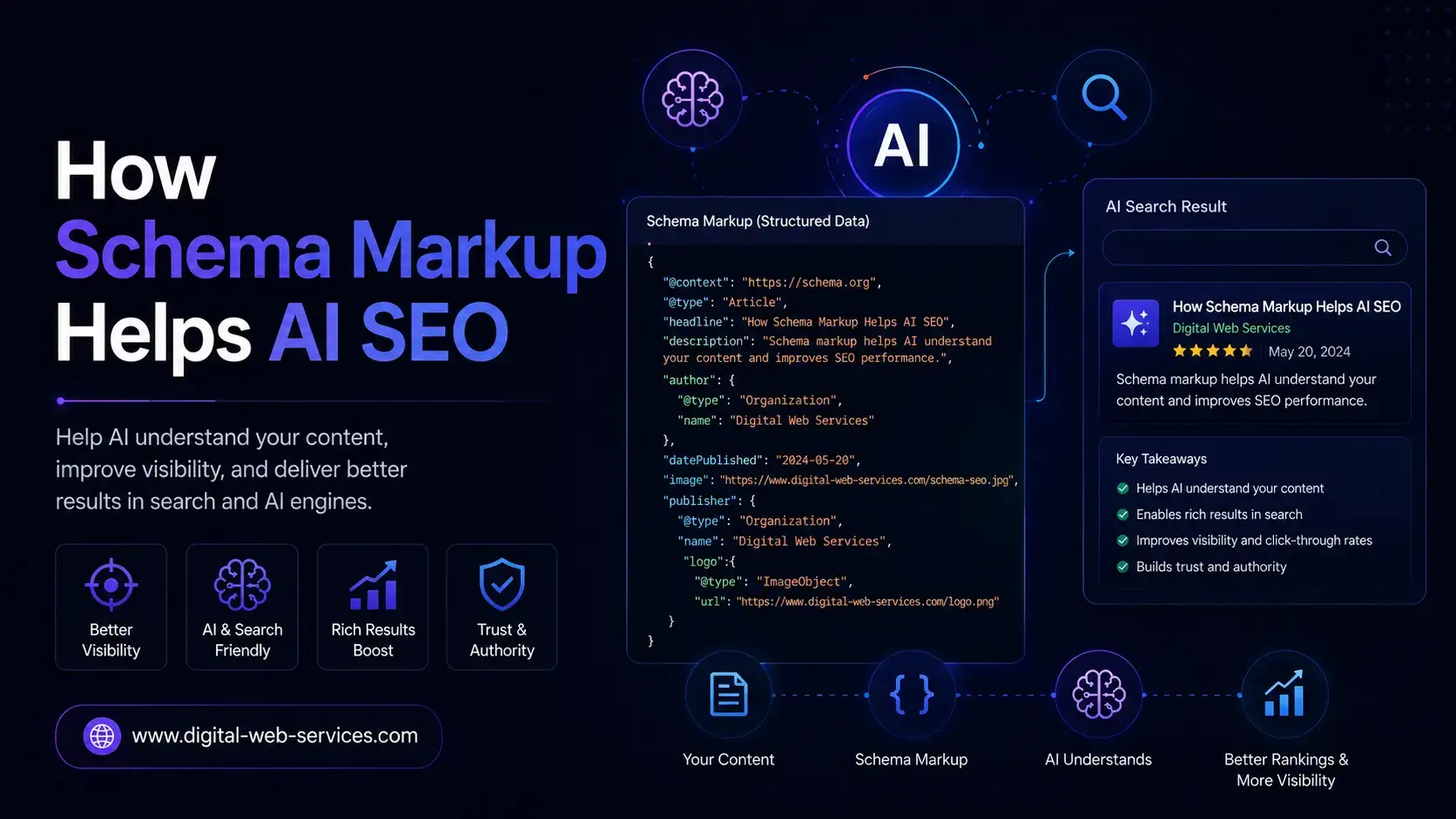
Schema markup helps AI SEO by turning your website content into clear, machine-readable information. It tells search engines and AI systems what your page is about, who wrote it, what your business offers, where you are located, what questions you answer, and how different facts on your website connect with each other.
In simple words, schema markup gives search engines extra context.
Today, search is no longer only about blue links. Google AI Overviews, AI Mode, ChatGPT, Gemini, Perplexity, and other answer engines are changing how users discover information. People now ask full questions such as “Which SEO agency is best for small businesses?” or “How does schema markup improve AI search visibility?”
To appear in these AI-driven answers, your website must be easy to understand, easy to crawl, and easy to trust. Schema markup supports this by organizing your content in a structured format.
However, schema is not a magic ranking button. It will not automatically make your page appear in AI Overviews. But when used with helpful content, strong technical SEO, and clear topical authority, schema markup can improve how search engines interpret your content and increase your chances of earning rich results, citations, and better visibility in AI search experiences.
What Is Schema Markup in SEO?
Schema markup is a type of structured data added to a webpage. It uses a standard vocabulary from Schema.org to describe the meaning of your content.
For example, a normal webpage may say:
“ABC Digital is an SEO agency in London offering technical SEO, local SEO, and AI SEO services.”
A human can understand this sentence easily. But a search engine may need more context. Schema markup can explain:
- The business name is ABC Digital.
- The business type is an SEO agency.
- The location is London.
- The page is about SEO services.
- The author is a real person or organization.
- The page answers specific user questions.
This makes the content easier for search engines and AI systems to process.
The most common schema format is JSON-LD. It is usually placed in the page code and does not change the visible design of the webpage.
Why Is Schema Markup Important for AI SEO?
AI SEO is about making your content more understandable, useful, and trustworthy for AI-powered search systems. These systems collect information from webpages, search indexes, business profiles, product feeds, knowledge graphs, and other sources.
Schema markup helps because it gives AI systems direct signals about your content.
When your page includes clean structured data, AI systems can better understand:
- What your page is mainly about
- Which entity or topic your content covers
- Who created the content
- What business or brand is connected to the page
- Which products, services, questions, reviews, or locations are relevant
- How your page connects to other pages on your website
This supports AI SEO, answer engine optimization, semantic SEO, and entity SEO.
How Schema Markup Helps AI Understand Your Content
AI systems are powerful, but they still need clear information. If your content is vague, poorly structured, or hidden inside complex layouts, search engines may not understand it correctly.
Schema markup improves understanding in three major ways.
1. It Identifies Exact Entities
An entity is a specific person, place, brand, product, service, topic, or organization.
For example:
- “Apple” could mean a fruit or a technology company.
- “Java” could mean coffee, an island, or a programming language.
- “SEO audit” could mean a service, checklist, tool, or report.
Schema helps reduce confusion by defining the exact entity on the page.
If your webpage is about an SEO service, schema can tell search engines that your page represents a professional service offered by a specific organization. This makes your content easier to connect with relevant queries.
2. It Defines Relationships Between Information
AI search is not only looking at individual keywords. It also tries to understand relationships.
For example:
- This article was written by this author.
- This service is offered by this business.
- This product has this price and availability.
- This local business serves this area.
- This FAQ answers this question.
- This page belongs to this website category.
Schema markup helps connect these facts.
This is useful for AI SEO because answer engines prefer clear, connected information. When your website has a strong content structure and schema supports that structure, AI systems can better understand your authority on a topic.
3. It Reduces Misinterpretation
AI tools can sometimes misunderstand content when information is not clear. Schema markup reduces this risk by providing direct, factual data.
For example, if your page mentions “free audit,” schema can help clarify whether it is a service offer, a page topic, or part of a call-to-action.
This does not fully prevent AI mistakes, but it gives search systems a cleaner signal to work with.
How Schema Markup Supports Google AI Overviews
Google AI Overviews are designed to answer user questions by pulling information from relevant pages and search systems. To be considered useful, your content must first be indexable, helpful, and relevant.
Schema markup can support AI Overview visibility by improving content clarity.
It can help Google understand:
- The main topic of your page
- The type of content you published
- The author or organization behind it
- The questions your page answers
- The products, services, or locations mentioned
- The structure of your website
Still, adding schema does not guarantee inclusion in AI Overviews. Google has made it clear that there is no special schema markup required for AI Overviews or AI Mode. The best approach is to create helpful content, follow SEO best practices, and use structured data correctly where it matches the page.
So, the correct mindset is this:
Schema markup does not replace great content. It supports great content.
Schema Markup and E-E-A-T: How Are They Connected?
E-E-A-T stands for Experience, Expertise, Authoritativeness, and Trustworthiness. It is especially important for websites in finance, healthcare, legal, education, B2B, SaaS, and professional services.
Schema markup can support E-E-A-T signals by making important trust information easier to identify.
For example, you can use schema to clarify:
- Who wrote the article
- Who reviewed the content
- Which organization owns the website
- Where the business is located
- What services the business provides
- Which social profiles belong to the brand
- What reviews or ratings are connected to a product or service
- When the article was published or updated
For a blog post, Article schema or BlogPosting schema can include the author, publisher, date published, date modified, headline, and image.
For a company website, Organization schema can include the business name, logo, contact details, sameAs social profile links, and official website.
For local businesses, LocalBusiness schema can include address, opening hours, phone number, area served, and service details.
This helps search engines connect your brand with real-world trust signals.
Best Schema Types for AI SEO
Not every website needs every type of schema. The best schema depends on your page type and business goal.
1. Organization Schema
Organization schema helps search engines understand your brand.
Use it for:
- Company websites
- SaaS brands
- Agencies
- B2B companies
- Educational platforms
- Healthcare organizations
It can include your business name, logo, website, contact details, founder, social profiles, and brand identity.
2. Article or BlogPosting Schema
Article schema helps search engines understand your blog content.
Use it for:
- Blog posts
- Guides
- News articles
- Thought leadership articles
- Educational content
It can include headline, author, publisher, featured image, publish date, update date, and article description.
3. FAQ Schema
FAQ schema helps structure common questions and answers.
Use it when your page has real FAQ content visible to users.
It is useful for AI SEO because question-based content matches how people search in AI tools. For example:
- “How does schema markup help AI SEO?”
- “Is schema markup a ranking factor?”
- “Which schema type is best for SEO?”
4. BreadcrumbList Schema
Breadcrumb schema helps search engines understand your site hierarchy.
It shows how a page fits within your website structure.
Example:
Home > Blog > AI SEO > Schema Markup for AI SEO
This supports crawlability, internal linking, and topical structure.
5. LocalBusiness Schema
LocalBusiness schema is important for businesses targeting local SEO.
Use it for:
- Local service providers
- Clinics
- Restaurants
- Real estate agencies
- Legal firms
- Digital marketing agencies
- Home service businesses
It can include name, address, phone number, business hours, location, service area, and reviews.
6. Product Schema
Product schema helps eCommerce and SaaS websites show product details.
Use it for:
- Online stores
- Software products
- Paid tools
- Courses
- Digital products
It can include product name, image, price, availability, ratings, and reviews.
7. Service Schema
Service schema helps describe a service you offer.
Use it for:
- SEO services
- Web design services
- Consulting services
- Healthcare services
- Legal services
- Marketing services
It can include service name, provider, area served, service type, and description.
8. Person Schema
Person schema helps identify experts, authors, founders, doctors, consultants, or speakers.
It can support authority when your website has real expert contributors.
Real Example: How Schema Helps an AI SEO Article
Let’s say you publish an article titled:
“How Schema Markup Helps AI SEO”
Without schema, search engines must read the page and guess the structure.
With schema, you can clearly tell search engines:
- This page is a BlogPosting.
- The headline is “How Schema Markup Helps AI SEO.”
- The author is a named SEO expert or your company.
- The publisher is your brand.
- The article was updated recently.
- The page answers specific FAQs.
- The article belongs to your AI SEO topic cluster.
- The page links internally to a related guide.
This gives your page a stronger semantic structure.
It also helps search engines connect this article with related topics such as AI SEO, structured data, answer engine optimization, generative engine optimization, rich results, semantic search, and entity SEO.
Information Gain: What Most Websites Get Wrong About Schema Markup
Many websites add schema markup only because an SEO plugin suggested it. But effective schema is not about adding random code.
The real value comes from matching schema to the user intent of the page.
Here are common mistakes:
Mistake 1: Adding Schema That Does Not Match the Page
If your page is a service page, do not force Product schema unless there is a real product. If your page is a blog article, use Article or BlogPosting schema.
Schema must describe the visible content on the page.
Mistake 2: Using FAQ Schema Without Real FAQs
FAQ schema should only be used when the questions and answers are visible on the page.
Do not hide FAQ content only inside code.
Mistake 3: Marking Up Fake Reviews
Fake reviews can damage trust. If you use Review schema, make sure reviews are genuine and visible to users.
Mistake 4: Forgetting to Update Schema
If your business hours, prices, author details, or service locations change, your schema should also change.
Outdated schema can create confusion for search engines and users.
Mistake 5: Thinking Schema Alone Will Rank the Page
Schema helps search engines understand your content. But rankings still depend on helpful content, relevance, authority, technical SEO, backlinks, page experience, and user satisfaction.
AI SEO Workflow: How to Add Schema Markup Correctly
Here is a simple workflow you can follow.
Step 1: Identify the Page Intent
First, understand the purpose of the page.
Ask:
- Is this a blog post?
- Is this a service page?
- Is this a product page?
- Is this a local business page?
- Is this a homepage?
- Is this a FAQ page?
The page intent decides the schema type.
Step 2: Choose the Right Schema Type
Match the schema with the page.
Examples:
- Homepage: Organization schema + WebSite schema
- Blog post: BlogPosting schema + FAQ schema
- Service page: Service schema + Organization schema
- Local page: LocalBusiness schema + Service schema
- Product page: Product schema + Offer schema
- Category page: BreadcrumbList schema
Step 3: Add Only Accurate Information
Your schema should match the visible content.
If the page does not show author information, do not add fake author details. If the page does not show reviews, do not add review schema.
Accuracy builds trust.
Step 4: Use JSON-LD Format
JSON-LD is the most commonly recommended format for structured data. It is easier to manage and does not disturb your webpage design.
You can add JSON-LD through:
- Website code
- WordPress SEO plugins
- Shopify apps
- Custom CMS fields
- Google Tag Manager, where appropriate
- Developer implementation
Step 5: Validate the Schema
Before publishing, test your structured data.
Use:
- Google Rich Results Test
- Schema Markup Validator
- Google Search Console
Check for errors, warnings, missing required fields, and wrong schema types.
Step 6: Monitor Performance
After publishing, track results in:
- Google Search Console
- Rich result reports
- Indexing reports
- Organic clicks
- Impression changes
- Ranking improvements
- AI Overview visibility observations
- Featured snippet performance
Schema is not a one-time task. It should be reviewed regularly.
How Schema Markup Helps Answer Engine Optimization
Answer Engine Optimization, also known as AEO, focuses on helping your content appear in direct answers.
Schema supports AEO because it structures your content around clear questions, entities, and facts.
For example, if your page has a question like:
“What is schema markup in SEO?”
Your content should answer it directly in simple language.
Then FAQ schema can help search engines understand that this question and answer belong together.
This improves your chance of being understood by answer engines.
How Schema Markup Helps Generative Engine Optimization
Generative Engine Optimization, also called GEO, is about improving visibility in generative AI search tools.
AI tools often summarize information from multiple sources. They need clean, reliable, and well-structured content.
Schema helps GEO by:
- Making your content easier to parse
- Clarifying entity relationships
- Supporting brand authority
- Improving content discoverability
- Reducing ambiguity
- Helping AI systems identify useful facts
But GEO still depends on content quality. Thin content with schema will not perform well.
To understand the bigger strategy behind AI search visibility, read our detailed guide on What Is AI SEO and Why Is It Important for Businesses?
Best Practices for Schema Markup in AI SEO
Follow these best practices to get better results.
Keep Schema Accurate
Only mark up information that exists on the visible page.
Use the Most Specific Schema Type
Use BlogPosting instead of a generic CreativeWork when the page is a blog post. Use LocalBusiness when the page is for a local business.
Add Author and Publisher Details
This supports trust and helps search engines understand who is responsible for the content.
Include Date Published and Date Modified
Freshness matters, especially for SEO, AI search, technology, legal, finance, and healthcare content.
Add FAQ Schema Carefully
Use FAQ schema only for helpful questions that users actually ask.
Use Breadcrumb Schema
Breadcrumbs improve site structure and help search engines understand page hierarchy.
Validate Every Page
Never publish schema without testing it.
Update Schema When Content Changes
If your content, prices, locations, reviews, or business details change, update your schema.
FAQs About Schema Markup and AI SEO
1. How does schema markup help AI SEO?
Schema markup helps AI SEO by making your website content easier for search engines and AI systems to understand. It adds structured information about your page, business, author, services, products, FAQs, and related entities.
2. Is schema markup important for Google AI Overviews?
Yes, schema markup can support AI Overview visibility by improving page clarity and structure. However, it does not guarantee inclusion in AI Overviews. Your content must still be helpful, crawlable, indexable, and relevant.
3. What is the best schema format for SEO?
JSON-LD is the most commonly used and recommended format because it is easy to implement and manage. It can be added to the page code without changing the visible content layout.
4. Can schema markup improve rich results?
Yes. Correct structured data can make your page eligible for rich results such as FAQs, product details, reviews, breadcrumbs, events, recipes, and other enhanced search appearances.
5. Does every page need schema markup?
Not every page needs advanced schema. But important pages such as homepages, blog posts, product pages, service pages, local landing pages, and FAQ pages should use relevant structured data.
6. What is the difference between schema markup and structured data?
Structured data is the general format used to organize information for search engines. Schema markup is a specific vocabulary, mainly from Schema.org, used to describe that information.
7. Is FAQ schema still useful for SEO?
Yes, FAQ schema can still be useful when the page includes real, helpful FAQs. It helps search engines understand question-and-answer content, which is useful for AI SEO and answer engine optimization.
8. Can schema markup help local SEO?
Yes. LocalBusiness schema can help search engines understand your business name, address, phone number, opening hours, service area, and location details. This supports local SEO visibility.
9. How often should schema markup be updated?
Schema should be updated whenever your content changes. This includes changes in price, availability, business hours, author details, service areas, reviews, or publication dates.
10. Can I use a plugin to add schema markup?
Yes. WordPress, Shopify, Wix, and other CMS platforms offer plugins or built-in settings for schema markup. However, you should still test the output to make sure it is accurate and valid.
Final Thoughts: Is Schema Markup Worth It for AI SEO?
Yes, schema markup is worth using for AI SEO because it helps search engines and AI systems understand your website more clearly.
It identifies entities, defines relationships, supports E-E-A-T signals, improves rich result eligibility, and makes your content easier to process in AI-driven search experiences.
But schema markup works best when it is part of a complete SEO strategy.
To get real results, combine schema with:
- Helpful content
- Strong topical authority
- Clear internal linking
- Technical SEO
- Fast page experience
- Updated business information
- Expert-driven writing
- Clean website structure
AI search rewards clarity, usefulness, and trust. Schema markup helps you communicate all three.
Need Help With AI SEO and Schema Markup?
Want your website to perform better in Google Search, AI Overviews, and answer engines?
Our SEO experts can help you create a complete AI SEO strategy, implement schema markup, improve technical SEO, optimize your content, and build topical authority for your business.
Get in touch today to make your website easier for search engines, AI tools, and customers to trust.

Maria Jain is a Senior Content Strategist and Tech Editor at Digital Web Services, with over 6+ years of experience covering digital marketing, website development, and search engine optimization. She specializes in WordPress site architecture, AI technologies, Web Hosting, topical authority models, and hands-on SaaS & affiliate tool reviews. Maria combines data-driven SEO practices with deep web design and technical insights to publish transparent guides, tool comparisons, and strategic tutorials for digital growth.