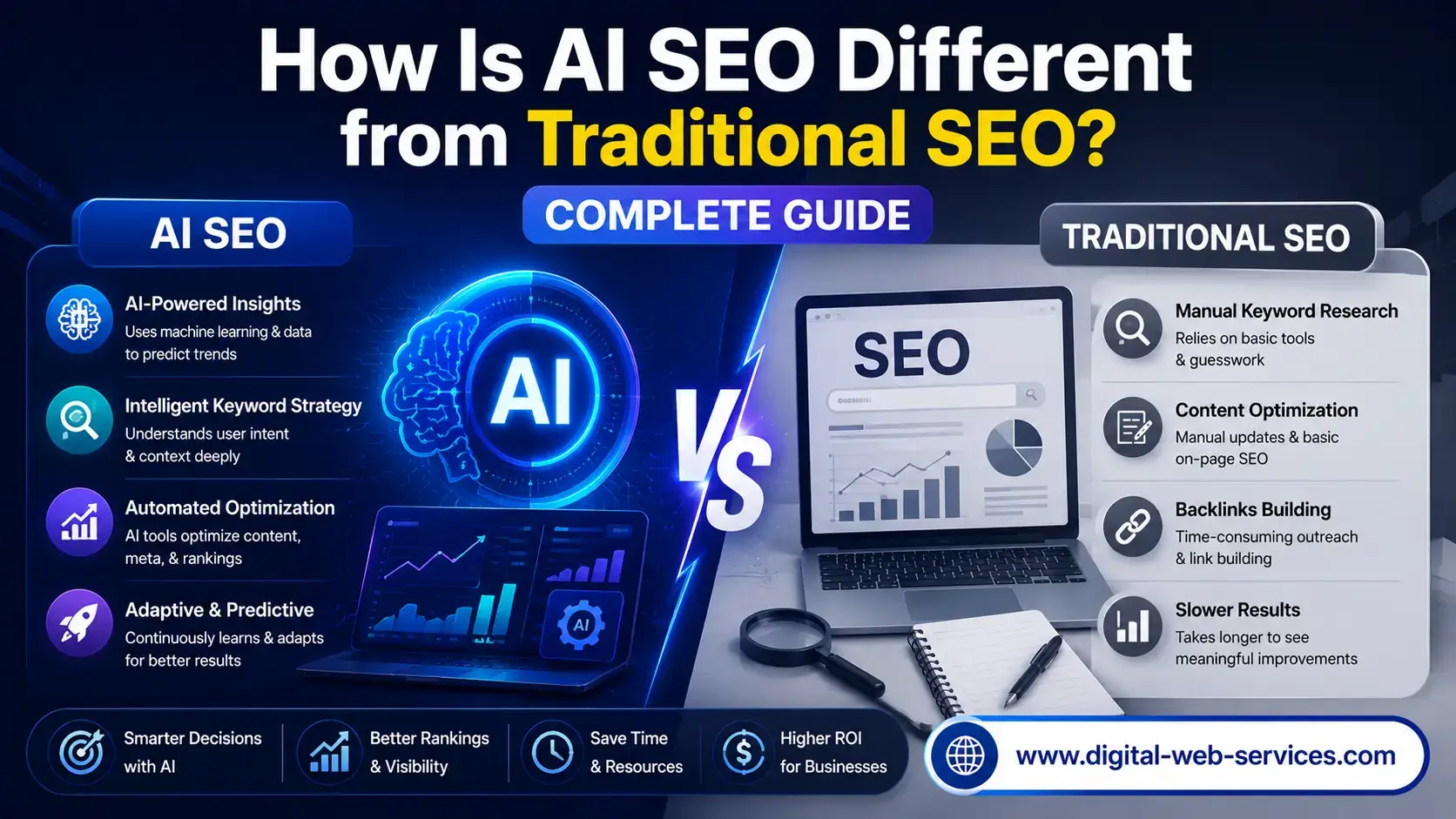
Traditional SEO?
AI SEO focuses on making your content easy for AI search engines and large language models to understand, trust, summarize, and cite. Traditional SEO focuses on improving your website ranking in search engine result pages so users click your website link.
In simple words, traditional SEO helps you rank in Google’s normal search results. AI SEO helps your brand appear inside AI-generated answers, such as Google AI Overviews, ChatGPT, Perplexity, Gemini, and other answer engines.
Both are important. Traditional SEO builds the foundation of visibility. AI SEO prepares your content for the future of search, where users often ask full questions and expect direct answers.
What Is Traditional SEO?
Traditional SEO, or search engine optimization, is the process of improving a website so it ranks higher on search engines like Google and Bing.
The main goal of traditional SEO is to bring organic traffic to your website. This usually happens when your page ranks on the first page of Google and users click your link.
Traditional SEO includes:
- Keyword research
- Meta title and meta description optimization
- On-page SEO
- Technical SEO
- Internal linking
- Backlink building
- Website speed improvement
- Mobile-friendly design
- Image optimization
- Content updates
- User experience improvement
For many years, traditional SEO has helped businesses get leads, sales, calls, form submissions, and brand visibility through organic search.
For example, if someone searches “best SEO agency for small business,” traditional SEO helps your website appear in the top search results. The user then clicks your page, reads your content, and may contact your business.
What Is AI SEO?
AI SEO is the process of optimizing your content so AI-powered search engines can understand, select, summarize, and mention your content in AI-generated answers.
AI SEO is also called:
- Generative Engine Optimization
- GEO SEO
- Answer Engine Optimization
- AI search optimization
- LLM optimization
AI SEO is becoming important because users are no longer searching only with short keywords. They now ask detailed questions like:
“What is the difference between AI SEO and traditional SEO for a small business?”
“Which SEO strategy is better for ranking in Google AI Overviews?”
“How can my brand appear in ChatGPT answers?”
AI tools do not always show ten blue links like traditional search engines. Instead, they give a direct answer. In that answer, they may mention a brand, cite a source, recommend a company, or summarize content from trusted pages.
So, AI SEO is not just about ranking. It is about being understood and trusted enough to be included in the answer.
AI SEO vs Traditional SEO: What Are the Core Differences?
| Feature | Traditional SEO | AI SEO |
|---|---|---|
| Main goal | Get rankings, clicks, and organic traffic | Get citations, brand mentions, and answer visibility |
| Target audience | Human users searching on Google | AI models, answer engines, and human users |
| Search style | Short keywords | Conversational questions and prompts |
| Content format | Blog posts, landing pages, meta tags | Direct answers, clear sections, FAQs, structured content |
| Success metric | Ranking, CTR, impressions, traffic | AI citations, mentions, answer inclusion, share of voice |
| Authority signal | Backlinks and domain authority | Trust, facts, entities, mentions, expert content |
| Optimization focus | Keywords and search intent | Context, entities, clarity, evidence, and usefulness |
| Best result | User clicks your website | AI includes your brand in its answer |
The biggest difference is this: traditional SEO is built for search result pages, while AI SEO is built for answer-based search.
Why Is AI SEO Important Now?
AI SEO is important because search behavior is changing. People want faster answers. They do not always want to open five different websites to compare information. They want AI tools to summarize the best answer for them.
This change affects businesses in many ways.
If your website is optimized only for traditional SEO, you may still rank in Google. But if your content is not clear, structured, factual, and easy to summarize, AI engines may ignore it.
On the other hand, if your content gives direct answers, explains concepts simply, uses strong topic authority, and includes trustworthy information, AI systems are more likely to understand it.
That means your brand can appear in:
- Google AI Overviews
- ChatGPT search answers
- Perplexity citations
- Gemini responses
- Voice search answers
- Featured snippets
- People Also Ask results
- Conversational search results
AI SEO helps your business stay visible even when users do not click traditional search results.
Is Traditional SEO Still Important?
Yes, traditional SEO is still very important.
AI SEO does not replace traditional SEO. It builds on it.
If your website has poor technical SEO, thin content, slow page speed, weak authority, or unclear structure, AI search engines may not trust it. AI systems still depend on discoverable, indexable, and helpful web content.
Traditional SEO helps search engines find your pages. AI SEO helps answer engines use your pages.
Think of it this way:
Traditional SEO gets your website into the search ecosystem. AI SEO makes your content useful inside AI answers.
A strong modern SEO strategy needs both.
How Does Keyword Strategy Change in AI SEO?
In traditional SEO, keyword strategy often focuses on search volume, keyword difficulty, and ranking potential.
For example, a traditional SEO strategy may target keywords like:
- AI SEO
- traditional SEO
- SEO agency
- SEO services
- digital marketing company
These keywords are still useful. But AI SEO goes deeper.
AI SEO focuses on full questions, natural language, search intent, and related entities.
For example:
- How is AI SEO different from traditional SEO?
- Is AI SEO better than traditional SEO?
- How do I optimize content for Google AI Overviews?
- How can my business appear in AI search results?
- What is generative engine optimization?
- How does ChatGPT choose sources?
AI SEO is less about repeating the same keyword many times. It is more about covering the topic completely and clearly.
Your content should answer the main question, related questions, follow-up questions, and comparison questions in one helpful page.
Real Insight: AI SEO Rewards Clear Thinking, Not Keyword Stuffing
Old SEO content sometimes used the same keyword again and again to improve keyword density. That does not work well anymore.
AI search engines need meaning, not repetition.
For example, this sentence is not helpful:
“AI SEO is the best AI SEO strategy for AI SEO ranking because AI SEO improves AI SEO.”
This sounds robotic and unnatural.
A better sentence is:
“AI SEO helps search engines and AI tools understand your content clearly, so your brand has a better chance of being mentioned in AI-generated answers.”
The second sentence is better because it explains the concept in simple language. It uses the keyword naturally and gives real value.
This is how modern SEO content should be written.
How Does Content Structure Change in AI SEO?
Traditional SEO content usually focuses on headings, keywords, internal links, meta tags, and readability.
AI SEO needs all of these, but it also needs answer-ready formatting.
AI-friendly content should include:
- Question-based headings
- Short answer sections
- Clear definitions
- Comparison tables
- Bullet points
- FAQs
- Step-by-step workflows
- Real examples
- Expert insights
- Updated facts
- Schema markup
- Strong internal links
- Clear author or brand expertise
AI tools prefer content that is easy to extract and summarize.
For example, instead of writing one long paragraph about AI SEO, break it into smaller sections:
- What is AI SEO?
- How does AI SEO work?
- Why is AI SEO important?
- How is it different from traditional SEO?
- How can businesses use both?
This structure helps both humans and AI systems understand your page faster.
How Does Search Intent Work in AI SEO?
Search intent means the reason behind a user’s search.
In traditional SEO, search intent is usually grouped into:
- Informational intent
- Commercial intent
- Navigational intent
- Transactional intent
AI SEO expands this because users ask more complex questions.
For example, a user may not simply search “AI SEO.” They may ask:
“I run a local business. Should I invest in AI SEO or traditional SEO first?”
This question has mixed intent. The user wants education, comparison, and business advice.
To satisfy this intent, your content should not only define AI SEO. It should explain when to use it, why it matters, how it works, and what steps the business should take.
That is why AI SEO content must be more complete and useful.
What Type of Content Performs Better in AI Search?
AI search engines usually prefer content that is clear, trustworthy, specific, and easy to verify.
Good AI SEO content often includes:
- Definitions
- Data-backed statements
- Examples
- Expert opinions
- Product or service comparisons
- Step-by-step instructions
- Case studies
- Original insights
- Practical workflows
- FAQs
- Schema markup
Weak content usually has:
- Generic statements
- No examples
- No clear answer
- Too much keyword stuffing
- Outdated information
- No expert value
- Poor formatting
- Thin sections
- Unclear claims
If your content sounds like every other article on the internet, AI tools have no strong reason to choose it.
To improve AI SEO, add something original. This can be your process, your experience, your checklist, your examples, or your expert opinion.
Example: Traditional SEO Content vs AI SEO Content
Traditional SEO Style
“AI SEO is important for businesses because it improves online visibility. Our SEO services help businesses rank higher on Google and get more traffic.”
This is fine, but it is too general.
AI SEO Style
“AI SEO helps businesses appear in AI-generated answers by making content easier for tools like Google AI Overviews, ChatGPT, and Perplexity to understand. For example, instead of only targeting the keyword ‘SEO services,’ a business should also answer questions like ‘Which SEO service is best for local lead generation?’ and ‘How does SEO help small businesses appear in AI search?’ This improves visibility across both traditional and AI-powered search results.”
The AI SEO version is better because it explains the concept, gives examples, and answers real user questions.
How Do AI Search Engines Choose Content?
AI search engines look for content that matches the user’s question and can be trusted.
They may consider signals such as:
- Relevance to the query
- Content clarity
- Topical depth
- Website authority
- Brand mentions
- Freshness
- Expert input
- Structured data
- Crawlability
- Internal links
- External references
- User-focused explanations
This does not mean you can force AI tools to cite your page. But you can improve your chances by creating content that is useful, accurate, and easy to understand.
What Role Does E-E-A-T Play in AI SEO?
E-E-A-T stands for Experience, Expertise, Authoritativeness, and Trustworthiness.
It is very important for both traditional SEO and AI SEO.
To improve E-E-A-T, your content should show:
- Real experience
- Expert knowledge
- Clear author information
- Brand credibility
- Accurate facts
- Updated information
- Transparent claims
- Helpful examples
- Trust signals
- Case studies or results where possible
For AI SEO, E-E-A-T is even more important because AI engines need trusted sources. If your content is vague or unsupported, it may not be selected.
A strong E-E-A-T section can include:
“Our SEO team has worked on content strategies for service businesses, local businesses, ecommerce websites, and B2B brands. Based on real SEO audits, we have seen that pages with clear answers, strong internal links, updated FAQs, and structured data perform better across both search rankings and AI-driven results.”
This kind of experience-based content adds trust and makes the page more useful.
How Does Technical SEO Support AI SEO?
Technical SEO is still the foundation.
AI tools cannot use your content well if search engines cannot crawl, index, or understand your website.
Important technical SEO factors include:
- Fast page loading speed
- Mobile-friendly design
- Clean URL structure
- Proper indexation
- XML sitemap
- Robots.txt setup
- Canonical tags
- Schema markup
- Internal linking
- Secure HTTPS website
- Fixing broken links
- Clear heading structure
- Optimized images
- Accessible content
AI SEO is not only about writing. It also depends on how well your website is built.
A well-structured website helps AI systems find important pages, understand relationships between topics, and identify your brand as a trusted source.
How Does Schema Markup Help AI SEO?
Schema markup is structured data added to a webpage to help search engines understand the page better.
Schema can help explain:
- What the page is about
- Who wrote the content
- What questions are answered
- What services are offered
- What business is behind the page
- What reviews or ratings exist
- What products or services are listed
For this topic, FAQ schema and Article schema can be helpful.
Schema does not guarantee ranking or AI Overview inclusion. But it gives search engines clearer information about your content.
For AI SEO, clarity matters. Schema is one way to create that clarity.
AI SEO Workflow: How to Optimize Content for AI Search
Here is a simple workflow you can follow.
Step 1: Start With the Main User Question
Choose one clear question as your main topic.
Example:
“How is AI SEO different from traditional SEO?”
This helps you create a focused article that can appear in AI Overviews and answer engines.
Step 2: Add a Short Answer at the Top
AI tools and users both like direct answers.
Add a short answer within the first 100 words. Make it simple and clear.
Step 3: Cover Related Questions
Include questions people may ask next, such as:
- What is AI SEO?
- Is traditional SEO still important?
- How do AI search engines choose content?
- How do I optimize for AI Overviews?
- Do backlinks still matter?
- What metrics should I track?
Step 4: Use Entities and Context
Do not only repeat keywords. Mention related entities such as:
- Google AI Overviews
- ChatGPT
- Perplexity
- Gemini
- Large language models
- Structured data
- E-E-A-T
- Search intent
- Semantic SEO
This helps AI systems understand the full topic.
Step 5: Add Examples and Comparisons
AI tools often prefer content that explains differences clearly.
Use tables, examples, use cases, and simple explanations.
Step 6: Add FAQ Schema
FAQs help answer long-tail search queries. FAQ schema can also make your content easier for search engines to understand.
Step 7: Update Content Regularly
AI search is changing quickly. Update your content when Google, ChatGPT, Perplexity, or other platforms change how they show answers.
What Metrics Should You Track for Traditional SEO?
For traditional SEO, track:
- Keyword rankings
- Organic traffic
- Click-through rate
- Impressions
- Backlinks
- Domain authority
- Page speed
- Bounce rate
- Conversions
- Leads
- Revenue from organic traffic
These metrics show how well your website performs in normal search results.
What Metrics Should You Track for AI SEO?
For AI SEO, track:
- Brand mentions in AI answers
- Citations in AI search results
- Visibility in Google AI Overviews
- Perplexity source mentions
- ChatGPT browsing mentions
- Share of voice in AI answers
- Featured snippet presence
- People Also Ask visibility
- Branded search growth
- Referral traffic from AI platforms
- Assisted conversions from AI search
AI SEO measurement is still developing, but these metrics can help you understand whether your brand is becoming visible in AI-powered discovery.
Do Backlinks Still Matter in AI SEO?
Yes, backlinks still matter.
Backlinks are important in traditional SEO because they help build authority and trust. In AI SEO, backlinks may also support credibility because AI search engines often rely on trusted sources.
However, AI SEO also looks beyond backlinks.
Brand mentions, expert content, reviews, citations, third-party references, and clear topical authority can also help.
This means your digital PR strategy is important. Your brand should appear on trusted websites, industry blogs, directories, podcasts, news sites, and expert roundups.
The more trustworthy your brand looks across the web, the easier it becomes for AI systems to understand and mention it.
How Can Businesses Use AI SEO and Traditional SEO Together?
The best strategy is not AI SEO or traditional SEO. The best strategy is AI SEO plus traditional SEO.
Here is how to combine both:
1. Use Traditional SEO for Foundation
Start with technical SEO, keyword research, page speed, mobile optimization, internal linking, and backlinks.
2. Use AI SEO for Answer Visibility
Add direct answers, question-based headings, FAQs, examples, comparisons, schema, and expert insights.
3. Build Topic Clusters
Create connected content around one topic.
For example:
- What is AI SEO?
- AI SEO vs traditional SEO
- How to optimize for Google AI Overviews
- How schema markup helps AI SEO
- AI SEO checklist for businesses
- Best AI SEO tools
- AI SEO strategy for local businesses
This creates topical authority.
4. Improve Brand Trust
Add author bios, case studies, testimonials, client results, service pages, and clear contact information.
5. Update Content Often
AI search changes quickly. Refresh your content with new examples, new FAQs, and updated best practices.
Practical Example: AI SEO Strategy for a Digital Marketing Agency
Let’s say you run a digital marketing agency.
A traditional SEO page may target:
“SEO services in Canada”
The page may include:
- Service details
- Location keywords
- Meta tags
- Testimonials
- Pricing information
- Contact form
- Internal links
An AI SEO version of the same page would also answer:
- What SEO services does a business need first?
- How long does SEO take to show results?
- Is AI SEO included in SEO services?
- How does local SEO help small businesses?
- What is the difference between SEO, AEO, and GEO?
- How can a business appear in Google AI Overviews?
This makes the page more useful for both humans and AI search engines.
Common Mistakes to Avoid in AI SEO
Avoid these mistakes:
- Writing only for keywords
- Copying generic content from competitors
- Ignoring search intent
- Not answering the main question quickly
- Using long paragraphs with no structure
- Adding unsupported claims
- Forgetting schema markup
- Ignoring technical SEO
- Publishing outdated content
- Not building brand authority
- Creating content without real examples
- Depending only on AI-generated text
AI SEO needs human insight. AI tools may help with research and formatting, but your content should include real experience, expert thinking, and brand value.
How to Make Your Content AI Overview-Friendly
To improve your chances of appearing in AI Overviews, structure your content like this:
- Use a question-based H1.
- Add a direct answer below the introduction.
- Use simple language.
- Include comparison tables.
- Add FAQs with short answers.
- Use clear H2 and H3 headings.
- Add original insights or examples.
- Include internal links to related topics.
- Add schema markup.
- Keep content updated.
- Make sure the page is crawlable and indexable.
- Build authority through quality backlinks and brand mentions.
This does not guarantee AI Overview placement, but it improves content quality and machine readability.
Final Thoughts: Is AI SEO Better Than Traditional SEO?
AI SEO is not better than traditional SEO. It is the next layer of SEO.
Traditional SEO helps your website rank, attract clicks, and build authority. AI SEO helps your content appear in direct answers, AI summaries, and conversational search results.
Businesses that use both will have a stronger search presence.
If you only focus on traditional SEO, you may miss visibility in AI-generated answers. If you only focus on AI SEO and ignore technical SEO, your content may not be discovered or trusted.
The future of SEO belongs to brands that create helpful, clear, expert-led, and well-structured content for both humans and AI systems.
Need Help With AI SEO and Traditional SEO?
Search is changing fast. Your business needs a strategy that works for Google rankings, AI Overviews, ChatGPT, Perplexity, and future search experiences.
Our SEO experts can help you:
- Audit your current SEO performance
- Optimize your website for AI search
- Improve content structure
- Add schema markup
- Build topic authority
- Create AI Overview-friendly content
- Improve rankings, traffic, and conversions
Get in touch today to build a future-ready SEO strategy that helps your brand stay visible everywhere your customers are searching.
FAQs About AI SEO and Traditional SEO
1. What is the difference between AI SEO and traditional SEO?
AI SEO focuses on helping your content appear in AI-generated answers, citations, and brand mentions. Traditional SEO focuses on ranking your website in search engine result pages to get clicks and organic traffic.
2. Is AI SEO replacing traditional SEO?
No, AI SEO is not replacing traditional SEO. Traditional SEO is still important because AI search engines rely on crawlable, useful, and trusted web content. AI SEO adds another layer by making content easier for AI tools to understand and cite.
3. What is Generative Engine Optimization?
Generative Engine Optimization, or GEO, is the process of optimizing content for AI-powered search engines that generate direct answers. GEO helps brands improve visibility in tools like Google AI Overviews, ChatGPT, Perplexity, and Gemini.
4. How do I optimize my website for AI SEO?
To optimize for AI SEO, use question-based headings, direct answers, structured content, schema markup, FAQs, examples, expert insights, and clear internal links. Also make sure your website is technically strong and easy to crawl.
5. Does keyword research still matter for AI SEO?
Yes, keyword research still matters, but it should be combined with conversational queries, semantic SEO, entities, and user intent. AI SEO is not about keyword stuffing. It is about answering real questions clearly.
6. Can AI SEO help my business get more leads?
Yes, AI SEO can help your business get more leads by increasing brand visibility in AI search results, answer engines, and conversational search platforms. When users see your brand in trusted answers, they are more likely to search for you or contact you.
7. Are backlinks still important for AI SEO?
Yes, backlinks are still important because they support authority and trust. However, AI SEO also values brand mentions, expert content, digital PR, structured information, and clear topical authority.
8. What type of content works best for AI SEO?
Content that works best for AI SEO is clear, helpful, accurate, well-structured, and based on real expertise. FAQs, comparison tables, step-by-step guides, definitions, examples, and case studies are especially useful.

Maria Jain is a Senior Content Strategist and Tech Editor at Digital Web Services, with over 6+ years of experience covering digital marketing, website development, and search engine optimization. She specializes in WordPress site architecture, AI technologies, Web Hosting, topical authority models, and hands-on SaaS & affiliate tool reviews. Maria combines data-driven SEO practices with deep web design and technical insights to publish transparent guides, tool comparisons, and strategic tutorials for digital growth.