On-page SEO refers to the optimization techniques implemented directly within a website’s content and structure to improve its visibility and ranking in search engines like Google. It involves optimizing individual pages to ensure they are fully optimized for both search engine crawlers and human users.
Explore the Best On-page SEO Components
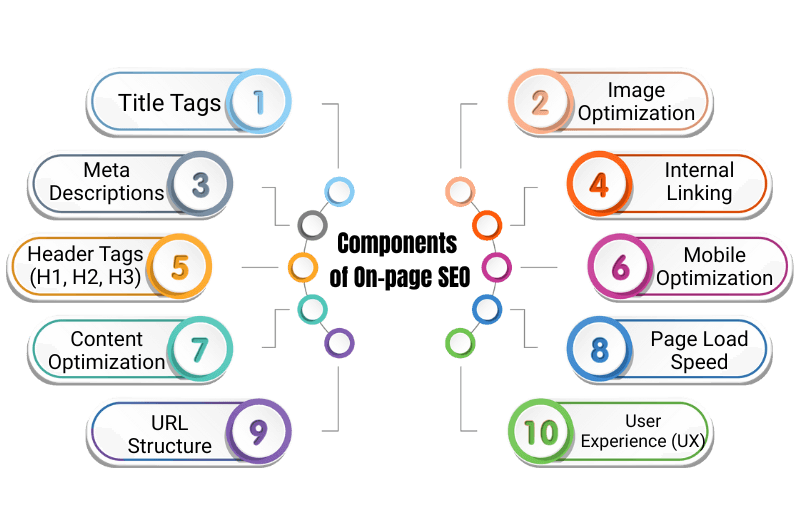
Let’s take a closer look at the key components that contribute to on-page SEO success.
1. Title Tags
Title tags are one of the most important on-page SEO elements. They are displayed in search engine results and on the browser tab, so creating a compelling and keyword-rich title can significantly impact click-through rates (CTR). Ensure that the title tag is clear, concise, and relevant to the content of the page.
Best Practice: Include your primary keyword near the beginning and keep the title under 60 characters.
2. Meta Descriptions
Meta descriptions are short summaries that appear beneath the title in search results. While meta descriptions don’t directly affect rankings, they play a significant role in encouraging users to click on your link. An optimized meta description should be compelling, relevant, and between 150-160 characters.
Best Practice: Use action-oriented language and include a call-to-action (CTA) with your target keyword.
3. Header Tags (H1, H2, H3)
Header tags (H1, H2, H3, etc.) help organize content and make it easier for both users and search engines to understand the structure of a page. The H1 tag should be used for the main title of the page, while H2 and H3 tags break down the content into subsections.
Best Practice: Use one H1 tag per page and include relevant keywords in subheadings.
4. Content Optimization
High-quality, engaging content is at the heart of on-page SEO. Search engines favor well-written content that answers user queries and provides value. Be sure to incorporate your target keywords naturally within the text, but avoid keyword stuffing.
Best Practice: Write content that is user-focused, informative, and optimized for search intent. Include related keywords and LSI (Latent Semantic Indexing) keywords to broaden the topic coverage.
5. URL Structure
An SEO-friendly URL is concise, descriptive, and includes relevant keywords. A clean URL structure makes it easier for search engines to crawl your page, and it also enhances the user experience.
Best Practice: Keep URLs short, use hyphens to separate words, and avoid unnecessary parameters.
6. Image Optimization
Images can enhance user experience, but they also need to be optimized for SEO. Properly optimized images improve page load speed and can rank in Google Image Search, further boosting your website’s visibility.
Best Practice: Use descriptive, keyword-rich filenames and alt texts for all images. Compress image sizes to improve page load times.
7. Internal Linking
Internal links help search engines crawl your site efficiently and understand the hierarchy of your content. Linking related content on your website boosts SEO by distributing link equity across pages.
Best Practice: Use internal links to guide users to relevant content and improve the site’s overall navigation.
8. Mobile Optimization
With the majority of web traffic coming from mobile devices, ensuring that your website is mobile-friendly is critical for on-page SEO. A responsive design ensures that your content displays correctly on all screen sizes and devices.
Best Practice: Test your website’s mobile-friendliness and optimize load times for mobile users.
9. Page Load Speed
A slow-loading website can frustrate users and negatively impact search rankings. Search engines favor websites that load quickly, so optimizing page speed is a crucial component of on-page SEO.
Best Practice: Minimize large files, optimize images, and leverage browser caching to enhance speed.
10. User Experience (UX)
An intuitive and user-friendly website is essential for both engagement and SEO. Factors like easy navigation, fast loading times, and a clean design contribute to a positive user experience.
Best Practice: Ensure your website is easy to navigate, visually appealing, and provides clear CTAs to guide users.
Conclusion
Mastering on-page SEO is essential for driving organic traffic to your website and improving its overall search engine ranking. By focusing on key components like title tags, content optimization, header tags, and URL structure, you can create an SEO-friendly website that provides value to both search engines and users. Regularly audit your pages and implement best practices to stay ahead of the competition.
By optimizing each of these elements, you’ll not only improve your search engine rankings but also provide a better experience for your visitors, which ultimately leads to higher engagement and conversions.

Maria Jain is a Senior Content Strategist and Tech Editor at Digital Web Services, with over 6+ years of experience covering digital marketing, website development, and search engine optimization. She specializes in WordPress site architecture, AI technologies, Web Hosting, topical authority models, and hands-on SaaS & affiliate tool reviews. Maria combines data-driven SEO practices with deep web design and technical insights to publish transparent guides, tool comparisons, and strategic tutorials for digital growth.